








Heritage

Season 26
Types de médias
  • Photos
  • Vidéos
  • Sons
Années
  • 2026
  • 2024
  • 2023
  • 2022
  • 2021
  • 2020
  • 2019
  • 2018
  • 2017
  • 2016
  • 2015
  • 2014
Afficher les résultats (121)
supprimer tous les filtres
  • News
  • Gallery
  • Gitana 18
  • Team
  • Retractable Y-shaped foils, adjustable in three dimensions

    Inspired by the appendages of the America's Cup foiling monohulls, these Y-shaped foils have a wingspan of over 5 metres. They are designed to generate powerful lift, increase power and offer a wide range of adjustments to optimise flight at every point of sail and in all conditions. Beyond their impressive size, these foils feature many unique innovations.

    Revolutionary U-shaped rudders

    These are probably the most visually striking innovations on the new Maxi Edmond de Rothschild. To fly high above rough seas while maintaining control, the team wanted very long rudders that would remain in contact with the water. The challenge is that longer rudders tend to flex under load, severely affecting steering and the efficiency of their lifting surfaces. A new geometry was needed to give these appendages maximum stiffness, resist cavitation and ultimately improve control of the boat and make better use of its power. The result is a set of U-shaped rudders over 4 metres long, a metre longer than those on Gitana 17. Their shape, reminiscent of a tripod or an inverted π, is only the visible part of what makes them so distinctive.

    A daggerboard optimised to stabilise the boat and limit cavitation

    With its wide span, the daggerboard resembles an aircraft tail assembly, with two adjustable flaps: one on the vertical section and the other on the horizontal section, the distinctive “manta-ray wing”. On Gitana 18, the innovation is to position this wing behind the vertical part of the appendage, rather than directly beneath it, to minimise flow disturbance and cavitation.

    Gitana 18’s daggerboard

    Rig: adjustable spreaders to control mainsail power while sailing

    Gitana 18’s mast is 1.50 metres taller than its predecessor’s. The boom is also shorter, creating a more slender sail plan. The major innovation is a set of spreaders that can be adjusted while sailing to bend the mast fore and aft. Actuated by hydraulic rams, these spreaders can pivot through 35 degrees to adjust the bend in the middle of the mast. This unprecedented system allows the sailor to control mainsail power: adding depth in light winds to take off sooner, or flattening the sail to reduce power at high speed or in strong winds. Adjusting the depth, and therefore the power, of the mainsail can also save a solo sailor time and energy by reducing the need for risky manoeuvres or headsail changes.

    Central hull:
    an integrated, structural coachroof

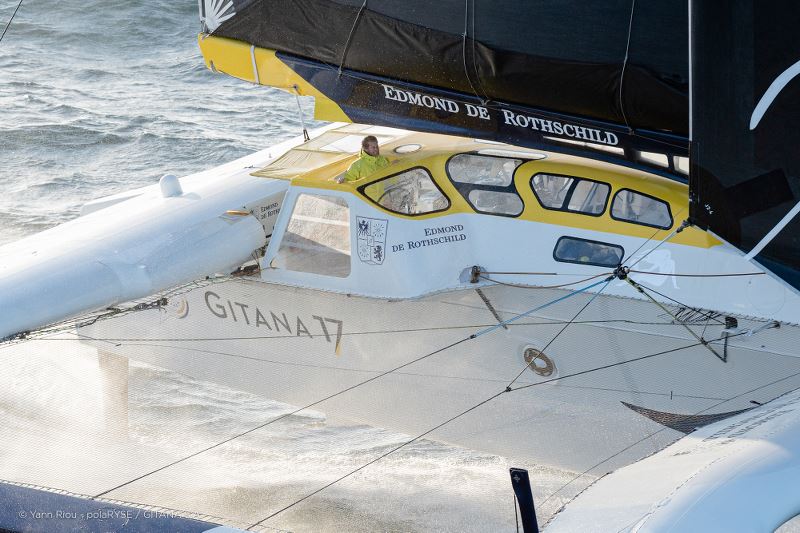
    The naval architects and Gitana design team wanted an exceptionally stiff, structurally robust platform. This applies both to the floats, which must withstand heavy loads from the foils and rudders, and to the central hull, which is subject to torsion. The enclosed coachroof is integrated into the hull and contributes to its structural strength. Inside, the cockpit brings all sail-handling controls together, with ergonomics shaped by many hours of design and development. The coachroof also stands out for the number and size of its windows. This configuration meets the visibility requirements of the Ultim class rules and gives sailors the best possible view to keep a visual watch.

    Gitana 18’s coachroof

    08.02.2024

    Not a very pacific Atlantic.

    In the pale light of the austral lands, Charles Caudrelier was able to savour his first single-handed Cape Horn two days ago. Ahead of the Maxi Edmond de Rothschild, there are still another 6,000 miles to go to transform the magic of this moment into the accomplishment of reaching the finish line. In the meantime, beside the Falklands, the South At…

    par Gitana

    In the pale light of the austral lands, Charles Caudrelier was able to savour his first single-handed Cape Horn two days ago. Ahead of the Maxi Edmond de Rothschild, there are still another 6,000 miles to go to transform the magic of this moment into the accomplishment of reaching the finish line. In the meantime, beside the Falklands, the South Atlantic has just thrown up another challenge.
    Where major firsts are celebrated

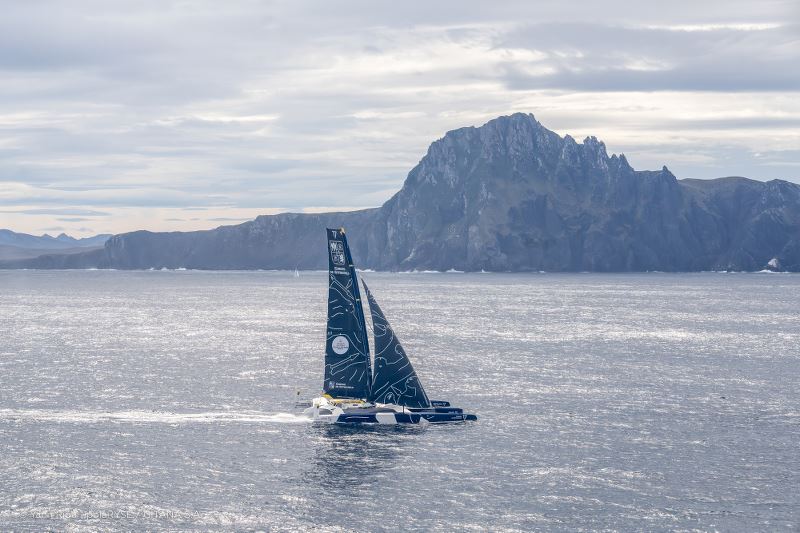
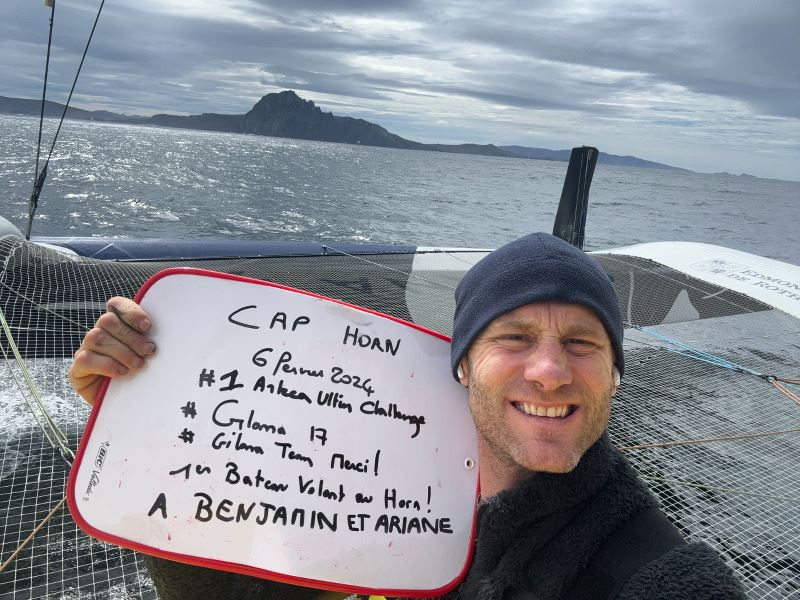
    A confetti of rock strewn across the extreme south of Tierra del Fuego, in a narrow corridor separating Chile from the Antarctic peninsula. Tuesday 6 February at 17:08:20 UTC, the Maxi Edmond de Rothschild rounds Cape Horn after 30 days, 4 hours, 38 minutes and 20 seconds of racing, having spent two-thirds of the race at the front of the fleet.

    Upon entering the Atlantic Ocean at the head of the Arkea Ultim Challenge, Charles Caudrelier pulls off multiple feats. He treats himself to his first Cape Horn in solo format and treats his boat to the same, thus paying tribute to the visionary spirit of the Gitana Team and its operators, Ariane and Benjamin de Rothschild. He also proves that a flying trimaran of this generation can circumnavigate Antarctica.

    The cape is so legendary because, for Charles and all those who have gone before, it represents a welcome epilogue: the exit from the Southern Ocean, from its grey expanses as far as the eye can see, and the end of a sense of vulnerability.

    The third and final major cape of a round the world under sail is also the cape most shrouded in myth as it has an historic scent of the great navigators of the 16th and 17th centuries, when the Spanish, Portuguese, then the Dutch, British and French dominated the seas of the globe.

    And yet here, there is no sea route to open, no strategic or economic war to wage, it is about sport, technology, human intelligence and setting new targets and challenges for oneself. For the skipper of the Maxi Edmond de Rothschild, this “historic and magical” passage will remain as one of the major milestones in his life as a man and as a sailor.
    Pacification

    It has not been as simple as all that to get to this stage. Indeed, on 1 February at 20:00 UTC, having racked up four days at an average speed of 30-33 knots in the Pacific, Charles Caudrelier is forced to slow up to avoid plunging with full force into the teeth of an explosive low-pressure system. For more than 48 hours, the blue trimaran barely exceeds 10 knots. It is an unprecedented, strange and ludicrous moment in offshore racing for her skipper who has “never done such a thing ever before” but manages to make the most of this period of calm to go over the boat with a fine-toothed comb.

    On 4 February, when he finally fires up again, the sailor is rested and relaxed… especially given the fact that he has lost virtually nothing of his lead over his pursuers prior to his forced stoppage. Two days later, Cape Horn rewards him handsomely with a magnificent passage two miles from the rock, under full main and J2.
    A return to a familiar if slightly sensitive area

    Charles Caudrelier is now making headway in the decompression chamber that is the South Atlantic. A place where the return to civilisation and the sense of relief often clashes with the reality in the first few days of navigating this region: not easy…

    Close-hauled, in a building breeze, the Maxi Edmond de Rothschild is forced to sweep into the Le Maire Strait initially to protect herself from the ice spotted to the north-east of the Isla de los Estados. The presence of icebergs in the vicinity, together with the arrival of a sizeable austral depression map out his strategy for the next stage of the climb up the Atlantic.

    “On Wednesday afternoon (7 February), we slowed the boat down for 6 hours to let the worst of the stormy wake of the depression roll through. Next, we had to choose between the plague or cholera,” says Benjamin Schwartz, a member of the routing cell for Gitana Team. “To pass to the east of the Falklands, a strategically favourable option, albeit a sensitive one with the potential of ice, or stay inside amidst a myriad of fishing boats.” Option No.2 wins out, but Charles spends “a very, very laborious night, in strong wind and atrocious seas, whilst being compelled to keep a visual look-out for fishing boats.”

    There is a little over 6,000 miles to go before a glimpse of the finish line in this first solo round the world race in ULTIMs. It is a race which Charles Caudrelier has led for 22 days and has every intention of winning.