








Heritage

Season 26
Types de médias
  • Photos
  • Vidéos
  • Sons
Années
  • 2026
  • 2024
  • 2023
  • 2022
  • 2021
  • 2020
  • 2019
  • 2018
  • 2017
  • 2016
  • 2015
  • 2014
Afficher les résultats (121)
supprimer tous les filtres
  • News
  • Gallery
  • Gitana 18
  • Team
  • Retractable Y-shaped foils, adjustable in three dimensions

    Inspired by the appendages of the America's Cup foiling monohulls, these Y-shaped foils have a wingspan of over 5 metres. They are designed to generate powerful lift, increase power and offer a wide range of adjustments to optimise flight at every point of sail and in all conditions. Beyond their impressive size, these foils feature many unique innovations.

    Revolutionary U-shaped rudders

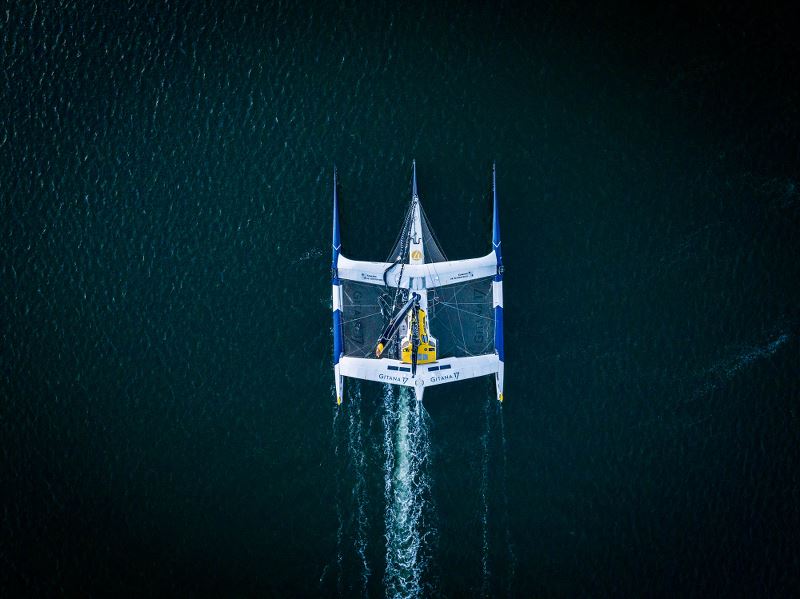
    These are probably the most visually striking innovations on the new Maxi Edmond de Rothschild. To fly high above rough seas while maintaining control, the team wanted very long rudders that would remain in contact with the water. The challenge is that longer rudders tend to flex under load, severely affecting steering and the efficiency of their lifting surfaces. A new geometry was needed to give these appendages maximum stiffness, resist cavitation and ultimately improve control of the boat and make better use of its power. The result is a set of U-shaped rudders over 4 metres long, a metre longer than those on Gitana 17. Their shape, reminiscent of a tripod or an inverted π, is only the visible part of what makes them so distinctive.

    A daggerboard optimised to stabilise the boat and limit cavitation

    With its wide span, the daggerboard resembles an aircraft tail assembly, with two adjustable flaps: one on the vertical section and the other on the horizontal section, the distinctive “manta-ray wing”. On Gitana 18, the innovation is to position this wing behind the vertical part of the appendage, rather than directly beneath it, to minimise flow disturbance and cavitation.

    Gitana 18’s daggerboard

    Rig: adjustable spreaders to control mainsail power while sailing

    Gitana 18’s mast is 1.50 metres taller than its predecessor’s. The boom is also shorter, creating a more slender sail plan. The major innovation is a set of spreaders that can be adjusted while sailing to bend the mast fore and aft. Actuated by hydraulic rams, these spreaders can pivot through 35 degrees to adjust the bend in the middle of the mast. This unprecedented system allows the sailor to control mainsail power: adding depth in light winds to take off sooner, or flattening the sail to reduce power at high speed or in strong winds. Adjusting the depth, and therefore the power, of the mainsail can also save a solo sailor time and energy by reducing the need for risky manoeuvres or headsail changes.

    Central hull:
    an integrated, structural coachroof

    The naval architects and Gitana design team wanted an exceptionally stiff, structurally robust platform. This applies both to the floats, which must withstand heavy loads from the foils and rudders, and to the central hull, which is subject to torsion. The enclosed coachroof is integrated into the hull and contributes to its structural strength. Inside, the cockpit brings all sail-handling controls together, with ergonomics shaped by many hours of design and development. The coachroof also stands out for the number and size of its windows. This configuration meets the visibility requirements of the Ultim class rules and gives sailors the best possible view to keep a visual watch.

    Gitana 18’s coachroof

    01.02.2024

    Never truly alone.

    For this twenty-fifth day at sea in the Arkea Ultim Challenge, leader Charles Caudrelier has passed the longitude of the famous Point Nemo, the farthest point on the planet from any emerged land. As such, this passage is normally associated with the idea of isolation. However, for the skipper of the Maxi Edmond de Rothschild, the reverse is true. I…

    par Gitana

    For this twenty-fifth day at sea in the Arkea Ultim Challenge, leader Charles Caudrelier has passed the longitude of the famous Point Nemo, the farthest point on the planet from any emerged land. As such, this passage is normally associated with the idea of isolation. However, for the skipper of the Maxi Edmond de Rothschild, the reverse is true. Indeed, having not come across a soul since the Kerguelen Islands, on 22 January, this morning it was with great surprise but undisguised glee that he heard his AIS alarm ring out in the cockpit of his giant. Sailing to his north was a crew competing in the Ocean Globe Race, a round the world race with stopovers but without any technology aboard to assist their navigation. This encounter only lasted a few moments given the massive speed differential between the boats. In light of the boisterous conditions on site at the moment, with Charles Caudrelier having to contend with a fresh breeze of 30-35 knots throughout the day, there was little time for contemplation however.
    Ranking at the 18:00 UTC position report   

    1/ Maxi Edmond de Rothschild – Charles Caudrelier     
    2/ Sodebo Ultim 3 – Thomas Coville – 3,469.4 miles behind the leader (on a pit stop in Hobart)     
    3/ Maxi Banque Populaire XI – Armel Le Cleac’h – 3,490.4 miles behind the leader     
    4/ Actual Ultim 3 – Anthony Marchand – 6,340.5 miles behind the leader     
    5/ Ultim Adagio – Eric Peron – 7,354.7 miles behind the leader       
    Retired  SVR Lazartigue – Tom Laperche       
    WAYPOINT #5, Gitana Team’s round the world rendez-vous   

    Every Thursday, throughout the Arkea Ultim Challenge, Gitana Team is offering you a complete round-up of Charles Caudrelier and the Maxi Edmond de Rothschild’s race. Via its weekly video broadcast, you’ll discover the latest onboard footage, analysis of the weather and strategy as explained by the members of the team’s routing cell, as well as delving behind the scenes of the five-arrow racing stable whilst its flagship is out on the racetrack. Finally, this rendez-vous will round off with a long oceanic interview recorded by a different star guest. Charles will share his feelings and his sentiments with the host throughout this epic adventure.   

    For this fifth episode of WAYPOINT, we discover the Arkea Ultim Challenge – Brest fleet more than 7,000 miles apart, split between the Indian and the Pacific: Eric Peron and Anthony Marchand are making headway between the Cape of Good Hope and that of Leeuwin and Armel le Cléac’h and Charles Caudrelier are between Australia and Cape Horn. Indeed, there are currently four maxi-trimarans at sea as Tom Laperche has sadly made his retirement official this week after stopping off in South Africa and Thomas Coville has been on a pit stop in Hobart, Tasmania, since yesterday.   

    As is the case every week, this new chapter of WAYPOINT begins with some images sent from on board by Charles Caudrelier: from the passage of Cape Leeuwin to a new record across the Indian, finishing with a chance encounter with one of the Ocean Globe Race competitors at Point Nemo, the sailor shares with us his past week at sea.   

    Within the weather routing cell, Benjamin Schwartz brilliantly takes on the mission of deciphering the trajectory of the Maxi Edmond de Rothschild. This lively insight gives us a better understanding of the strategy put in place by Charles Caudrelier and his routers in what is always a tricky section of the Southern Ocean, where it’s important to be in a position to deal with the trains of depressions in order to make headway eastward and, in the case of the Arkea Ultim Challenge, along the southern limit of the racetrack which is determined by the Antarctic Exclusion Zone.   

     As ever, this journey behind the scenes continues within the Gitana Base, where Cyril Dardashti, director of the racing stable, shares a few of the race incidents and notably the not insignificant damage to the desalinator, which occurred last weekend aboard the Maxi Edmond de Rothschild. The five-arrow team has been kept rather busy during this round the world because, in addition to monitoring the race, which is already taking up a lot of time, it is also simultaneously working on the future Maxi Edmond de Rothschild, code named Gitana 18.     

    Finally, this Thursday 1 February, is the opportunity to welcome a sailor we are really fond of into the Gitana Team’s fold: Yann Eliès. A sailor with an impressive track record: triple winner of the Solitaire du Figaro and the Transat Jacques Vabre, double champion of the Jules Verne Trophy and two participations in the Vendée Globe, one of which saw him secure a 5th place… the sailor is a familiar face in major yacht races. From the same generation as Charles Caudrelier, the two men have known one another for more than 25 years. It’s a jovial exchange, despite the timing of the rendez-vous, which sees the skipper just waking up from a long siesta, and above all the technical difficulties experienced during this connection. At 57° South in the middle of the Pacific, the satellite connection can sometimes become more random.     

    Welcome to the 5th episode of WAYPOINT!