








Heritage

Season 26
Types de médias
  • Photos
  • Vidéos
  • Sons
Années
  • 2026
  • 2024
  • 2023
  • 2022
  • 2021
  • 2020
  • 2019
  • 2018
  • 2017
  • 2016
  • 2015
  • 2014
Afficher les résultats (121)
supprimer tous les filtres
  • News
  • Gallery
  • Gitana 18
  • Team
  • Retractable Y-shaped foils, adjustable in three dimensions

    Inspired by the appendages of the America's Cup foiling monohulls, these Y-shaped foils have a wingspan of over 5 metres. They are designed to generate powerful lift, increase power and offer a wide range of adjustments to optimise flight at every point of sail and in all conditions. Beyond their impressive size, these foils feature many unique innovations.

    Revolutionary U-shaped rudders

    These are probably the most visually striking innovations on the new Maxi Edmond de Rothschild. To fly high above rough seas while maintaining control, the team wanted very long rudders that would remain in contact with the water. The challenge is that longer rudders tend to flex under load, severely affecting steering and the efficiency of their lifting surfaces. A new geometry was needed to give these appendages maximum stiffness, resist cavitation and ultimately improve control of the boat and make better use of its power. The result is a set of U-shaped rudders over 4 metres long, a metre longer than those on Gitana 17. Their shape, reminiscent of a tripod or an inverted π, is only the visible part of what makes them so distinctive.

    A daggerboard optimised to stabilise the boat and limit cavitation

    With its wide span, the daggerboard resembles an aircraft tail assembly, with two adjustable flaps: one on the vertical section and the other on the horizontal section, the distinctive “manta-ray wing”. On Gitana 18, the innovation is to position this wing behind the vertical part of the appendage, rather than directly beneath it, to minimise flow disturbance and cavitation.

    Gitana 18’s daggerboard

    Rig: adjustable spreaders to control mainsail power while sailing

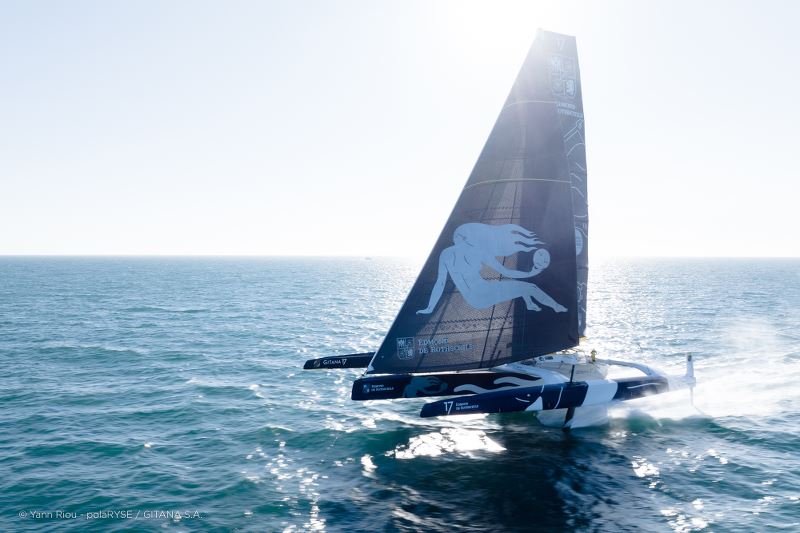
    Gitana 18’s mast is 1.50 metres taller than its predecessor’s. The boom is also shorter, creating a more slender sail plan. The major innovation is a set of spreaders that can be adjusted while sailing to bend the mast fore and aft. Actuated by hydraulic rams, these spreaders can pivot through 35 degrees to adjust the bend in the middle of the mast. This unprecedented system allows the sailor to control mainsail power: adding depth in light winds to take off sooner, or flattening the sail to reduce power at high speed or in strong winds. Adjusting the depth, and therefore the power, of the mainsail can also save a solo sailor time and energy by reducing the need for risky manoeuvres or headsail changes.

    Central hull:
    an integrated, structural coachroof

    The naval architects and Gitana design team wanted an exceptionally stiff, structurally robust platform. This applies both to the floats, which must withstand heavy loads from the foils and rudders, and to the central hull, which is subject to torsion. The enclosed coachroof is integrated into the hull and contributes to its structural strength. Inside, the cockpit brings all sail-handling controls together, with ergonomics shaped by many hours of design and development. The coachroof also stands out for the number and size of its windows. This configuration meets the visibility requirements of the Ultim class rules and gives sailors the best possible view to keep a visual watch.

    Gitana 18’s coachroof

    13.01.2024

    At the gateway to the South Atlantic.

    After a little over six days of racing, the head of the Arkea Ultim Challenge Brest fleet will leave the North Atlantic in their wake over the coming hours and start making headway in the southern hemisphere. Charles Caudrelier and Tom Laperche are continuing to stretch away from their pursuers and are still leading the way as they approach the nor…

    par Gitana

    After a little over six days of racing, the head of the Arkea Ultim Challenge Brest fleet will leave the North Atlantic in their wake over the coming hours and start making headway in the southern hemisphere. Charles Caudrelier and Tom Laperche are continuing to stretch away from their pursuers and are still leading the way as they approach the north coast of Brazil. They’ve benefited from fairly inactive doldrums to rapidly gain southing this Saturday and are due to cross the equator midway through this evening. Over 200 miles astern, their closest rivals are beginning to suffer the vagaries of the Inter-Tropical Convergence Zone as evidenced by a significant drop in their average speed.
    Fairly inactive doldrums     

    In offshore races, which pass from one hemisphere to the other, as is the case in a round the world of course, the sailors have to traverse the Inter-Tropical Convergence Zone to make the switch from the North Atlantic to the South Atlantic. It’s worth noting that this random meteorological zone, which hovers around the equator is the result of the NE’ly trade wind of the northern hemisphere encountering the SE’ly trade wind of the southern hemisphere. Renowned for its unpredictability, this area commonly referred to by sailors as the doldrums is always dreaded, especially by solo sailors. This Saturday though, the wind gods have been gentle with Charles Caudrelier and Tom Laperche, the first competitors in the Arkea Ultim Challenge – Brest to navigate the zone with their giants. Positioned further over to the west, SVR- Lazartigue has proven to be a tad quicker and has made the most of the situation to claw back a few miles at the 16:00 UTC ranking.   

    The skipper of the Maxi Edmond de Rothschild shared with us a first picture postcard of the scene midway through the afternoon: “Things are going rather well for this passage through the doldrums. Since this morning, we’ve barely even stalled. We’ve had breeze the whole time. It’s been a fairly simple passage, much easier than a few weeks ago in the Transat Jacques Vabre! It’s an advantage to negotiate it by day too, because if there’s a lot of storm activity at night, you can’t see the squalls rolling in and expanding and, back on land, our routers don’t have such accurate satellite images. We’ll cross the equator over the coming hours, which equates to a little over 6 days. 6 days and a few hours single-handed, with the rather unfavourable conditions we’ve had for this descent, is not too bad at all!”   
    Duelling leaders   

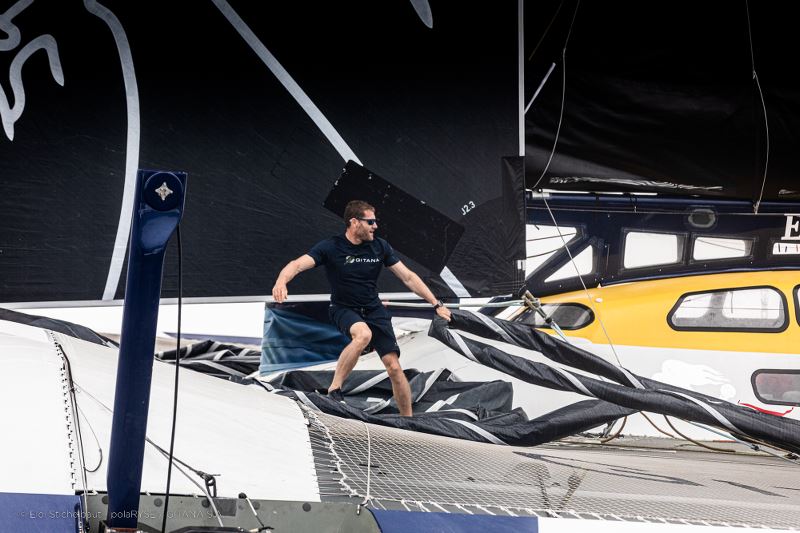
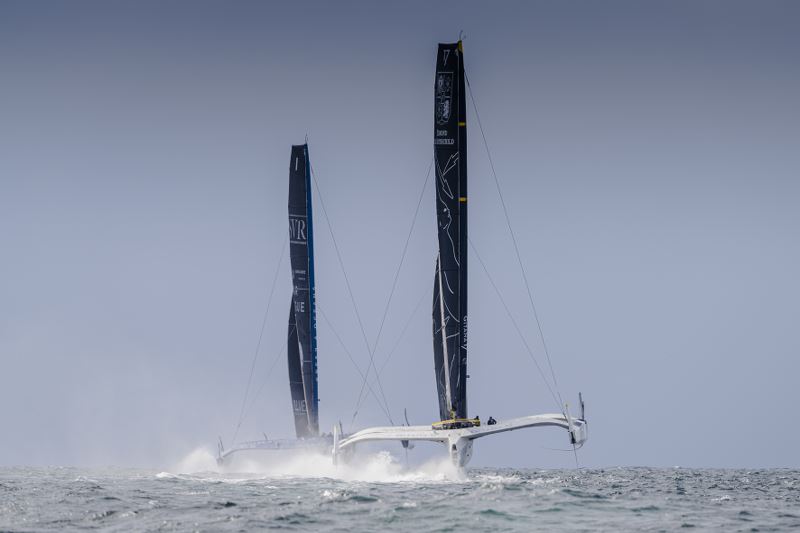
    Charles has made no secret of his admiration for the youngster of the race, Tom Laperche. The two sailors have both studied at the demanding Figaro school, and they have each secured victory in the series’ main event: the Solitaire du Figaro. In the Arkea Ultim Challenge, their descent of the Atlantic has seen them embroiled in a fierce duel since midway through the week when the front rolled through. The skipper of the Maxi Edmond de Rothschild and his fellow rival have since gained an edge, opening up a sizeable lead of over 200 miles ahead of the chasing pack this Saturday.     

    “Tom and I have a good old battle on our hands! We’re very close. There’s really nothing in it given the scale of what lies ahead. This duel is rather nice. It livens up the race, adds some intensity, motivates us and encourages us to trim our boats better, so it’s keeping us occupied… We’ve been chatting over VHF for the past few days.”         
    Ranking at the 16:00 UTC 

    1) SVR Lazartigue – Tom Laperche     
    2) Maxi Edmond de Rothschild – Charles Caudrelier – 23.2 miles behind the leader   
    3) Maxi Banque Populaire XI – Armel Le Cléac’h – 264 miles behind the leader 
     4) Sodebo Ultim 3 – Thomas Coville – 278 miles behind the leader   
    5) Actual Ultim 3 – Anthony Marchand – 751.3 miles behind the leader   
    6) Ultim Adagio – Eric Peron – 1,019 miles behind the leader