







Heritage

Season 26
Types de médias
  • Photos
  • Vidéos
  • Sons
Années
  • 2026
  • 2024
  • 2023
  • 2022
  • 2021
  • 2020
  • 2019
  • 2018
  • 2017
  • 2016
  • 2015
  • 2014
Afficher les résultats (121)
supprimer tous les filtres
  • News
  • Gallery
  • Gitana 18
  • Team
  • Retractable Y-shaped foils, adjustable in three dimensions

    Inspired by the appendages of the America's Cup foiling monohulls, these Y-shaped foils have a wingspan of over 5 metres. They are designed to generate powerful lift, increase power and offer a wide range of adjustments to optimise flight at every point of sail and in all conditions. Beyond their impressive size, these foils feature many unique innovations.

    Revolutionary U-shaped rudders

    These are probably the most visually striking innovations on the new Maxi Edmond de Rothschild. To fly high above rough seas while maintaining control, the team wanted very long rudders that would remain in contact with the water. The challenge is that longer rudders tend to flex under load, severely affecting steering and the efficiency of their lifting surfaces. A new geometry was needed to give these appendages maximum stiffness, resist cavitation and ultimately improve control of the boat and make better use of its power. The result is a set of U-shaped rudders over 4 metres long, a metre longer than those on Gitana 17. Their shape, reminiscent of a tripod or an inverted π, is only the visible part of what makes them so distinctive.

    A daggerboard optimised to stabilise the boat and limit cavitation

    With its wide span, the daggerboard resembles an aircraft tail assembly, with two adjustable flaps: one on the vertical section and the other on the horizontal section, the distinctive “manta-ray wing”. On Gitana 18, the innovation is to position this wing behind the vertical part of the appendage, rather than directly beneath it, to minimise flow disturbance and cavitation.

    Gitana 18’s daggerboard

    Rig: adjustable spreaders to control mainsail power while sailing

    Gitana 18’s mast is 1.50 metres taller than its predecessor’s. The boom is also shorter, creating a more slender sail plan. The major innovation is a set of spreaders that can be adjusted while sailing to bend the mast fore and aft. Actuated by hydraulic rams, these spreaders can pivot through 35 degrees to adjust the bend in the middle of the mast. This unprecedented system allows the sailor to control mainsail power: adding depth in light winds to take off sooner, or flattening the sail to reduce power at high speed or in strong winds. Adjusting the depth, and therefore the power, of the mainsail can also save a solo sailor time and energy by reducing the need for risky manoeuvres or headsail changes.

    Central hull:
    an integrated, structural coachroof

    The naval architects and Gitana design team wanted an exceptionally stiff, structurally robust platform. This applies both to the floats, which must withstand heavy loads from the foils and rudders, and to the central hull, which is subject to torsion. The enclosed coachroof is integrated into the hull and contributes to its structural strength. Inside, the cockpit brings all sail-handling controls together, with ergonomics shaped by many hours of design and development. The coachroof also stands out for the number and size of its windows. This configuration meets the visibility requirements of the Ultim class rules and gives sailors the best possible view to keep a visual watch.

    Gitana 18’s coachroof

    09.01.2024

    Wiping the slate clean offshore of Madeira!.

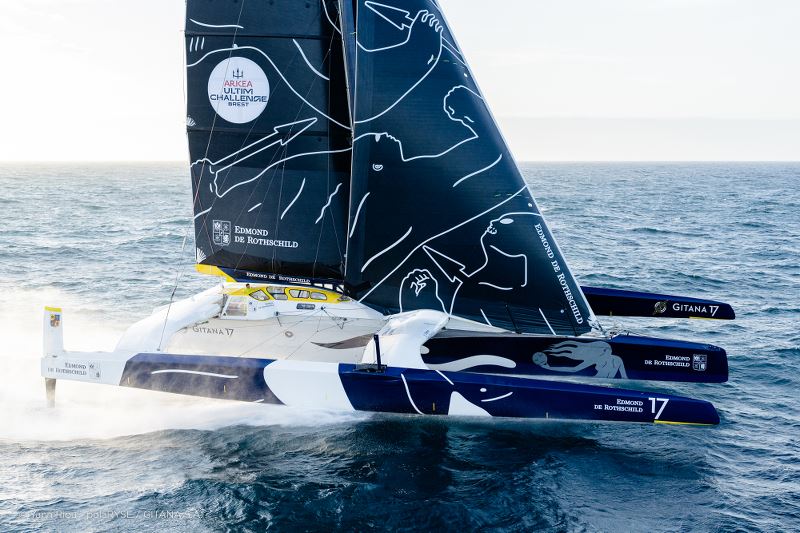
    Setting sail from Brest on Sunday at 12:30 UTC, the Arkea Ultim Challenge fleet has had a third day at sea, this one punctuated by light airs. Whilst Charles Caudrelier and his five companions on this round the world race enjoyed a brisk start to the race, really fulfilling the potential of their fantastic flying machines, today has seen a complete…

    par Gitana

    Setting sail from Brest on Sunday at 12:30 UTC, the Arkea Ultim Challenge fleet has had a third day at sea, this one punctuated by light airs. Whilst Charles Caudrelier and his five companions on this round the world race enjoyed a brisk start to the race, really fulfilling the potential of their fantastic flying machines, today has seen a complete change of atmosphere and the speeds have plummeted. Indeed, short of breeze since this morning, the 32-metre giants are rounding a zone of high pressure. To negotiate the random conditions synonymous with this anticyclonic zone to best effect, the sailors know that opportunism and patience will be their weapons of choice. This is especially true given that the weather scenario is proving favourable for a general bunching up of the fleet as they approach the Portuguese archipelago of Madeira. Charles Caudrelier has yielded his lead by a handful of miles to Thomas Coville. In fact, the two men even crossed tacks within a few boat lengths of one another this afternoon amidst an oceanic match racing atmosphere.
    A trajectory in the shape of a gull’s wing as they gear up for their first depression

     Not far from Gitana’s base in Lorient, three men are alternating night and day within the Maxi Edmond de Rothschild’s weather routing cell. This group of experts comprises Erwan Israël, a mainstay of various Gitana crews over the past few years and the recent co-skipper of Charles Caudrelier in the Transat Jacques Vabre, Julien Villion and Benjamin Schwartz. Supporting this trio of sailors is American meteorologist Chris Bedford, who is deciphering and analysing the major trends for Charles Caudrelier on the other side of the Atlantic.

    This morning, during their daily round-up, they discussed what was set to be a tough day, not least for the sailors’ nerves: “The start has gone rather well, with some good navigation at the head of the fleet, but things are getting tougher today as they round to the south of a zone of high pressure! In terms of trajectory, we’re going to adopt the famous gull wing-shaped trajectory to hunt down our gybing position to the south. It won’t be quick, but this day of very light winds will very soon be replaced by an entirely different atmosphere since tomorrow evening the solo sailors will have to negotiate their first depression of this round the world race. This low-pressure phenomenon (980 hPa measured at its centre) which we’ve been observing for several days, is generating a lot of gradient and its stormy wake seems very active. The next few hours will involve a compromise to determine where we want to position the gybe. It won’t be an easy manoeuvre, as there will be rather heavy 5 m seas, with around 30 knots of breeze and gusts.”
    This storm sequence is scheduled to roll through in a little over 24 hours’ time, namely on Wednesday night through into Thursday, European time. After just a handful of days on the racetrack in this massive planetary challenge, it’s highly likely that none of the solo sailors will want to rub shoulders with conditions that are overly boisterous for their machine. In any case, such will be the gameplan aboard the Maxi Edmond de Rothschild because with just 4% of the total course covered so far, as the saying goes: “he who takes it slow and steady goes a long way.”

    The rhythm and intensity of the sailing during the skippers’ first few days at sea in the Arkea Ultim Challenge – Brest are absolutely crucial. Indeed, the uniformity of the ULTIM fleet, together with the quality of the line-up of solo sailors competing in this 1st edition, means that they’re getting little respite for now. However, managing this element of the race will be one of the keys to success over the coming days and weeks.

    Charles Caudrelier, Tuesday 9 January  

    “I’m well rested right now. I’m eating well and since last night I’ve clearly switched to round the world mode with a more long-term rhythm! We’ve wiped the slate clean today with more stalling as we round the anticyclone! Everyone’s catching up but it’s not that serious a threat given what awaits us. I’m going to make the most of tonight to rack up some sleep as tomorrow evening will be a whole other ball game. We’re tackling the hard stuff tomorrow with the negotiation of our first depression. The plan is not to be extreme, rather we’ll aim to play for time to ensure the boat handling is smooth. Despite all that, we’ll need to line ourselves up nicely for what will be a very special course, which is carrying us a long way west for now. However, things may well change.”