








Heritage

Season 26
Types de médias
  • Photos
  • Vidéos
  • Sons
Années
  • 2026
  • 2024
  • 2023
  • 2022
  • 2021
  • 2020
  • 2019
  • 2018
  • 2017
  • 2016
  • 2015
  • 2014
Afficher les résultats (121)
supprimer tous les filtres
  • News
  • Gallery
  • Gitana 18
  • Team
  • Retractable Y-shaped foils, adjustable in three dimensions

    Inspired by the appendages of the America's Cup foiling monohulls, these Y-shaped foils have a wingspan of over 5 metres. They are designed to generate powerful lift, increase power and offer a wide range of adjustments to optimise flight at every point of sail and in all conditions. Beyond their impressive size, these foils feature many unique innovations.

    Revolutionary U-shaped rudders

    These are probably the most visually striking innovations on the new Maxi Edmond de Rothschild. To fly high above rough seas while maintaining control, the team wanted very long rudders that would remain in contact with the water. The challenge is that longer rudders tend to flex under load, severely affecting steering and the efficiency of their lifting surfaces. A new geometry was needed to give these appendages maximum stiffness, resist cavitation and ultimately improve control of the boat and make better use of its power. The result is a set of U-shaped rudders over 4 metres long, a metre longer than those on Gitana 17. Their shape, reminiscent of a tripod or an inverted π, is only the visible part of what makes them so distinctive.

    A daggerboard optimised to stabilise the boat and limit cavitation

    With its wide span, the daggerboard resembles an aircraft tail assembly, with two adjustable flaps: one on the vertical section and the other on the horizontal section, the distinctive “manta-ray wing”. On Gitana 18, the innovation is to position this wing behind the vertical part of the appendage, rather than directly beneath it, to minimise flow disturbance and cavitation.

    Gitana 18’s daggerboard

    Rig: adjustable spreaders to control mainsail power while sailing

    Gitana 18’s mast is 1.50 metres taller than its predecessor’s. The boom is also shorter, creating a more slender sail plan. The major innovation is a set of spreaders that can be adjusted while sailing to bend the mast fore and aft. Actuated by hydraulic rams, these spreaders can pivot through 35 degrees to adjust the bend in the middle of the mast. This unprecedented system allows the sailor to control mainsail power: adding depth in light winds to take off sooner, or flattening the sail to reduce power at high speed or in strong winds. Adjusting the depth, and therefore the power, of the mainsail can also save a solo sailor time and energy by reducing the need for risky manoeuvres or headsail changes.

    Central hull:
    an integrated, structural coachroof

    The naval architects and Gitana design team wanted an exceptionally stiff, structurally robust platform. This applies both to the floats, which must withstand heavy loads from the foils and rudders, and to the central hull, which is subject to torsion. The enclosed coachroof is integrated into the hull and contributes to its structural strength. Inside, the cockpit brings all sail-handling controls together, with ergonomics shaped by many hours of design and development. The coachroof also stands out for the number and size of its windows. This configuration meets the visibility requirements of the Ultim class rules and gives sailors the best possible view to keep a visual watch.

    Gitana 18’s coachroof

    11.11.2023

    Repairs and a ballet of Brazilian gybes.

    Like the top two in the Transat Jacques Vabre, the Maxi Edmond de Rothschild has been weaving her way downwind along the edge of the traffic exclusion zone off northern Brazil. This game of gybes, which has already required a great deal of manoeuvring and concentration from the duos, has been spiced up by a rather tough DIY session aboard the five-…

    par Gitana

    Like the top two in the Transat Jacques Vabre, the Maxi Edmond de Rothschild has been weaving her way downwind along the edge of the traffic exclusion zone off northern Brazil. This game of gybes, which has already required a great deal of manoeuvring and concentration from the duos, has been spiced up by a rather tough DIY session aboard the five-arrow giant. However, the news from the open ocean is positive this Saturday! The skipper spent a large part of last night at the back of the central hull repairing yesterday morning’s damage to the steering system. There has been considerable loss of ground in the ranking on both the Maxi Banque Populaire XI and SVR-Lazartigue, but thanks to all their efforts and constantly taking it in turns at the helm, Charles Caudrelier and Erwan Israël have managed to maintain an acceptable lead ahead of their rivals. Some 1,500 miles from the finish, there is still a long way to go, especially with the curveball presented by a second passage of the doldrums over the coming hours. This is not a scenario the top two maxi-multihulls will have to deal with however, so they will likely extend their lead still further before Fort-de-France.
    Steering system operational again     

    Since the start of the Transat Jacques Vabre, the crew of the Maxi Edmond de Rothschild has had to contend with a certain number of technical issues. Yesterday morning though, they suffered serious damage to the steering system, forcing them to take it in turns helming the giant using just the central rudder. Indeed, the steering arm, which connects the central rudder to the float rudders, broke during an impact. Back on land, the team led by Pierre Tissier, technical director, and David Boileau, the Maxi Edmond de Rothschild’s boat captain, immediately sprang into action to come up with a repair procedure to send to the sailors. Late last night, the skipper of Gitana 17 found the energy to action the recommendations put forward by the members of Gitana Team, a mammoth task which the shore team hailed as a success on this the anniversary of the armistice: “The proposed repair was studied in depth. It was feasible but rather difficult to pull off at sea and out on the racetrack. Indeed, it was out of the question to bring the boat to a standstill. Charles took the time to rest yesterday in order to put it into action last night. This repair required work to the central hull, astern of the aft beam. We were seriously impressed given that it required a lot of tools and work!”   

    The skipper gave us an insight into the work required and the rather special efforts last night off the Brazilian coast: “We haven’t communicated a great deal since yesterday because, as you know, we’ve had some steerage issues and we’ve been forced to helm the whole time, as we only had the central rudder to sail with. We got a bit exhausted working all night and at one point the autopilot kind of took over again for a bit without causing us to lose too much speed. The news this morning is rather good. On the advice of the shore team, I spent the end of last night doing a spot of DIY with a view to attempting repairs to the steering system and it’s working! It’s been successful for now so we’re pretty happy with that. I’ve never used so many tools on the Maxi Edmond de Rothschild.”   

    A second doldrums   

    This breakage has caused the Maxi Edmond de Rothschild to lose a lot of ground in relation to the head of the fleet. At the 15:00 UTC ranking, she had a deficit of over 500 miles behind the Maxi Banque Populaire XI compared with 263 miles at the same time yesterday. However, the damage is not the only reason for that because, at the front of the fleet, the crews also benefited from better weather, as the onshore weather cell explained: “The doldrums is swelling up again. Up ahead, they have more breeze and will always have more breeze than us, and above all they’ll benefit from breeze further to the left so they’ll be able to sail a virtually direct course towards the finish. For our part, the wind will come more from the right, which means that we’ll have to continue gybing so we’ll essentially have to sail further to reach Fort-de-France.”  In short, the further in front you are, the fewer miles you have to sail. This also goes some way to explaining why the distance between Banque Populaire and SVR-Lazartigue has tripled over the past 24 hours. As a result, there should be significant deficits opening up between the leader and the rest of the fleet at the finish.     
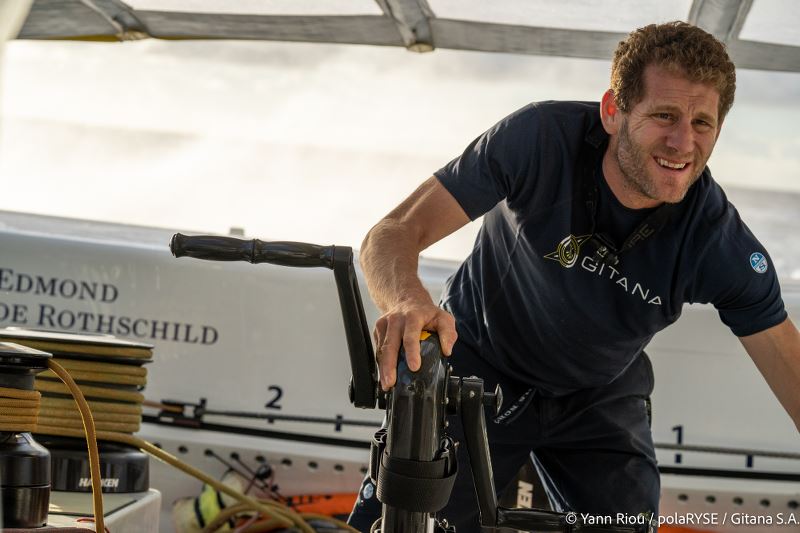
    Though the Maxi Edmond de Rothschild is still not operating at her true potential, she now has more weapons at her disposal to try to defend her podium place as Charles Caudrelier concluded this morning: “We’re not firing on all cylinders, but we can now sail under autopilot, get some rest and tone down our fear of capsizing a little… Indeed, sailing the boat with a single rudder in the pitch black is not easy. The steering system has been playing up since the start, preventing us from getting the best out of the boat. It’s quite frustrating, but it’s important to keep focusing on moving forward. First place looks a long way off this morning with an injured boat, but we’ll try to hang onto our 3rd place. That’s our aim!”