Heritage

Season 26
Types de médias
  • Photos
  • Vidéos
  • Sons
Années
  • 2026
  • 2024
  • 2023
  • 2022
  • 2021
  • 2020
  • 2019
  • 2018
  • 2017
  • 2016
  • 2015
  • 2014
Afficher les résultats (121)
supprimer tous les filtres
  • News
  • Gallery
  • Gitana 18
  • Team
  • Retractable Y-shaped foils, adjustable in three dimensions

    Inspired by the appendages of the America's Cup foiling monohulls, these Y-shaped foils have a wingspan of over 5 metres. They are designed to generate powerful lift, increase power and offer a wide range of adjustments to optimise flight at every point of sail and in all conditions. Beyond their impressive size, these foils feature many unique innovations.

    Revolutionary U-shaped rudders

    These are probably the most visually striking innovations on the new Maxi Edmond de Rothschild. To fly high above rough seas while maintaining control, the team wanted very long rudders that would remain in contact with the water. The challenge is that longer rudders tend to flex under load, severely affecting steering and the efficiency of their lifting surfaces. A new geometry was needed to give these appendages maximum stiffness, resist cavitation and ultimately improve control of the boat and make better use of its power. The result is a set of U-shaped rudders over 4 metres long, a metre longer than those on Gitana 17. Their shape, reminiscent of a tripod or an inverted π, is only the visible part of what makes them so distinctive.

    A daggerboard optimised to stabilise the boat and limit cavitation

    With its wide span, the daggerboard resembles an aircraft tail assembly, with two adjustable flaps: one on the vertical section and the other on the horizontal section, the distinctive “manta-ray wing”. On Gitana 18, the innovation is to position this wing behind the vertical part of the appendage, rather than directly beneath it, to minimise flow disturbance and cavitation.

    Gitana 18’s daggerboard

    Rig: adjustable spreaders to control mainsail power while sailing

    Gitana 18’s mast is 1.50 metres taller than its predecessor’s. The boom is also shorter, creating a more slender sail plan. The major innovation is a set of spreaders that can be adjusted while sailing to bend the mast fore and aft. Actuated by hydraulic rams, these spreaders can pivot through 35 degrees to adjust the bend in the middle of the mast. This unprecedented system allows the sailor to control mainsail power: adding depth in light winds to take off sooner, or flattening the sail to reduce power at high speed or in strong winds. Adjusting the depth, and therefore the power, of the mainsail can also save a solo sailor time and energy by reducing the need for risky manoeuvres or headsail changes.

    Central hull:
    an integrated, structural coachroof

    The naval architects and Gitana design team wanted an exceptionally stiff, structurally robust platform. This applies both to the floats, which must withstand heavy loads from the foils and rudders, and to the central hull, which is subject to torsion. The enclosed coachroof is integrated into the hull and contributes to its structural strength. Inside, the cockpit brings all sail-handling controls together, with ergonomics shaped by many hours of design and development. The coachroof also stands out for the number and size of its windows. This configuration meets the visibility requirements of the Ultim class rules and gives sailors the best possible view to keep a visual watch.

    Gitana 18’s coachroof

    03.11.2023

    Strong trade wind vibes.

    This Transat Jacques Vabre 2023 clearly has its fair share of surprises and contrasts. After an intense start to the race in rough weather, the five duos which make up the ULTIM line-up had to demonstrate both patience and self-sacrifice in their negotiation of the Portuguese archipelago of Madeira to traverse a ridge of high pressure barring the w…

    par Gitana

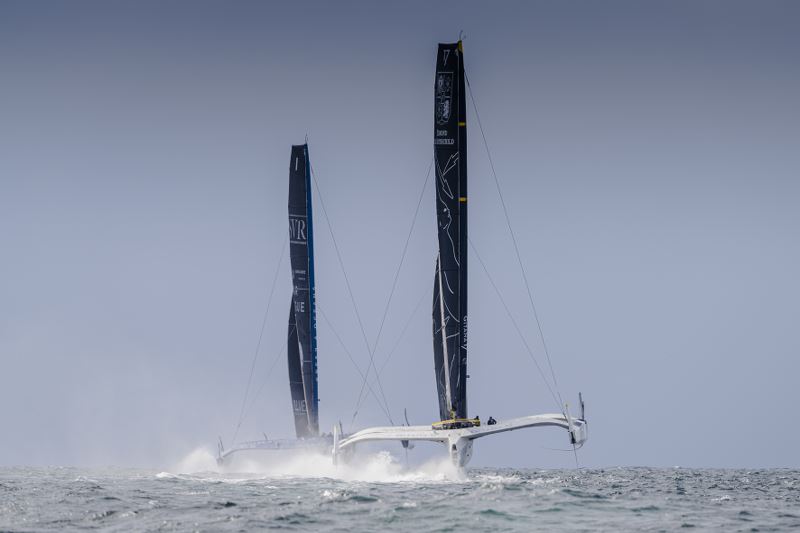
    This Transat Jacques Vabre 2023 clearly has its fair share of surprises and contrasts. After an intense start to the race in rough weather, the five duos which make up the ULTIM line-up had to demonstrate both patience and self-sacrifice in their negotiation of the Portuguese archipelago of Madeira to traverse a ridge of high pressure barring the way for their journey southward. Released from the clutches of the anticyclone late yesterday morning, the Maxi Edmond de Rothschild and her rivals were quick to put pedal to the metal and dramatically up the tempo. Since then, the fleet of maxi-multihulls has been embroiled in a drag race through the trades as they head towards Cape Verde. Following a great option as they negotiated Madeira, the Maxi Banque Populaire XI is leading the troops at a rapid pace. On the attack in their wake, on port tack, Charles Caudrelier and Erwan Israël are sparing no effort in their bid to defend their current second place. On this long leg towards the doldrums and the next course mark of São Pedro e São Paulo, concentration, trimming and precision piloting are punctuating the watches aboard the leading boats in the Coffee Route.
    On the pace at Cabo Verde

    After five days of racing, the fleet of maxi-trimarans is finally hotfooting it southward at high speed. There is a sense of liberation for the Charles Caudrelier / Erwan Israël duo and their fellow rivals in the Transat Jacques Vabre, after having to battle their way around Madeira for hours on end, caught up in a ridge of high pressure.  The co-skipper of the Maxi Edmond de Rothschild, for whom this is his first double-handed transatlantic race in the ULTIM class, gave us an insight into the past few nerve-racking miles: “The negotiation of Madeira was a pretty stressful situation, as we had to deal with precious little breeze and a wind shadow. There were several options, one of them being to pass to windward of them like Banque Populaire, which would mean shifting across to the north and putting in a series of tacks, or dipping under them. Ourselves and SVR opted to pass to leeward of the islands, leaving some distance between us and the land and we didn’t suffer too much from the wind shadow, which was a bonus. However, Banque Populaire reaped greater rewards for her option between the islands…”  
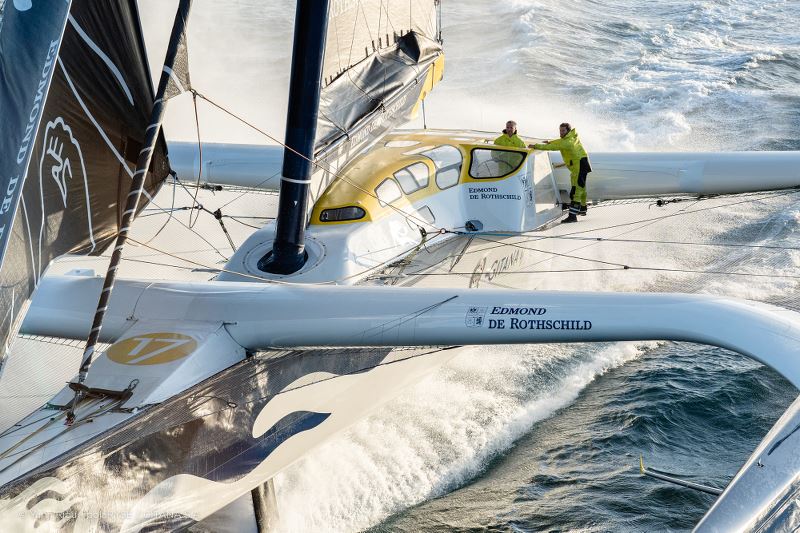
     

    Playing hard-to-get initially, the trade wind is now settled nicely in position with the ULTIMs set to pass the Cape Verde archipelago later today. Pushed along by this solid NE’ly breeze, established at around 20 knots, the crews can really get their steeds firing on all cylinders. Aboard the five-arrow giant, Charles Caudrelier and Erwan Israël have racked up over 756 miles in 24 hours, which equates to an average speed of 31.5 knots at the 15:00 UTC position report. These numbers may well get the imagination going, but such a pace is only possible through hour upon hour of trimming and helming. And being able to maintain this tempo is important because Gitana 17 and her rivals will be embroiled in a veritable drag race as far as the doldrums.  

    The joys of racing

    This 16th edition of the Transat Jacques Vabre – Normandie Le Havre is certainly not lacking spice! Since the start, last Sunday at 12:05 UTC, the men on the Maxi Edmond de Rothschild have been through their entire sail wardrobe decorated with artist Cleon Peterson’s powerful warriors. Upwind with one or two reefs, reaching and now downwind, the race currently being played out on the Atlantic is proving to be fabulously diverse and intense.
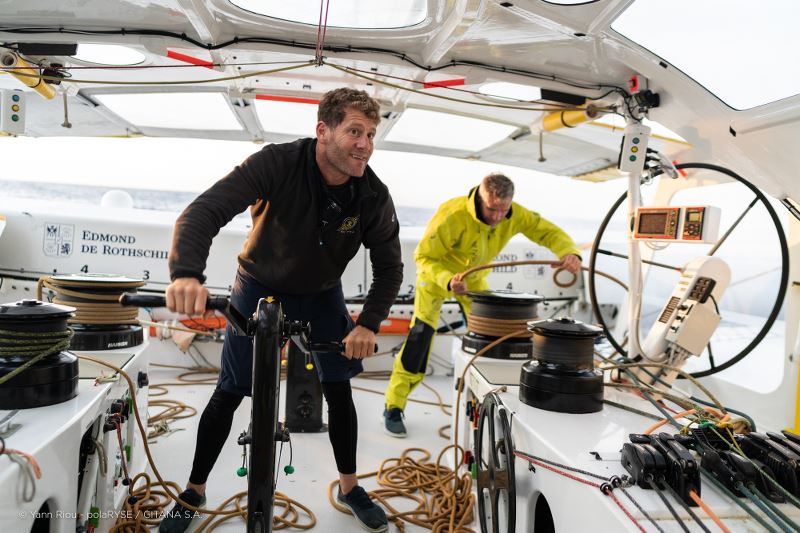
    Indeed, though Banque Populaire has gained the upper hand and stolen a march on her rivals since passing Madeira and harvesting the fruits of her option, there is still a very long way to go with over 5,000 miles ahead of their bows. In second position, Charles Caudrelier and Erwan Israël are getting the most out of their Verdier design and know only too well that their fifty-mile deficit in relation to the leader can be swallowed up in a matter of hours. On the hunt for the top spot, they’re sailing in convoy with SVR-Lazartigue, which is a convenient way to really push back the limits of their performance.