








Heritage

Season 26
Types de médias
  • Photos
  • Vidéos
  • Sons
Années
  • 2026
  • 2024
  • 2023
  • 2022
  • 2021
  • 2020
  • 2019
  • 2018
  • 2017
  • 2016
  • 2015
  • 2014
Afficher les résultats (121)
supprimer tous les filtres
  • News
  • Gallery
  • Gitana 18
  • Team
  • Retractable Y-shaped foils, adjustable in three dimensions

    Inspired by the appendages of the America's Cup foiling monohulls, these Y-shaped foils have a wingspan of over 5 metres. They are designed to generate powerful lift, increase power and offer a wide range of adjustments to optimise flight at every point of sail and in all conditions. Beyond their impressive size, these foils feature many unique innovations.

    Revolutionary U-shaped rudders

    These are probably the most visually striking innovations on the new Maxi Edmond de Rothschild. To fly high above rough seas while maintaining control, the team wanted very long rudders that would remain in contact with the water. The challenge is that longer rudders tend to flex under load, severely affecting steering and the efficiency of their lifting surfaces. A new geometry was needed to give these appendages maximum stiffness, resist cavitation and ultimately improve control of the boat and make better use of its power. The result is a set of U-shaped rudders over 4 metres long, a metre longer than those on Gitana 17. Their shape, reminiscent of a tripod or an inverted π, is only the visible part of what makes them so distinctive.

    A daggerboard optimised to stabilise the boat and limit cavitation

    With its wide span, the daggerboard resembles an aircraft tail assembly, with two adjustable flaps: one on the vertical section and the other on the horizontal section, the distinctive “manta-ray wing”. On Gitana 18, the innovation is to position this wing behind the vertical part of the appendage, rather than directly beneath it, to minimise flow disturbance and cavitation.

    Gitana 18’s daggerboard

    Rig: adjustable spreaders to control mainsail power while sailing

    Gitana 18’s mast is 1.50 metres taller than its predecessor’s. The boom is also shorter, creating a more slender sail plan. The major innovation is a set of spreaders that can be adjusted while sailing to bend the mast fore and aft. Actuated by hydraulic rams, these spreaders can pivot through 35 degrees to adjust the bend in the middle of the mast. This unprecedented system allows the sailor to control mainsail power: adding depth in light winds to take off sooner, or flattening the sail to reduce power at high speed or in strong winds. Adjusting the depth, and therefore the power, of the mainsail can also save a solo sailor time and energy by reducing the need for risky manoeuvres or headsail changes.

    Central hull:
    an integrated, structural coachroof

    The naval architects and Gitana design team wanted an exceptionally stiff, structurally robust platform. This applies both to the floats, which must withstand heavy loads from the foils and rudders, and to the central hull, which is subject to torsion. The enclosed coachroof is integrated into the hull and contributes to its structural strength. Inside, the cockpit brings all sail-handling controls together, with ergonomics shaped by many hours of design and development. The coachroof also stands out for the number and size of its windows. This configuration meets the visibility requirements of the Ultim class rules and gives sailors the best possible view to keep a visual watch.

    Gitana 18’s coachroof

    13.01.2023

    The Maxi Edmond de Rothschild makes for Brest.

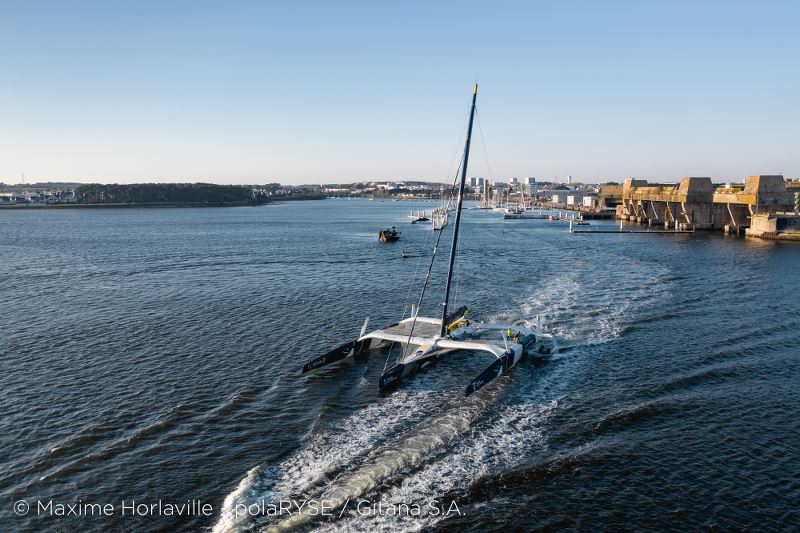
    Friday the 13th, a lucky day? The Maxi Edmond de Rothschild left her base in Lorient to head for Brest shortly after 12 noon local time today. Objective number one for Charles Caudrelier, Franck Cammas and their four crew is to get as close as possible to Ushant and the start line for the Jules Verne Trophy, which Gitana Team once again has her sig…

    par Gitana

    Friday the 13th, a lucky day? The Maxi Edmond de Rothschild left her base in Lorient to head for Brest shortly after 12 noon local time today. Objective number one for Charles Caudrelier, Franck Cammas and their four crew is to get as close as possible to Ushant and the start line for the Jules Verne Trophy, which Gitana Team once again has her sights on. Indeed, a weather window seems to be opening over the next few days but, given the sea conditions expected at the north-west tip of Brittany over the weekend, the team who were victorious in the recent Route du Rhum is playing it safe and will tie up alongside in the Marina du Château for a few hours or days… The jury is still out with regard to the exact timing of their departure, but the next weather files will enable them to refine both their strategy and the all-important launch slot.
    A departure tomorrow or next week?   

    Since the start of the week, the Maxi Edmond de Rothschild’s crew and weather cell have been looking out for a favourable situation with which to set sail on the Jules Verne Trophy from this weekend. Though the latest observations from this morning remain optimistic about very fine weather to the equator, they are now proving to be more pessimistic about the South Atlantic and the passage time at the Cape of Good Hope.   

    This ‘uncertain’ configuration has prompted the men of Gitana Team to go and position themselves in Brest so they can respond quickly to any eventuality and are closer to the virtual start line off Ushant. The updated grib files for this evening and tomorrow morning will determine whether the Caudrelier – Cammas duo and their crew set sail on their round the world record bid tomorrow or if they’ll have to sit it out for a few more days in the hope of a better weather window. Indeed, other opportunities seem to be on the cards for the middle of next week.     

    “This is what makes these pre-start phases so difficult! The desire to set sail inevitably weighs heavy, but we’re at the start of our standby period and we mustn’t rush things. The record will be tough to get our hands on and we need to leave with an ambitious weather window to give ourselves the best possible chance of success,” explains Charles Caudrelier.   
    “The time criteria we’re after are dictated by the performances we know the Maxi Edmond de Rothschild is capable of, together with our analysis of the different record sequences posted by Idec in 2017. The passage to the equator and the time at Cape Agulhas make up our initial criteria. Outside a time of 5 days to the equator and 12 days to the tip of South Africa, it’s no longer a very favorable window. The launch slot is one of the only things we can really control on this record attempt, so we’re putting every effort into making it a good one as Idec has set the bar very high.”   
    Third time lucky   

    Following two interrupted attempts due to technical issues, the men of Gitana Team are extremely keen to take on this third adventure, especially in light of the fact that it could be the last for quite some time given the packed schedule announced for the Maxi Edmond de Rothschild over the coming years, which notably includes a singlehanded round the world race in 2024.   

    In 2021, during their second shot at the Jules Verne Trophy, Charles Caudrelier, Franck Cammas and their crew really made an impression, really showing off the potential of their steed by setting an all-time record for the fastest passage from Ushant to the tip of South Africa, namely 11 days, 14 hours and 3 minutes to Cape Agulhas. However, the breakage of the float rudder at the gateway to the Southern Ocean abruptly put an end to this record attempt.     

    This next attempt will be the third then for the men of Gitana Team, who have one goal for this planetary challenge: to beat the record set by Idec in 2017 in a time of 40 days 23 hours and 30 minutes. However, aboard the Maxi Edmond de Rothschild, the six sailors also cherish a dream, that of circumnavigating the globe via the three capes inside the legendary 40-day mark.     

    An unaltered crew to target this planetary record 

     There will be a six-strong crew setting sail aboard the Maxi Edmond de Rothschild in the quest for the Jules Verne Trophy. Charles Caudrelier, the recent winner of the Route du Rhum – Destination Guadeloupe in Ultim will once again partner with Franck Cammas at the helm of the 32-metre giant. This duo will be able to rely on the experience and skills of the four sailors who have been supporting them in crewed races since 2019: Morgan Lagravière, Yann Riou, David Boileau and Erwan Israël. On shore, Marcel van Triest is also returning to his familiar spot in the routing cell. The so-called 7th man is a great round the world specialist and notably holds two Jules Verne Trophies, including one for the current record of 40 days 23 hours and 30 minutes.   
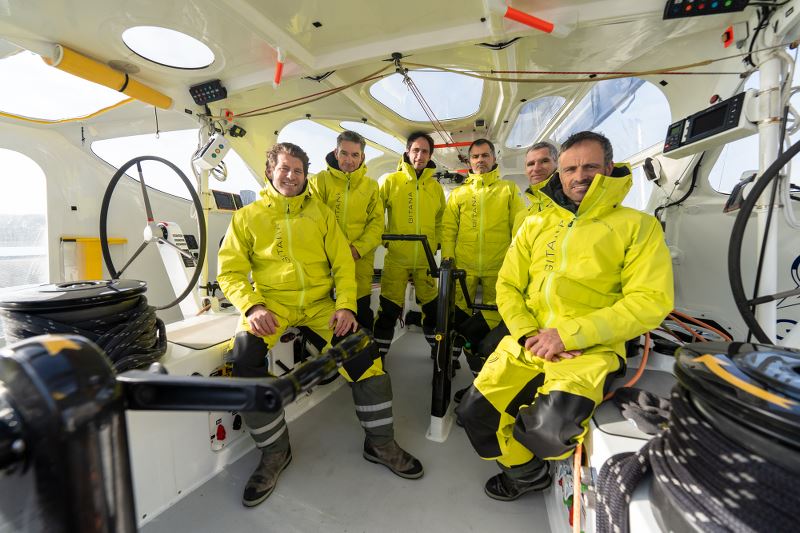
    The crew in detail   

    Charles Caudrelier 
    Role: skipper 
    3 round the worlds, including 2 victorious Volvo Ocean Races (2012 and 2018)   

    Franck Cammas 
    Role: co-skipper 
    2 round the worlds, including 1 victorious Volvo Ocean Race and 1 Jules Verne Trophy (48 days in 2010) 

    Erwan Israël 
    Role: helm trimmer 
    2 round the worlds, including 1 victorious Volvo Ocean Race (2012) and 1 Jules Verne Trophy attempt (47 days in 2016)   

    Morgan Lagravière 
    Role: helm trimmer 
    Two Jules Verne Trophy attempts (2020 and 2021), 1 participation in the Vendée Globe (2016)   

    David Boileau 
    Role: trimmer, bowman 
    Two Jules Verne Trophy attempts (2020 and 2021), 1 westabout passage around the Cape of Good Hope and Cape Horn (Tea Route record and Route de l’Or on Gitana 13 in 2008)   

    Yann Riou
    Role: trimmer onboard reporter 
    3 round the worlds, including 1 victorious Volvo Ocean Race (2012) and 1 Jules Verne Trophy attempt (47 days in 2016)   

    Marcel van Triest 
    Role: weather router, the ‘7th man’ 
    7 Jules Verne Trophy attempts, 2 of which secured a record (2012 and 2017)