








Heritage

Season 26
Types de médias
  • Photos
  • Vidéos
  • Sons
Années
  • 2026
  • 2024
  • 2023
  • 2022
  • 2021
  • 2020
  • 2019
  • 2018
  • 2017
  • 2016
  • 2015
  • 2014
Afficher les résultats (121)
supprimer tous les filtres
  • News
  • Gallery
  • Gitana 18
  • Team
  • Retractable Y-shaped foils, adjustable in three dimensions

    Inspired by the appendages of the America's Cup foiling monohulls, these Y-shaped foils have a wingspan of over 5 metres. They are designed to generate powerful lift, increase power and offer a wide range of adjustments to optimise flight at every point of sail and in all conditions. Beyond their impressive size, these foils feature many unique innovations.

    Revolutionary U-shaped rudders

    These are probably the most visually striking innovations on the new Maxi Edmond de Rothschild. To fly high above rough seas while maintaining control, the team wanted very long rudders that would remain in contact with the water. The challenge is that longer rudders tend to flex under load, severely affecting steering and the efficiency of their lifting surfaces. A new geometry was needed to give these appendages maximum stiffness, resist cavitation and ultimately improve control of the boat and make better use of its power. The result is a set of U-shaped rudders over 4 metres long, a metre longer than those on Gitana 17. Their shape, reminiscent of a tripod or an inverted π, is only the visible part of what makes them so distinctive.

    A daggerboard optimised to stabilise the boat and limit cavitation

    With its wide span, the daggerboard resembles an aircraft tail assembly, with two adjustable flaps: one on the vertical section and the other on the horizontal section, the distinctive “manta-ray wing”. On Gitana 18, the innovation is to position this wing behind the vertical part of the appendage, rather than directly beneath it, to minimise flow disturbance and cavitation.

    Gitana 18’s daggerboard

    Rig: adjustable spreaders to control mainsail power while sailing

    Gitana 18’s mast is 1.50 metres taller than its predecessor’s. The boom is also shorter, creating a more slender sail plan. The major innovation is a set of spreaders that can be adjusted while sailing to bend the mast fore and aft. Actuated by hydraulic rams, these spreaders can pivot through 35 degrees to adjust the bend in the middle of the mast. This unprecedented system allows the sailor to control mainsail power: adding depth in light winds to take off sooner, or flattening the sail to reduce power at high speed or in strong winds. Adjusting the depth, and therefore the power, of the mainsail can also save a solo sailor time and energy by reducing the need for risky manoeuvres or headsail changes.

    Central hull:
    an integrated, structural coachroof

    The naval architects and Gitana design team wanted an exceptionally stiff, structurally robust platform. This applies both to the floats, which must withstand heavy loads from the foils and rudders, and to the central hull, which is subject to torsion. The enclosed coachroof is integrated into the hull and contributes to its structural strength. Inside, the cockpit brings all sail-handling controls together, with ergonomics shaped by many hours of design and development. The coachroof also stands out for the number and size of its windows. This configuration meets the visibility requirements of the Ultim class rules and gives sailors the best possible view to keep a visual watch.

    Gitana 18’s coachroof

    13.11.2022

    The Ultims at the gateway to the trades.

    Setting sail from Saint Malo on Wednesday, this is the 4th day at sea for the Route du Rhum Destination Guadeloupe. The fleet was well and truly pummelled yesterday in the boisterous conditions synonymous with a front rolling through, with multiple retirements to lament following a series of dismastings and the capsize of an Ocean Fifty. Among the…

    par Gitana

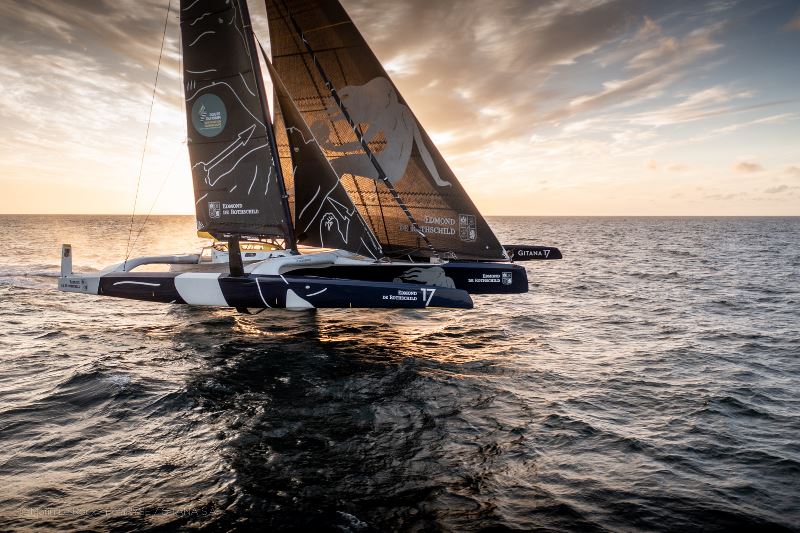
    Setting sail from Saint Malo on Wednesday, this is the 4th day at sea for the Route du Rhum Destination Guadeloupe. The fleet was well and truly pummelled yesterday in the boisterous conditions synonymous with a front rolling through, with multiple retirements to lament following a series of dismastings and the capsize of an Ocean Fifty. Among the Ultims, all eight contenders are back out on the racetrack since Armel Le Cléac’h was able to head back out to sea at midday after the replacement of his broken centreboard. At the top of the leader board, Charles Caudrelier is continuing to post a stellar performance in his Route du Rhum, still leading the way to the West Indies, even though he has been joined over the past forty-eight hours by François Gabart. The two sailors are involved in a fierce duel and Thomas Coville is also on the hunt around a hundred miles in their wake, poised to pounce on the duo for the final sprint. On today’s programme, the Maxi Edmond de Rothschild and her other two playmates in the breakaway group should finish circumnavigating the Azores High and will finally be able to latch onto the trade wind, which is expected to fill the sails of the five-arrow giant tomorrow. These downwind conditions should then propel them towards the finish.
    Azores launchpad 

    592 miles have been covered since yesterday at 15:19 hours, which is the time that the Maxi Edmond de Rothschild passed offshore of the island of São Miguel in the Azores archipelago, at an average speed of 32.88 knots… Yesterday, once the second front had rolled through, there was a session of match racing for the giants with the islands as course marks and they have clearly put pedal to the metal since setting a course for Pointe-à-Pitre. “For the past 24 hours, they’ve been setting an incredible pace! Even though we were well aware of what the sailor and the boat were capable of, it’s always impressive to see them posting and maintaining such a pace,” enthused Cyril Dardashti, director of Gitana Team.   

    Morgan Lagravière, a talented crew on the Maxi Edmond de Rothschild and replacement skipper for Charles for the Route du Rhum, was keen to discuss yesterday’s racing which, though it didn’t shake up the established hierarchy among the Ultims, will be remembered as a key passage in this 2022 edition. “Beyond the speeds, which are a source of stress and require increased attention on the part of the skippers, it’s a very full-on phase of the race for the solo sailors. Yesterday, the passage of the front must have soaked up a great deal of their energy as it was very bracing and they also had to adapt to a new route plan. They were headed south towards the trade wind, but the door slammed shut on them, so they had to pick their way west again and switch their gameplan to go and tackle strong upwind conditions instead. It was a big day as they linked onto the passage of the front associated with high speeds. Since then, we’ve kind of been entering a new race with new conditions under J0, with VMG in downwind conditions. That’s the point of sail which will be most prominent to the finish. We’ll have to strike the right balance between speed and angle in relation to the wind.”   

    By tomorrow then, the leading Ultims should finally be able to hook onto the trade wind, where they’ll hopefully have more stable conditions than those encountered over the past few hours. “We’ll have to put in another series of manoeuvres (gybes) today to slip along nicely along the eastern edge of the Azores High in a bid to latch onto the NE’ly trade wind tomorrow. From that point on, there will be a long tack towards Guadeloupe, where it will be important to focus solely on trimming the boat and getting her making headway. To finish, there will be another series of manoeuvres required to get around the island…”, explained Erwan Israël, one of the routers for the Maxi Edmond de Rothschild.   
    The passage of the second front yesterday and the subsequent acceleration at the head of the fleet has clearly split the Ultims into two groups, three even if we include Banque Populaire, which is naturally trailing a little following her 36-hour pit stop in Lorient to effect repairs. At the front of the pack, Charles Caudrelier, a solid leader since the opening tacks in this Route du Rhum 2022, is neck and neck with François Gabart, who came right back into the match as the first front rolled through. Thomas Coville, though set back a little this morning, completes the top trio. More than 450 miles in the wake of the Maxi Edmond de Rothschild we find another trio led by the reigning champion of the event, Francis Joyon.     

    Tuesday or Wednesday in Pointe-à-Pitre 

    At the 09:00 UTC position report, the leaders still had some 1,700 miles to go along the great circle route in this 12th edition of the Route du Rhum – Destination Guadeloupe. However, the past 24 hours have been a demonstration of the incredible capacity for acceleration of the giants of the seas, which are able to sail twice as fast as the wind speed the moment they’re airborne. In this way, the Maxi Edmond de Rothschild’s routing cell is still working on the prospect of a finish on Tuesday evening through into the early hours of 16 November. However, there is a more random element that will influence this ETA: the rounding of Guadeloupe. Indeed, this final 70-mile sprint, fifty miles if we use the famous Tête à l’anglais headland as the final marker for this Route du Rhum course, is always a great unknown.     
    Extracts from the official radio link-up on Sunday 13 November 

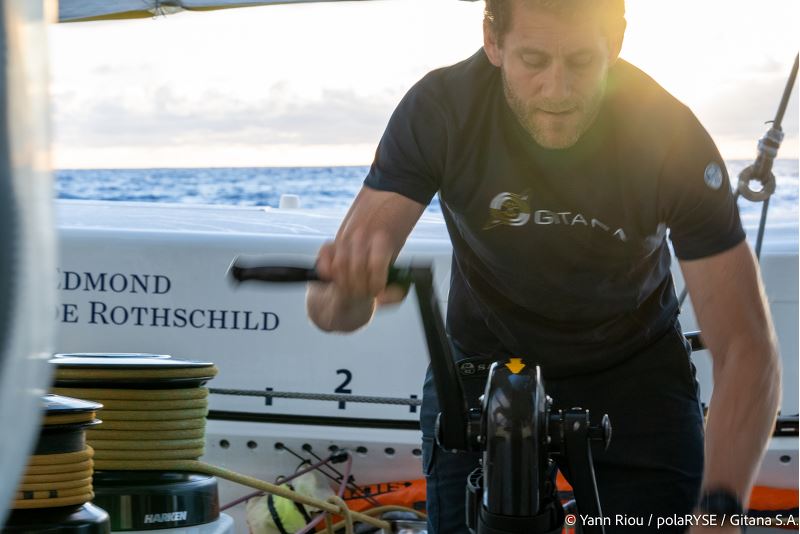
    Charles Caudrelier (Maxi Edmond de Rothschild): “It’s kind of battle stations here. The wind is very shifty. You need to be careful. It’s not dreamlike conditions yet. There’s still a disturbed weather system and things are pretty tense. I can’t wait to take off my foulies. The wind is very shifty and you couldn’t really described conditions as downwind yet. Right now, we have 20 knots of breeze, with big gusts of 30. Each time I want to get my head down, there are two more big gusts. It’s full-on! We’ve been quick over the past few hours. It’s been more about trying to get the boat to stall rather than accelerate. We’ve posted speeds of up to 48-49-50 knots. Prior to the Azores, François (Gabart) had caught up with me in the light airs. He was able to go straight on whilst I could not! I tacked 4-5 times and at one point I said “right, I’m off”. He took a slightly less boisterous option and ultimately caught right back up again.”