








Heritage

Season 26
Types de médias
  • Photos
  • Vidéos
  • Sons
Années
  • 2026
  • 2024
  • 2023
  • 2022
  • 2021
  • 2020
  • 2019
  • 2018
  • 2017
  • 2016
  • 2015
  • 2014
Afficher les résultats (121)
supprimer tous les filtres
  • News
  • Gallery
  • Gitana 18
  • Team
  • Retractable Y-shaped foils, adjustable in three dimensions

    Inspired by the appendages of the America's Cup foiling monohulls, these Y-shaped foils have a wingspan of over 5 metres. They are designed to generate powerful lift, increase power and offer a wide range of adjustments to optimise flight at every point of sail and in all conditions. Beyond their impressive size, these foils feature many unique innovations.

    Revolutionary U-shaped rudders

    These are probably the most visually striking innovations on the new Maxi Edmond de Rothschild. To fly high above rough seas while maintaining control, the team wanted very long rudders that would remain in contact with the water. The challenge is that longer rudders tend to flex under load, severely affecting steering and the efficiency of their lifting surfaces. A new geometry was needed to give these appendages maximum stiffness, resist cavitation and ultimately improve control of the boat and make better use of its power. The result is a set of U-shaped rudders over 4 metres long, a metre longer than those on Gitana 17. Their shape, reminiscent of a tripod or an inverted π, is only the visible part of what makes them so distinctive.

    A daggerboard optimised to stabilise the boat and limit cavitation

    With its wide span, the daggerboard resembles an aircraft tail assembly, with two adjustable flaps: one on the vertical section and the other on the horizontal section, the distinctive “manta-ray wing”. On Gitana 18, the innovation is to position this wing behind the vertical part of the appendage, rather than directly beneath it, to minimise flow disturbance and cavitation.

    Gitana 18’s daggerboard

    Rig: adjustable spreaders to control mainsail power while sailing

    Gitana 18’s mast is 1.50 metres taller than its predecessor’s. The boom is also shorter, creating a more slender sail plan. The major innovation is a set of spreaders that can be adjusted while sailing to bend the mast fore and aft. Actuated by hydraulic rams, these spreaders can pivot through 35 degrees to adjust the bend in the middle of the mast. This unprecedented system allows the sailor to control mainsail power: adding depth in light winds to take off sooner, or flattening the sail to reduce power at high speed or in strong winds. Adjusting the depth, and therefore the power, of the mainsail can also save a solo sailor time and energy by reducing the need for risky manoeuvres or headsail changes.

    Central hull:
    an integrated, structural coachroof

    The naval architects and Gitana design team wanted an exceptionally stiff, structurally robust platform. This applies both to the floats, which must withstand heavy loads from the foils and rudders, and to the central hull, which is subject to torsion. The enclosed coachroof is integrated into the hull and contributes to its structural strength. Inside, the cockpit brings all sail-handling controls together, with ergonomics shaped by many hours of design and development. The coachroof also stands out for the number and size of its windows. This configuration meets the visibility requirements of the Ultim class rules and gives sailors the best possible view to keep a visual watch.

    Gitana 18’s coachroof

    02.11.2022

    The countdown is on in Saint-Malo!.

    After a rapid time-out with family, Charles Caudrelier is back in the Corsair city this Wednesday. Now just four days away from the start of the Route du Rhum Destination Guadeloupe, the safety briefing, which gathered together the one-hundred and thirty-eight sailors competing in the 2022 edition, set the tone. This Sunday, at 13:02 hours local ti…

    par Gitana

    After a rapid time-out with family, Charles Caudrelier is back in the Corsair city this Wednesday. Now just four days away from the start of the Route du Rhum Destination Guadeloupe, the safety briefing, which gathered together the one-hundred and thirty-eight sailors competing in the 2022 edition, set the tone. This Sunday, at 13:02 hours local time on the dot, the solo sailors will set sail on their transatlantic sprint with a weather situation that is already far from the norm, with the trade wind currently proving somewhat elusive along the southern route. The trains of low pressure systems sweeping across Brittany this week also point to a lively start to the race. However, between now and Sunday, there is still time for the forecasts to evolve and the weather models to reach an agreement. Familiar with this pre-race atmosphere, the skipper of the Maxi Edmond de Rothschild is gradually getting into his own little bubble, surrounded by the routing cell, with whom he is now collaborating on a daily basis to mull over the different course choices, which are opening up in front of the five-arrow giant.
    Exit from the Bassin Vauban scheduled for Friday 

    Last Tuesday, the Maxi Edmond de Rothschild came alongside in the Bassin Vauban after negotiating the Naye lock without incident. This long channel, measuring some 150 m in length and 25 m wide was a compulsory passage, but also one dreaded by the Ultim skippers whose maxi-trimarans are 23 m wide. However, the weather conditions proved to be ideal for a festive and sociable arrival in Saint Malo.     On Friday afternoon, Charles Caudrelier and his team will have to make their back through the lock in the other direction, casting off from the dock and the ramparts of St Malo, bound for a mooring off Dinard. It is within this imposing ‘call room’ that the five-arrow giant will sit it out until Sunday morning, the day of the race start.   
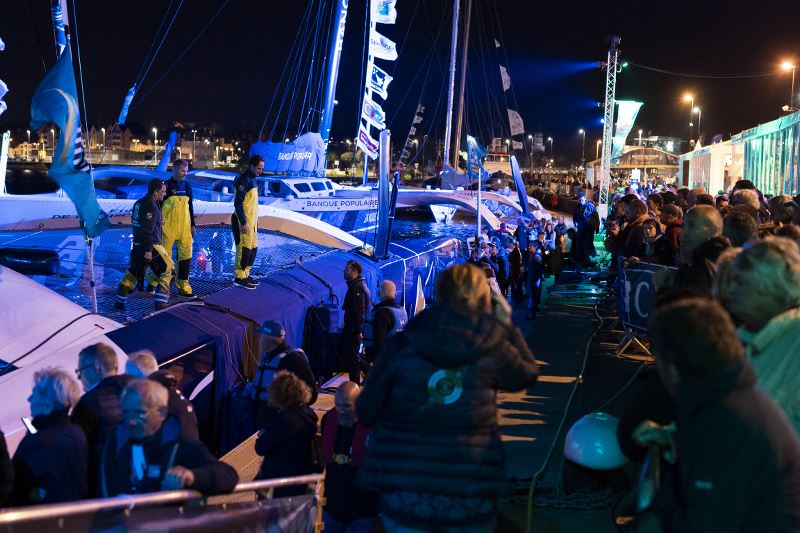
    If all goes to plan, the skipper of the Gitana Team will cast off shortly after 14:00 hours on Friday and immediately take his place in the lock. Accompanied by two other Ultims, the Maxi Edmond de Rothschild should exit the Naye lock an hour to an hour and a half later. However, the succussion of gales announced offshore of the Emerald Coast call for some caution in terms of timings. Given the epic proportions mentioned above, it’s a complex and tricky exercise for the shore teams, who have precious little room for manoeuvre. Indeed, operations will be all the more complicated by the strong NNW’ly winds announced for Friday!   
    The foiling revolution   

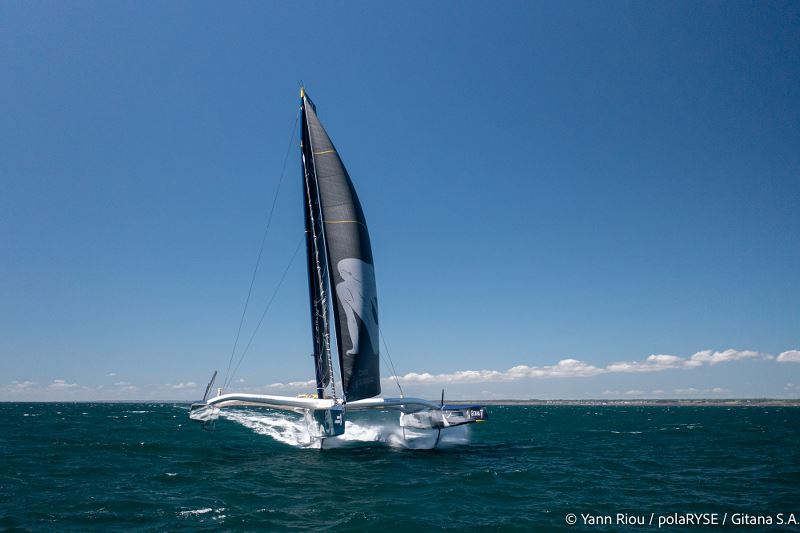
    Upon her launch in 2017, the Maxi Edmond de Rothschild was the first giant of her generation created and built to fly offshore. This pioneering and bold approach required a great deal of brainstorming and raised many questions amongst the competition. Since that time, the Verdier design has gone on to become a reference, and what still seemed to be something only dreams are made of just 5 years ago, is now the par for the course in this exceptional Ultim 32 / 23 class, which boasts the largest sailboats competing in the Route du Rhum – Destination Guadeloupe. Not only are these giants of the seas beautiful jewels of technology, it is the collective intelligence called for in their design and tweaking that fascinates one and all. This Sunday, five of the eight Ultims are set to fly in the open sea, whilst just four years ago there were only three of them… it’s a story that is becoming increasingly intriguing!     

    The keys to understanding

    In a series entitled ‘the keys to understanding’, the members of Gitana Team provide a simple and educational explanation of the technical topics, which are renowned for their complexity. This year, the focus is on the foils, these appendages which have revolutionised offshore racing.     

    Episode 1 takes us back over 160 years to the start of the 1860s, to explore the beginning of foils and their initial uses.     

    Episode 2, offers us a more practical insight into how these foils work in the company of two specialists, naval architect of the Maxi Edmond de Rothschild, Guillaume Verdier, and the director of the Gitana design office, Sébastien Sainson.