








Heritage

Season 26
Types de médias
  • Photos
  • Vidéos
  • Sons
Années
  • 2026
  • 2024
  • 2023
  • 2022
  • 2021
  • 2020
  • 2019
  • 2018
  • 2017
  • 2016
  • 2015
  • 2014
Afficher les résultats (121)
supprimer tous les filtres
  • News
  • Gallery
  • Gitana 18
  • Team
  • Retractable Y-shaped foils, adjustable in three dimensions

    Inspired by the appendages of the America's Cup foiling monohulls, these Y-shaped foils have a wingspan of over 5 metres. They are designed to generate powerful lift, increase power and offer a wide range of adjustments to optimise flight at every point of sail and in all conditions. Beyond their impressive size, these foils feature many unique innovations.

    Revolutionary U-shaped rudders

    These are probably the most visually striking innovations on the new Maxi Edmond de Rothschild. To fly high above rough seas while maintaining control, the team wanted very long rudders that would remain in contact with the water. The challenge is that longer rudders tend to flex under load, severely affecting steering and the efficiency of their lifting surfaces. A new geometry was needed to give these appendages maximum stiffness, resist cavitation and ultimately improve control of the boat and make better use of its power. The result is a set of U-shaped rudders over 4 metres long, a metre longer than those on Gitana 17. Their shape, reminiscent of a tripod or an inverted π, is only the visible part of what makes them so distinctive.

    A daggerboard optimised to stabilise the boat and limit cavitation

    With its wide span, the daggerboard resembles an aircraft tail assembly, with two adjustable flaps: one on the vertical section and the other on the horizontal section, the distinctive “manta-ray wing”. On Gitana 18, the innovation is to position this wing behind the vertical part of the appendage, rather than directly beneath it, to minimise flow disturbance and cavitation.

    Gitana 18’s daggerboard

    Rig: adjustable spreaders to control mainsail power while sailing

    Gitana 18’s mast is 1.50 metres taller than its predecessor’s. The boom is also shorter, creating a more slender sail plan. The major innovation is a set of spreaders that can be adjusted while sailing to bend the mast fore and aft. Actuated by hydraulic rams, these spreaders can pivot through 35 degrees to adjust the bend in the middle of the mast. This unprecedented system allows the sailor to control mainsail power: adding depth in light winds to take off sooner, or flattening the sail to reduce power at high speed or in strong winds. Adjusting the depth, and therefore the power, of the mainsail can also save a solo sailor time and energy by reducing the need for risky manoeuvres or headsail changes.

    Central hull:
    an integrated, structural coachroof

    The naval architects and Gitana design team wanted an exceptionally stiff, structurally robust platform. This applies both to the floats, which must withstand heavy loads from the foils and rudders, and to the central hull, which is subject to torsion. The enclosed coachroof is integrated into the hull and contributes to its structural strength. Inside, the cockpit brings all sail-handling controls together, with ergonomics shaped by many hours of design and development. The coachroof also stands out for the number and size of its windows. This configuration meets the visibility requirements of the Ultim class rules and gives sailors the best possible view to keep a visual watch.

    Gitana 18’s coachroof

    08.11.2021

    A very uncertain introduction to proceedings.

    The first day at sea is now in the wake of the 78 duos out on the racetrack. However, after yesterday’s start at 12:27 UTC, which was as intense as it was spectacular along the white cliffs of Normandy, with a very active first half of the night both on deck and in the skippers’ heads, the wind gods decided to come and test the mettle of the sailor…

    par Gitana

    The first day at sea is now in the wake of the 78 duos out on the racetrack. However, after yesterday’s start at 12:27 UTC, which was as intense as it was spectacular along the white cliffs of Normandy, with a very active first half of the night both on deck and in the skippers’ heads, the wind gods decided to come and test the mettle of the sailors competing in the Transat Jacques Vabre. As forecast, a long ridge of high pressure gatecrashed the course, barring the exit southwards. The men on the Maxi Edmond de Rothschild didn’t escape the blockade alas and have had to spend all day dealing with erratic and highly fluky winds. At the head of the fleet yesterday on leaving the English Channel, Franck Cammas and Charles Caudrelier were bringing up the rear of the Ultime fleet for a while this afternoon, before managing to latch onto a little more pressure to gain a place to the detriment of François Gabart’s SVR – Lazartigue. As the second day of racing kicks off in the Bay of Biscay, uncertainty reigns and patience remains the only possible weapon.
    Blockage in Biscay

    The Ultimes, like their fellow rivals in the other three classes, are racing in slow-mo… After setting off at high speed, the Transat Jacques Vabre fleet was brought to a virtual standstill mid-flight last night. The speeds plummeted leading to some highly original trajectories! In these conditions, the sailors are having to grin and bear it, albeit with a certain frustration rising to the surface: “It’s a right old mess! There are no other words to describe it…” Charles Caudrelier ventured immediately: “Since the start, those behind have been favoured and even though we sailed well to reach Ushant, it didn’t help our cause. Conditions are really complicated and random, but Franck and I know the tune: there’s absolutely no point getting annoyed. It’s only the beginning… the positive from all this is that the Maxi Edmond de Rothschild is in tip-top condition and we’ve seen that she’s quick. As soon as we’re battling side by side with our rivals, things go well”, concluded the sailor.

    To get a better understanding of what’s going on right now off the coast of Brittany, this afternoon we questioned Erwan Israël, one of Gitana 17’s routers, who is taking it in turns to provide 24/7 weather advice with Stan Honey and Chris Bedford from their HQ in Lorient: “The high pressure is stumbling up against the land and has ended up wallowing in the Bay of Biscay as the trains of low-pressure systems are an unusually long way south in the Atlantic for this time of year. As a result, we have no other option than to traverse the ridge of high pressure. The goal is to dip under the eastern limit of the high pressure to link up with steadier breeze and make headway towards Finisterre. Since yesterday, we’ve always had less breeze than announced by our weather forecasts. The upshot of that is that conditions are tiring as it’s stressful for the sailors”, added Erwan, who is as concerned about the weather strategy as he is about what shape the two skippers of the five-arrow maxi-trimaran are in.
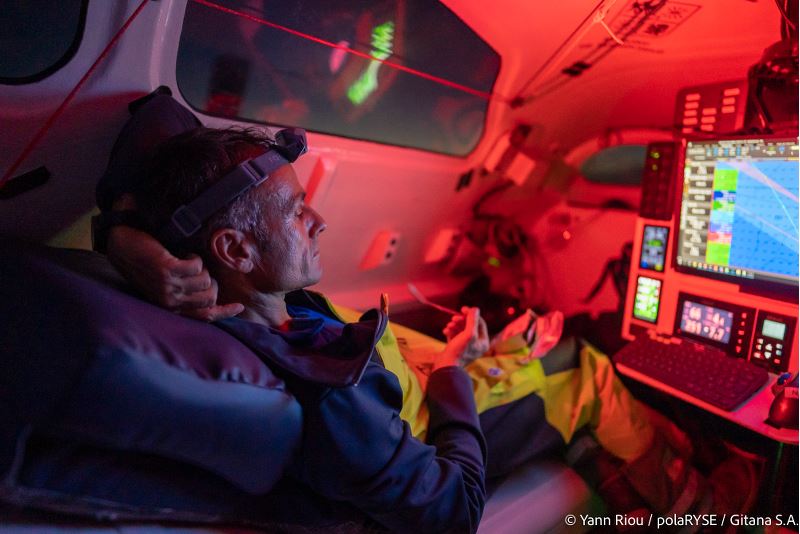
    Contacted by the organisation in the early hours, Franck Cammas discussed the great start they’d had yesterday, as well as the uncertainty that colours the first few hours of racing for the Maxi Edmond de Rothschild and the Transat Jacques Vabre fleet:

    “At the start, we had a fair bit of breeze and chop, but after that we found the right timing and a good speed. Up to Barfleur, things went exactly to plan. There were a fair few tack changes and tactics to get on top of so there was a lot of action. From midway through the night, we came to an abrupt standstill as we tried to punch tide and we even began sliding backwards, so we went into reverse instead. We were with SVR – Lazartigue and Banque Populaire XI. We’re going to try to pass to the north of Ushant and right now we’re attempting to go around it, but we’ve come to a standstill again. As we’re punching hard into the tide, we haven’t managed to really make any headway. This passage across Biscay is uncertain. We’re in erratic winds and we have to traverse a ridge of high pressure, but we’re not moving. We’re going to try to make headway towards Cape Finisterre. We’ve been right on top of our rivals at times. We’ve all crossed tacks at some point! We’re keeping a close eye on them with the AIS.” 

    Positions on Monday 8 November at 17:00 UTC
    1. 1. Banque Populaire XI (A. Le Cléac’h / K. Escoffier)
    2. 2. Actual (Y. Le Blevec / A. Marchand) + 7.1 miles
    3. 3. Sodebo (T. Coville / T.Rouxel)  + 7.9 miles
    4. 4. Maxi Edmond de Rothschild (F. Cammas / C. Caudrelier) + 16.7 miles
    5. 5. SVR Lazartigue (F. Gabart / T. Laperche) + 19.8 miles