








Heritage

Season 26
Types de médias
  • Photos
  • Vidéos
  • Sons
Années
  • 2026
  • 2024
  • 2023
  • 2022
  • 2021
  • 2020
  • 2019
  • 2018
  • 2017
  • 2016
  • 2015
  • 2014
Afficher les résultats (121)
supprimer tous les filtres
  • News
  • Gallery
  • Gitana 18
  • Team
  • Retractable Y-shaped foils, adjustable in three dimensions

    Inspired by the appendages of the America's Cup foiling monohulls, these Y-shaped foils have a wingspan of over 5 metres. They are designed to generate powerful lift, increase power and offer a wide range of adjustments to optimise flight at every point of sail and in all conditions. Beyond their impressive size, these foils feature many unique innovations.

    Revolutionary U-shaped rudders

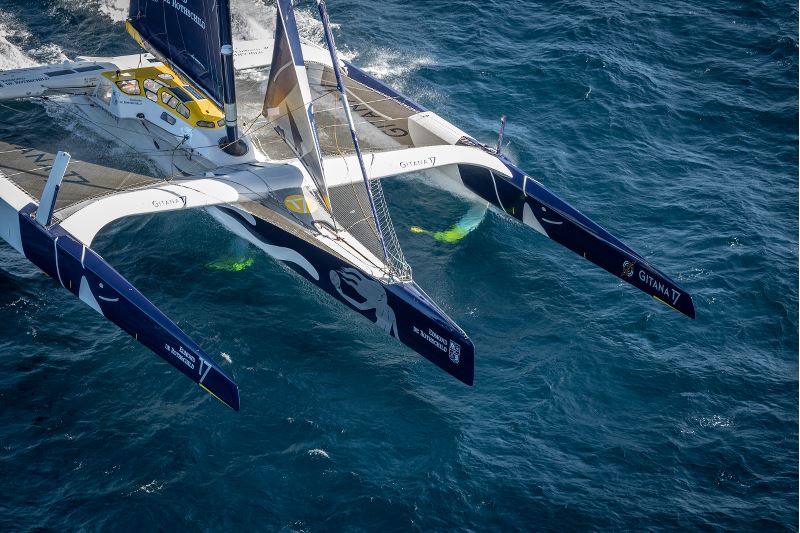
    These are probably the most visually striking innovations on the new Maxi Edmond de Rothschild. To fly high above rough seas while maintaining control, the team wanted very long rudders that would remain in contact with the water. The challenge is that longer rudders tend to flex under load, severely affecting steering and the efficiency of their lifting surfaces. A new geometry was needed to give these appendages maximum stiffness, resist cavitation and ultimately improve control of the boat and make better use of its power. The result is a set of U-shaped rudders over 4 metres long, a metre longer than those on Gitana 17. Their shape, reminiscent of a tripod or an inverted π, is only the visible part of what makes them so distinctive.

    A daggerboard optimised to stabilise the boat and limit cavitation

    With its wide span, the daggerboard resembles an aircraft tail assembly, with two adjustable flaps: one on the vertical section and the other on the horizontal section, the distinctive “manta-ray wing”. On Gitana 18, the innovation is to position this wing behind the vertical part of the appendage, rather than directly beneath it, to minimise flow disturbance and cavitation.

    Gitana 18’s daggerboard

    Rig: adjustable spreaders to control mainsail power while sailing

    Gitana 18’s mast is 1.50 metres taller than its predecessor’s. The boom is also shorter, creating a more slender sail plan. The major innovation is a set of spreaders that can be adjusted while sailing to bend the mast fore and aft. Actuated by hydraulic rams, these spreaders can pivot through 35 degrees to adjust the bend in the middle of the mast. This unprecedented system allows the sailor to control mainsail power: adding depth in light winds to take off sooner, or flattening the sail to reduce power at high speed or in strong winds. Adjusting the depth, and therefore the power, of the mainsail can also save a solo sailor time and energy by reducing the need for risky manoeuvres or headsail changes.

    Central hull:
    an integrated, structural coachroof

    The naval architects and Gitana design team wanted an exceptionally stiff, structurally robust platform. This applies both to the floats, which must withstand heavy loads from the foils and rudders, and to the central hull, which is subject to torsion. The enclosed coachroof is integrated into the hull and contributes to its structural strength. Inside, the cockpit brings all sail-handling controls together, with ergonomics shaped by many hours of design and development. The coachroof also stands out for the number and size of its windows. This configuration meets the visibility requirements of the Ultim class rules and gives sailors the best possible view to keep a visual watch.

    Gitana 18’s coachroof

    15.01.2021

    Navigating the southern hemisphere.

    After setting sail from Ushant on Sunday 10 January at 01:33 UTC on the quest for the Jules Verne Trophy, the crew of the Maxi Edmond de Rothschild crossed the equator this Friday 15 January at 14h48'32'' UTC, after 5 days 13 hours 14 minutes and 46 seconds at sea. Though this first passage time is a far cry from the outright record for this sectio…

    par Gitana

    After setting sail from Ushant on Sunday 10 January at 01:33 UTC on the quest for the Jules Verne Trophy, the crew of the Maxi Edmond de Rothschild crossed the equator this Friday 15 January at 14h48’32” UTC, after 5 days 13 hours 14 minutes and 46 seconds at sea. Though this first passage time is a far cry from the outright record for this section, which has been held since 2019 by Spindrift Racing in a time of 4 days 19 hours 57 minutes, it has nevertheless enabled the sailors of Gitana Team to make the switch into the southern hemisphere with a lead of nearly six hours over the time set by Idec Sport.
    A very sticky doldrums!

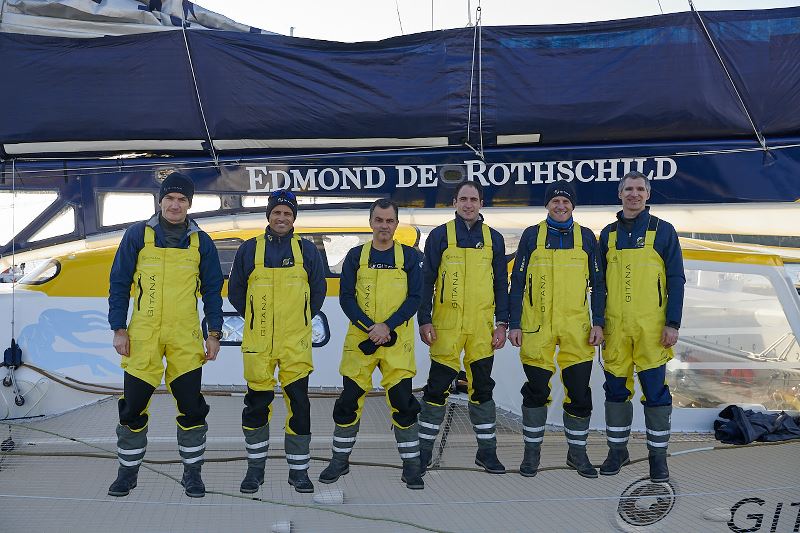
    This symbolic passage between the two hemispheres is certainly a moment for celebration for Franck Cammas, Charles Caudrelier and their four crew (David Boileau, Morgan Lagravière, Erwan Israël and Yann Riou), but above all they are happy to have rediscovered more favourable sailing conditions with which to do their steed justice. Indeed, the doldrums has been tough on the men of the flying maxi-trimaran. Finding herself with her wings clipped due to running out of breeze, the 32-metre giant struggled to extricate herself from the clutches of the infamous intertropical convergence zone. Throughout the course of the day yesterday and the following night, the crew had to simply learn to bide their time as they amassed multiple manoeuvres under a burning hot cuddy in a bid to make the most of the slightest gust and the tiniest cloud. This is evidenced by the navigation statistics from the past 24 hours: a little less than 260 miles covered at a speed of 10.8 knots with a VMG of just 6 knots… It proved to be interminable for a team of sailors striving to secure the round the world record under sail, who like nothing better than high-speed sailing.

    However, aboard the boat, it’s with this philosophy that the crew traversed this zone, as Charles Caudrelier explains: “It wasn’t that hard in the sense that we always managed to keep the boat moving, even if it was extremely slow progress at times… but that enabled us to get some rest, because even though the start of our race wasn’t very violent, we were going fast so it’s never easy to sleep well. Right now, we’ve nicely recharged our batteries, we’ve found our sea legs and we’re right into the action. The last few calmer hours have also enabled us to do a thorough check of the boat, which is good because we won’t have a lot of opportunities to do that further down the track. We’re attacking the southern hemisphere with a boat in fantastic shape and that’s the best news! We’d certainly have liked a better passage time to the equator, it’s always nice to break a record, but with the doldrums you never know how things are going to play out. It wasn’t very wide but it was very painful.”

    Welcome to the South Atlantic

    Franck Cammas, Charles Caudrelier and their four crew launched off on the Jules Verne Trophy with a weather pattern in mind. Indeed, the transition into the South Atlantic contributed a great deal to their choice of weather window and the time they crossed the start line off Ushant. The idea was to get to a point offshore of Brazil when a sufficiently powerful front powering down to the Southern Ocean unleashed itself from the South American continent. And to benefit from better conditions for slipping along, which come with the guarantee of high speeds, you generally need to position yourself in front of this train of low-pressure. This whole sequence is the current target for the crew of the Maxi Edmond de Rothschild and their weather router, Marcel van Triest, if they are to stand a chance of securing a fine passage time to Cape Agulhas, in South Africa: “The time lost in the doldrums will not have a drastic effect since we’re arriving in the south at the right time, just as the models are being corroborated for hooking onto the right weather system. The problem that may be posed now is that we don’t have a lot of leeway. For the next four days, we’ll need to be quick and precise in our trajectory so that we don’t miss the train of low-pressure systems to the south of Rio,” underlined Charles Caudrelier.
    An explanation of the timing

    The lead and deficit, which appear on our cartography, are calculated at each ranking in terms of the distance to the goal. With the Maxi Edmond de Rothschild crossing the equator further over to the west than Idec Sport and hence further from the direct course (great circle route), she lamented a 16.6-mile deficit in relation to her virtual adversary. However, in terms of the actual time between Ushant and the line dividing the two hemispheres, the flying five-arrow maxi-trimaran was faster than that of Francis Joyon and his men. Five days 13 hours 14 minutes and 46 seconds for Gitana 17 compared with 5 days 18 hours and 57 minutes for Idec, which translates as a passage time 5 hours and 44 minutes quicker.

    Jules Verne Trophy Info

    Position of the Maxi Edmond de Rothschild on 15 January at 16h UTC:
    Deficit in relation to the record: 6.9 nm
    Speed: 24.8 knots
    Course: 205°

    Numbers to note:
    – Passage across the line: 10 January 2021 at 01h 33′ 46” UTC
    – Passage of the equator: 15 January 2021 at 14h 48’ 32’’ UTC, in 5 days 13 hours 14 minutes and 46 seconds
    – Passage of the Cape of Good Hope: 21 January 2021 at 11h27’46’’ UTC, in 11 days 9 hours and 53 minutes (new reference time)
    – Passage of Cape Agulhas: 21 January 2021 at 15h37’53’’ UTC, in 11 days 14 hours and 03 minutes (new reference time)

    Crew of the Maxi Edmond de Rothschild:
    Franck Cammas and Charles Caudrelier, skippers
    David Boileau, trimmer bowman
    Erwan Israël, helm trimmer
    Morgan Lagravière, helm trimmer
    Yann Riou, trimmer media man

    Marcel van Triest, weather router
    Yann Eliès, replacement crew

    Record to beat: 
    40 days, 23 hours and 30 minutes > Record held by Francis Joyon and his crew (Idec Sport) since 26 January 2017.