








Heritage

Season 26
Types de médias
  • Photos
  • Vidéos
  • Sons
Années
  • 2026
  • 2024
  • 2023
  • 2022
  • 2021
  • 2020
  • 2019
  • 2018
  • 2017
  • 2016
  • 2015
  • 2014
Afficher les résultats (121)
supprimer tous les filtres
  • News
  • Gallery
  • Gitana 18
  • Team
  • Retractable Y-shaped foils, adjustable in three dimensions

    Inspired by the appendages of the America's Cup foiling monohulls, these Y-shaped foils have a wingspan of over 5 metres. They are designed to generate powerful lift, increase power and offer a wide range of adjustments to optimise flight at every point of sail and in all conditions. Beyond their impressive size, these foils feature many unique innovations.

    Revolutionary U-shaped rudders

    These are probably the most visually striking innovations on the new Maxi Edmond de Rothschild. To fly high above rough seas while maintaining control, the team wanted very long rudders that would remain in contact with the water. The challenge is that longer rudders tend to flex under load, severely affecting steering and the efficiency of their lifting surfaces. A new geometry was needed to give these appendages maximum stiffness, resist cavitation and ultimately improve control of the boat and make better use of its power. The result is a set of U-shaped rudders over 4 metres long, a metre longer than those on Gitana 17. Their shape, reminiscent of a tripod or an inverted π, is only the visible part of what makes them so distinctive.

    A daggerboard optimised to stabilise the boat and limit cavitation

    With its wide span, the daggerboard resembles an aircraft tail assembly, with two adjustable flaps: one on the vertical section and the other on the horizontal section, the distinctive “manta-ray wing”. On Gitana 18, the innovation is to position this wing behind the vertical part of the appendage, rather than directly beneath it, to minimise flow disturbance and cavitation.

    Gitana 18’s daggerboard

    Rig: adjustable spreaders to control mainsail power while sailing

    Gitana 18’s mast is 1.50 metres taller than its predecessor’s. The boom is also shorter, creating a more slender sail plan. The major innovation is a set of spreaders that can be adjusted while sailing to bend the mast fore and aft. Actuated by hydraulic rams, these spreaders can pivot through 35 degrees to adjust the bend in the middle of the mast. This unprecedented system allows the sailor to control mainsail power: adding depth in light winds to take off sooner, or flattening the sail to reduce power at high speed or in strong winds. Adjusting the depth, and therefore the power, of the mainsail can also save a solo sailor time and energy by reducing the need for risky manoeuvres or headsail changes.

    Central hull:
    an integrated, structural coachroof

    The naval architects and Gitana design team wanted an exceptionally stiff, structurally robust platform. This applies both to the floats, which must withstand heavy loads from the foils and rudders, and to the central hull, which is subject to torsion. The enclosed coachroof is integrated into the hull and contributes to its structural strength. Inside, the cockpit brings all sail-handling controls together, with ergonomics shaped by many hours of design and development. The coachroof also stands out for the number and size of its windows. This configuration meets the visibility requirements of the Ultim class rules and gives sailors the best possible view to keep a visual watch.

    Gitana 18’s coachroof

    26.11.2020

    Settling into life in the fast track!.

    Since Tuesday evening, at 20:37 UTC on the dot, and their departure from the dock in Lorient to make for the start line off the north-west tip of Brittany, the pace has continued to pick up for the men of the Maxi Edmond de Rothschild. At 02:26 UTC, on Wednesday 25 November, on a pitch-black autumn night on the back of a rainy front, the 32-metres…

    par Gitana

    Since Tuesday evening, at 20:37 UTC on the dot, and their departure from the dock in Lorient to make for the start line off the north-west tip of Brittany, the pace has continued to pick up for the men of the Maxi Edmond de Rothschild. At 02:26 UTC, on Wednesday 25 November, on a pitch-black autumn night on the back of a rainy front, the 32-metres giant crossed the virtual line stretching between Ushant and Lizard Point, the southernmost tip of England, thus triggering the stopwatch for its first Jules Verne Trophy attempt. Since that time, Franck Cammas, Charles Caudrelier and their four crew have already covered over 1000 miles in relation to the goal. This morning, they passed the latitude of the Azores and will this evening pass that of Madeira… The pace is quick, very quick, but of course that is the aim of a speed record. At the 14:30 UTC position report, the crew boasted a lead of 71.6 miles in relation to the record held by Francis Joyon and Idec Sport.

    A corridor southwards

    By setting sail from Ushant in the early hours of Wednesday morning, the Maxi Edmond de Rothschild’s weather cell, comprising the two skippers and their router Marcel van Triest, were targeting a vein of quite clean air, synonymous with high speeds along a virtually straight-line course towards the trade wind of the northern hemisphere and then on to the equator. However, this fine trajectory involves quite a work-up and aboard the latest addition to the Gitana fleet, the crew has had to quickly throw themselves in at the deep end.

    In fact, during the passage of over 30 hours, the six sailors have had to put in two gybes to stay inside this corridor of breeze, with the emphasis on a number of headsail changes in a constant bid to adjust their trajectory to face the conditions, which Charles Caudrelier described yesterday morning as shifty: “The first night was lively and intense! The wind was very shifty and though the seas weren’t very high, they were very messy and we spent our first night under autopilot as it was impossible to hand steer.” Last night, whilst Gitana 17 was beginning her second day of the record attempt, the wind and the seas picked up considerably offshore of the Iberian peninsula with “4.5 to 5-metre waves and a powerful 25-30-knot NNE’ly breeze gusting up to 40 knots.”  Suffice to say that being constantly powered up at over 30 knots is proving to be a bracing introduction for the sailors of Gitana Team.


    The latest generation maxi-trimarans, of which the Maxi Edmond de Rothschild is the pioneer, are sending the speedos into turmoil at the start of this record. The 2019 edition of the Brest Atlantiques gave us a chance to witness this in action, with a blistering pace from the get-go and an express exit from the Bay of Biscay despite the boisterous conditions. A year on, history is repeating itself and the intensity of the start of this Jules Verne Trophy is certainly living up to expectations. At 13:45 UTC, the Cammas – Caudrelier pairing and their crew had devoured over 1,200 miles over the ground at an average speed of 35 knots!
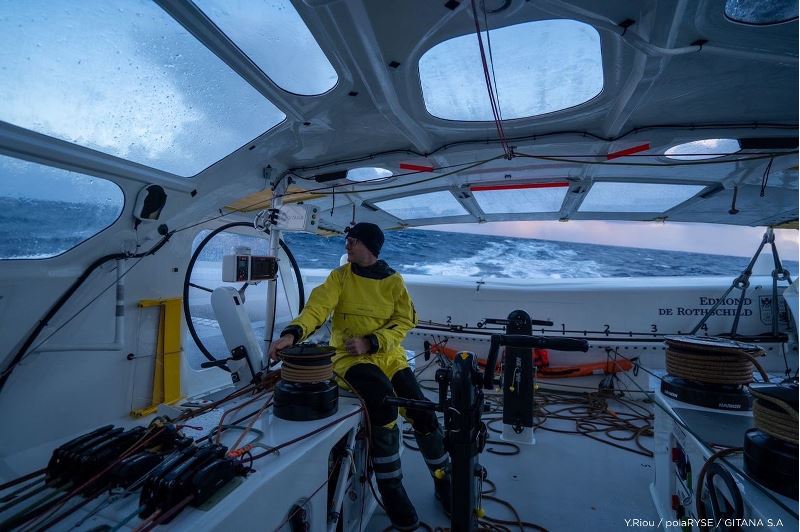
    A record attempt albeit with some semblance of a duel

    “The writing of one of the legendary pages of this Jules Verne Trophy began last night”, stated Yann Eliès yesterday, during the live broadcast filmed at the Gitana Team’s base. 


    Indeed, it won’t have escaped anyone that not one but two boats set sail from the foot of Le Créac’h lighthouse in the early hours of Wednesday. Sodebo set off at 01:55 UTC and the Maxi Edmond de Rothschild followed in her wake 31 minutes later at 02:26 UTC. 

    These virtually simultaneous starts may be reminiscent of a race set-up, but there’s one key point to remember: the two giants are on the hunt for the record set by Francis Joyon and hence it is a race against the clock to better the time set by Idec Sport in 2017. However, it would be an untruth not to mention the adversary and the mano a mano currently playing out in the descent of the Atlantic.


    “Setting sail as two boats? The idea of setting sail at the same time as Sodebo was very much on our minds since Thomas Coville team was on standby at the same time as us. From the outset, the prospect of two boats setting off was quite appealing. It’s a chance to emulate one another, added motivation! And in terms of safety it’s good too,” admitted Franck Cammas prior to the start.
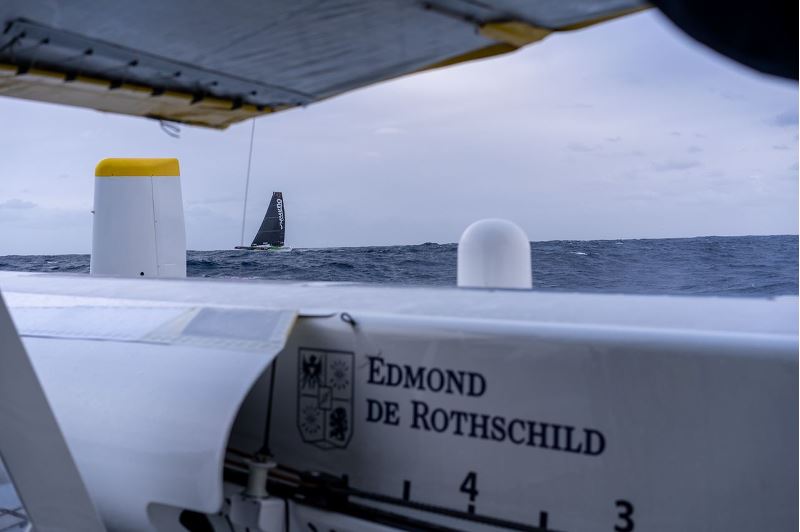
    The crew of the Maxi Edmond de Rothschild:

    Franck Cammas and Charles Caudrelier, skippers
    David Boileau, trimmer bowmanErwan Israël, helm trimmer
    Morgan Lagravière, helm trimmer
    Yann Riou, trimmer mediaman

    Marcel van Triest, weather router
    Yann Eliès, replacement crew