








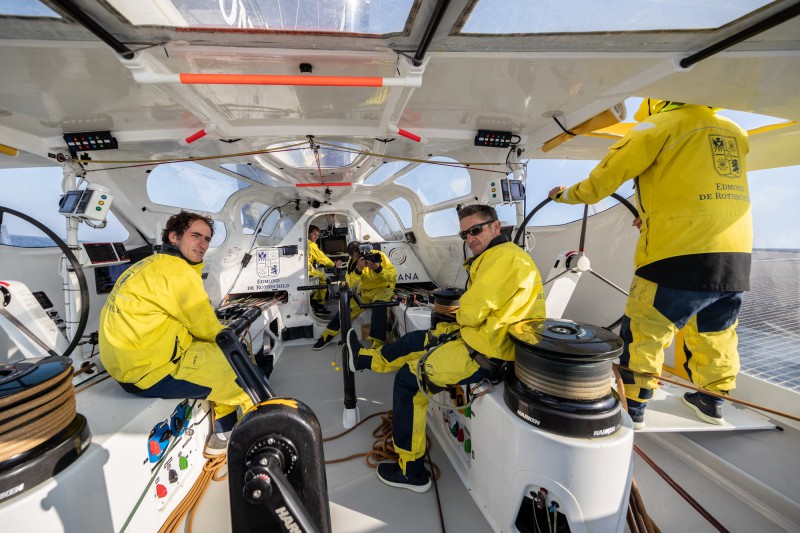
On their arrival within the Gitana Team in April 2019, Charles Caudrelier and Franck Cammas had a chance to familiarise themselves with the five-year programme put together by the team and its operators. The crew for the circumnavigation of the planet, whether it be for a record or a race, was fairly central to this plan. It is with these sporting challenges in sight then, that they very quickly put together their sailing programme and welcomed aboard those sailors who had been sounded out for a series of preparatory races like their victorious Rolex Fastnet Race in August 2019. In fact, this involvement in the run-up to the Trophy seemed to the two skippers to be key in the quest to understand how the boat flies and gain their automatic reflexes aboard a machine like the Maxi Edmond de Rothschild.
“Six! The number came about quite naturally without any real discussion between Franck and I. In 2010, in the Route du Rhum, Franck showed that a single man could cross the Atlantic on a maxi-trimaran and in 2017 Francis Joyon drove the point home with a crew of six in the Jules Verne. With regards to Gitana, the Brest Atlantiques and its double-handed format accompanied by a media man definitively confirmed our choice. Of the six men aboard, four of us have done a lot of sailing together and for very long periods since Franck, Yann, Erwan and I have shared a Volvo Ocean Race together. We know, respect and trust one another. That seems important to me when you’re heading down to the Deep South. To have David alongside us is a great strength. He knows how to do everything aboard and on the scale of a round the world his technical know-how will be a precious asset. And then of course there’s Morgan, who notably brings his great talent to the helm and his incredible feel for slipping along, but that’s not all”, admits Charles Caudrelier, as he explains the criteria which guided their choices.
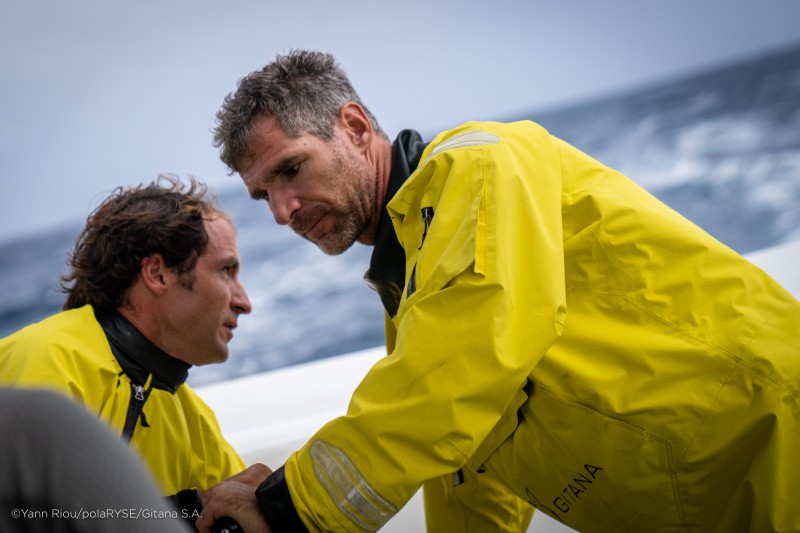
Erwan Israël confirmed
In late June, Erwan Israël suffered a torn posterior cruciate ligament on his left knee following an accident in training aboard one of the new flying catamarans from Lake Geneva. This injury, which required many long weeks of immobilisation and still needs some physiotherapy, upset the initial plans made by the skippers of the Maxi Edmond de Rothschild.
“I’ve had a lot of doubts over the past three months, because I really couldn’t see any improvement in the first few weeks and there were no positive signs that indicated it was healing. However, my patience paid off and in early September I learned that an operation will not be necessary. At that point, I was able to start intensive physiotheraphy – every afternoon, 5 days a week, to ensure I’m 100% fit for early November”, explained Erwan. “I’m very proud to be able to join the crew led by Franck and Charles and to be part of a team like Gitana. It’s a team I’ve really enjoyed getting to know. They’ve built and fine-tuned an incredible machine with a great deal of daring and innovation. The Maxi Edmond de Rothschild is the most accomplished Ultime today and I’m very happy to be part of her first round the world challenge.”
A crew under the lens
Round the world experience, a talent for helming at very high speeds with technical knowledge of the craft could well sum up the criteria set out by Franck Cammas and Charles Caudrelier in putting together the crew on the Maxi Edmond de Rothschild. However, the two men were also looking for varied profiles able to live together for 40 days in the discomfort and adrenalin associated with performance.
“Sailing, and I think it’s even more the case on a round the world, is not just about performance, it’s an adventure with a large human dimension,” explains Charles Caudrelier. This is a view shared by Franck Cammas, who goes into this point in more detail: “We’re tackling a record that is very tough to beat! The higher the performance the more it becomes a story about the human and the adventure. We’re all going to have to really push the envelope given the intensity of a record like the Jules Verne Trophy.”
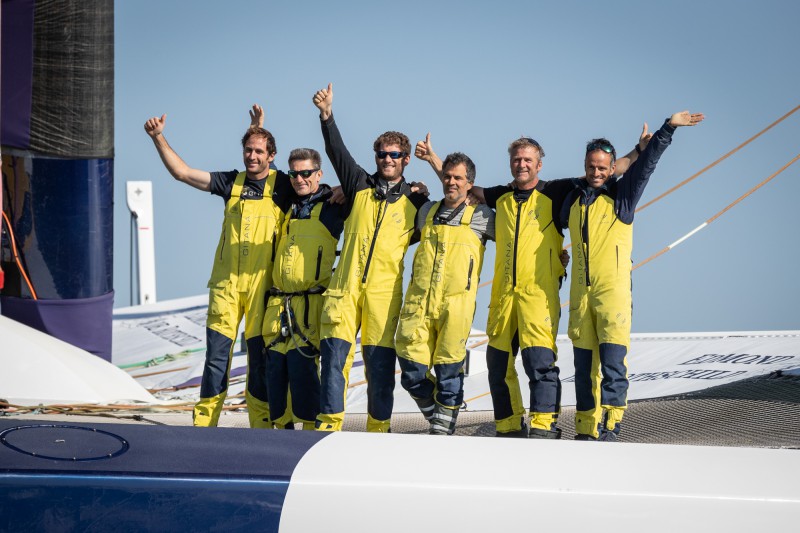
A few figures
Six on-board sailors, one replacement, one router nicknamed the 7th man and all the team supporting them.
“Some very fine helmsmen, navigators, trimmers and technicians… the richness of the profiles we have aboard the Maxi Edmond de Rothschild is necessary, essential even, on Jules Verne Trophy boats ” explains one of the two skippers.
Franck Cammas
Role: skipper
2 round the worlds, including 1 victorious Volvo Ocean Race and 1 Jules Verne Trophy (48 days in 2010)
Charles Caudrelier
Role: skipper
3 round the worlds, including 2 victorious Volvo Ocean Race (2012 and 2018)
Yann Riou
Role: trimmer, media man
3 round the worlds, including 1 victorious Volvo Ocean Race (2012) and 1 Jules Verne Trophy attempt (47 days in 2016)
Erwan Israël
Role: helmsman, trimmer
2 round the worlds, including 1 victorious Volvo Ocean Race (2012) and 1 Jules Verne Trophy attempt (47 days in 2016)
Morgan Lagravière
Role: helmsman, trimmer
Jules Verne Trophy rookie, 1 participation in the Vendée Globe 2016
David Boileau
Role: trimmer, bowman
Jules Verne Trophy rookie, 1 passage around the Cape of Good Hope and Cape Horn against the winds and currents (Tea Route and Route de l’Or record on Gitana 13 in 2008
Yann Eliès
Role: replacement crew
3 round the worlds, including 2 Jules Verne Trophies (2002 and 2005)and 1 Vendée Globe (2016)
Marcel van Triest
Role: weather router, the ‘7th man’
5 Jules Verne Trophy attempts, including 2 rewarded with a record (2012 and 2017)