








Heritage

Season 26
Types de médias
  • Photos
  • Vidéos
  • Sons
Années
  • 2026
  • 2024
  • 2023
  • 2022
  • 2021
  • 2020
  • 2019
  • 2018
  • 2017
  • 2016
  • 2015
  • 2014
Afficher les résultats (121)
supprimer tous les filtres
  • News
  • Gallery
  • Gitana 18
  • Team
  • Retractable Y-shaped foils, adjustable in three dimensions

    Inspired by the appendages of the America's Cup foiling monohulls, these Y-shaped foils have a wingspan of over 5 metres. They are designed to generate powerful lift, increase power and offer a wide range of adjustments to optimise flight at every point of sail and in all conditions. Beyond their impressive size, these foils feature many unique innovations.

    Revolutionary U-shaped rudders

    These are probably the most visually striking innovations on the new Maxi Edmond de Rothschild. To fly high above rough seas while maintaining control, the team wanted very long rudders that would remain in contact with the water. The challenge is that longer rudders tend to flex under load, severely affecting steering and the efficiency of their lifting surfaces. A new geometry was needed to give these appendages maximum stiffness, resist cavitation and ultimately improve control of the boat and make better use of its power. The result is a set of U-shaped rudders over 4 metres long, a metre longer than those on Gitana 17. Their shape, reminiscent of a tripod or an inverted π, is only the visible part of what makes them so distinctive.

    A daggerboard optimised to stabilise the boat and limit cavitation

    With its wide span, the daggerboard resembles an aircraft tail assembly, with two adjustable flaps: one on the vertical section and the other on the horizontal section, the distinctive “manta-ray wing”. On Gitana 18, the innovation is to position this wing behind the vertical part of the appendage, rather than directly beneath it, to minimise flow disturbance and cavitation.

    Gitana 18’s daggerboard

    Rig: adjustable spreaders to control mainsail power while sailing

    Gitana 18’s mast is 1.50 metres taller than its predecessor’s. The boom is also shorter, creating a more slender sail plan. The major innovation is a set of spreaders that can be adjusted while sailing to bend the mast fore and aft. Actuated by hydraulic rams, these spreaders can pivot through 35 degrees to adjust the bend in the middle of the mast. This unprecedented system allows the sailor to control mainsail power: adding depth in light winds to take off sooner, or flattening the sail to reduce power at high speed or in strong winds. Adjusting the depth, and therefore the power, of the mainsail can also save a solo sailor time and energy by reducing the need for risky manoeuvres or headsail changes.

    Central hull:
    an integrated, structural coachroof

    The naval architects and Gitana design team wanted an exceptionally stiff, structurally robust platform. This applies both to the floats, which must withstand heavy loads from the foils and rudders, and to the central hull, which is subject to torsion. The enclosed coachroof is integrated into the hull and contributes to its structural strength. Inside, the cockpit brings all sail-handling controls together, with ergonomics shaped by many hours of design and development. The coachroof also stands out for the number and size of its windows. This configuration meets the visibility requirements of the Ultim class rules and gives sailors the best possible view to keep a visual watch.

    Gitana 18’s coachroof

    02.12.2019

    Under the 1,000-mile barrier!.

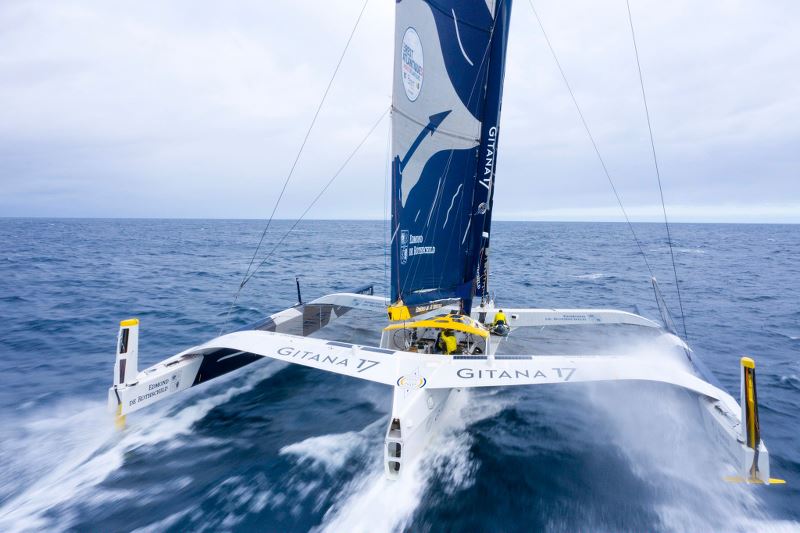
    This morning, Franck Cammas and Charles Caudrelier, the solid leaders of the Brest Atlantiques, treated themselves to a passage through the Azores archipelago. However, making over thirty knots and in the pitch black, it wasn’t quite what you’d call tourism for the duo on the Maxi Edmond de Rothschild. At 15:00 UTC this Monday 2 December, the giant…

    par Gitana

    This morning, Franck Cammas and Charles Caudrelier, the solid leaders of the Brest Atlantiques, treated themselves to a passage through the Azores archipelago. However, making over thirty knots and in the pitch black, it wasn’t quite what you’d call tourism for the duo on the Maxi Edmond de Rothschild. At 15:00 UTC this Monday 2 December, the giant with five arrows was less than 1,000 miles from the finish, 920 miles from the goal to be precise. She is now closer to Brest than she is to her two pursuers who are relegated to nearly 1,300 miles behind. The numbers are stacked in their favour, however the sailors of Gitana Team are much too experienced to consider blowing the whistle to call time. Indeed, they know that these last few miles are among the most important. On top of that, since this morning they’ve been on a reach in a beefy S’ly breeze making headway at speeds fluctuating between 30 and 40 knots; conditions which call for a great deal of vigilance at the helm and on deck. If the forecasts play out as planned, the maxi-trimaran fitted out by Ariane and Benjamin de Rothschild could well make her entrance into Brest harbour by Wednesday morning at the latest.
    Foulies back in favour on deck

    This morning, the Maxi Edmond de Rothschild was threading her way between the Azores archipelago at over 30 knots between the islands of Terceira and Sao Miguel. Targeted for several days by their weather router, this waypoint heralded the start of a fairly lively but efficient reach (wind on the beam) in terms of velocity made good towards the goal! “We’ve managed to hook onto the right carriage and we’re currently sailing ahead of a front that’s crossing the Atlantic. This front is enabling us to make rapid headway with a S’ly wind of 18-24 knots. We’re going to be able to keep ahead of it but right now there’s a zone of high pressure to the west of Europe, centred over the Scillies, and we’re going to end up stumbling into these light airs. As a result, Franck and Charles will experience an abrupt change of gear as they approach the coast with a wind that will very quickly switch from the south to the east”, explained Marcel van Triest.

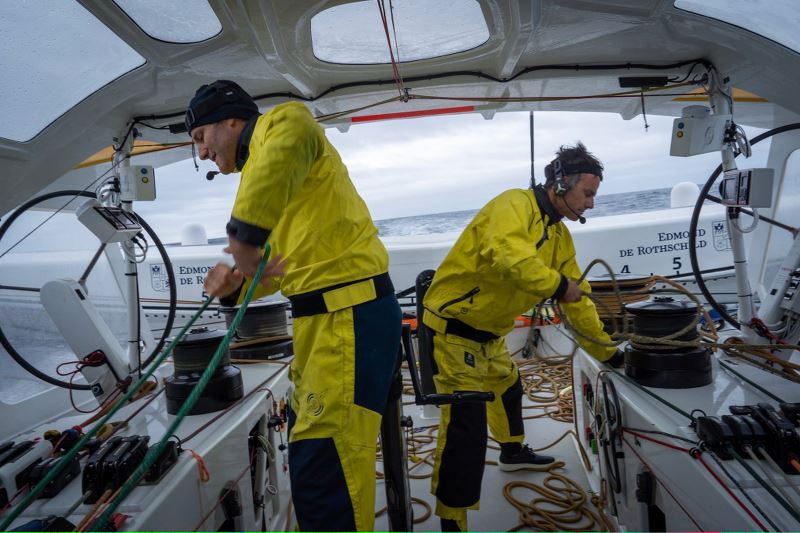
    Aboard the latest Gitana, the passage between the islands that make up the Portuguese archipelago also marked a change of atmosphere: “This morning I pulled on my foulies for the first time since Cape Town. It’s also the first time since the southern latitudes that we’ve been sailing in a depression, or ahead of a front at least. We’ve circumnavigated a lot of anticyclones of late… We passed the Azores in the early hours. It’s not too cold yet, but you can sense that we’re entering the European winter. The sea hasn’t been very smooth since we passed the Azores. We’re not going to go on the attack because we want to preserve the boat and above all we now have a very comfortable lead over our pursuers to make that feasible for us”, explained Charles Caudrelier.
    ETA, place your bets!

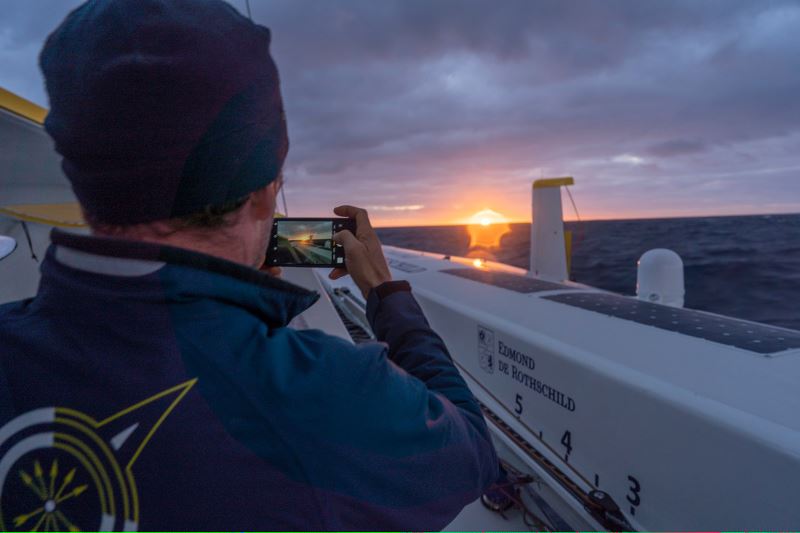
    According to the latest routing, the Maxi Edmond de Rothschild should be able to cross the finish line, which runs diagonally between the signal station on the Saint-Mathieu headland and that of the Toulinguet headland, on the Crozon peninsula side, by Wednesday morning at the latest. Indeed, as explained by the router for the Cammas / Caudrelier duo, the end of the race should be played out in light airs generated by the anticyclone located to the west of Europe. So although we’ll have to wait a little longer to find out the exact time, one thing for sure this evening is that the sun should be out to welcome them home but essentially it’s the cold air from the north-east that will punctuate the finish of this 1st edition of the Brest Atlantiques.
       

    Ranking on 2 December 2019 at 15:00 UTC

    1. MAXI EDMOND DE ROTHSCHILD (Franck Cammas / Charles Caudrelier / Yann Riou) – distance to the goal: 920.9 miles – average speed over the past 30 mins: 33.5 knots

    2. MACIF (François Gabart / Gwenolé Gahinet / Jérémie Eloy) – 1,282.5 miles behind the leader – average speed over the past 30 mins: 13.6 knots

    3. ACTUAL LEADER (Yves Le Blevec / Alex Pella / Ronan Gladu) – 1,328.5 miles behind the leader – average speed over the past 30 mins: 17.2 knots

    RETIREMENT – SODEBO ULTIM 3 (Thomas Coville / Jean-Luc Nelias / Martin Keruzoré)