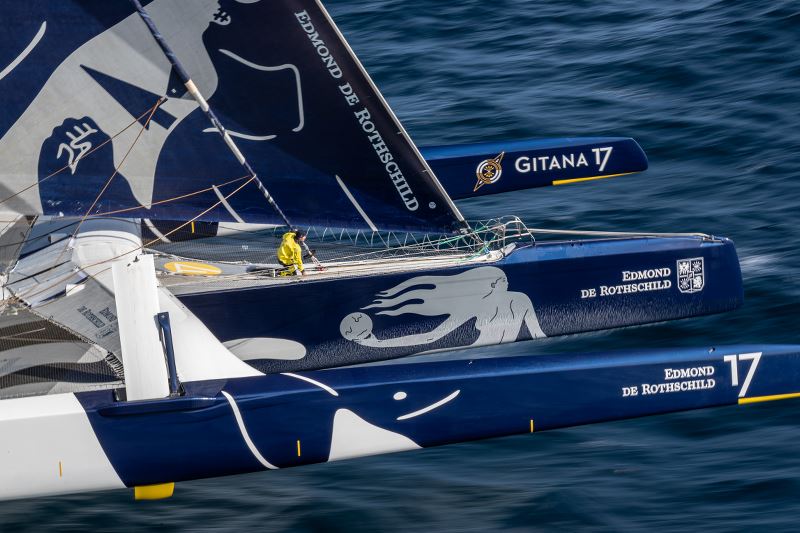
Heritage

Season 26
Types de médias
  • Photos
  • Vidéos
  • Sons
Années
  • 2026
  • 2024
  • 2023
  • 2022
  • 2021
  • 2020
  • 2019
  • 2018
  • 2017
  • 2016
  • 2015
  • 2014
Afficher les résultats (121)
supprimer tous les filtres
  • News
  • Gallery
  • Gitana 18
  • Team
  • Retractable Y-shaped foils, adjustable in three dimensions

    Inspired by the appendages of the America's Cup foiling monohulls, these Y-shaped foils have a wingspan of over 5 metres. They are designed to generate powerful lift, increase power and offer a wide range of adjustments to optimise flight at every point of sail and in all conditions. Beyond their impressive size, these foils feature many unique innovations.

    Revolutionary U-shaped rudders

    These are probably the most visually striking innovations on the new Maxi Edmond de Rothschild. To fly high above rough seas while maintaining control, the team wanted very long rudders that would remain in contact with the water. The challenge is that longer rudders tend to flex under load, severely affecting steering and the efficiency of their lifting surfaces. A new geometry was needed to give these appendages maximum stiffness, resist cavitation and ultimately improve control of the boat and make better use of its power. The result is a set of U-shaped rudders over 4 metres long, a metre longer than those on Gitana 17. Their shape, reminiscent of a tripod or an inverted π, is only the visible part of what makes them so distinctive.

    A daggerboard optimised to stabilise the boat and limit cavitation

    With its wide span, the daggerboard resembles an aircraft tail assembly, with two adjustable flaps: one on the vertical section and the other on the horizontal section, the distinctive “manta-ray wing”. On Gitana 18, the innovation is to position this wing behind the vertical part of the appendage, rather than directly beneath it, to minimise flow disturbance and cavitation.

    Gitana 18’s daggerboard

    Rig: adjustable spreaders to control mainsail power while sailing

    Gitana 18’s mast is 1.50 metres taller than its predecessor’s. The boom is also shorter, creating a more slender sail plan. The major innovation is a set of spreaders that can be adjusted while sailing to bend the mast fore and aft. Actuated by hydraulic rams, these spreaders can pivot through 35 degrees to adjust the bend in the middle of the mast. This unprecedented system allows the sailor to control mainsail power: adding depth in light winds to take off sooner, or flattening the sail to reduce power at high speed or in strong winds. Adjusting the depth, and therefore the power, of the mainsail can also save a solo sailor time and energy by reducing the need for risky manoeuvres or headsail changes.

    Central hull:
    an integrated, structural coachroof

    The naval architects and Gitana design team wanted an exceptionally stiff, structurally robust platform. This applies both to the floats, which must withstand heavy loads from the foils and rudders, and to the central hull, which is subject to torsion. The enclosed coachroof is integrated into the hull and contributes to its structural strength. Inside, the cockpit brings all sail-handling controls together, with ergonomics shaped by many hours of design and development. The coachroof also stands out for the number and size of its windows. This configuration meets the visibility requirements of the Ultim class rules and gives sailors the best possible view to keep a visual watch.

    Gitana 18’s coachroof

    07.10.2019

    Targeting aerodynamics.

    On 16 September 2019, the Maxi Edmond de Rothschild was relaunched after a few days on land for an express refit. On exiting the yard, one new feature didn’t go unnoticed; indeed a fairing had put in an appearance on the aft beam of the 32-metre giant. This canvas structure spanning 32m2, an introduction that had always been part of the design penn…

    par Gitana

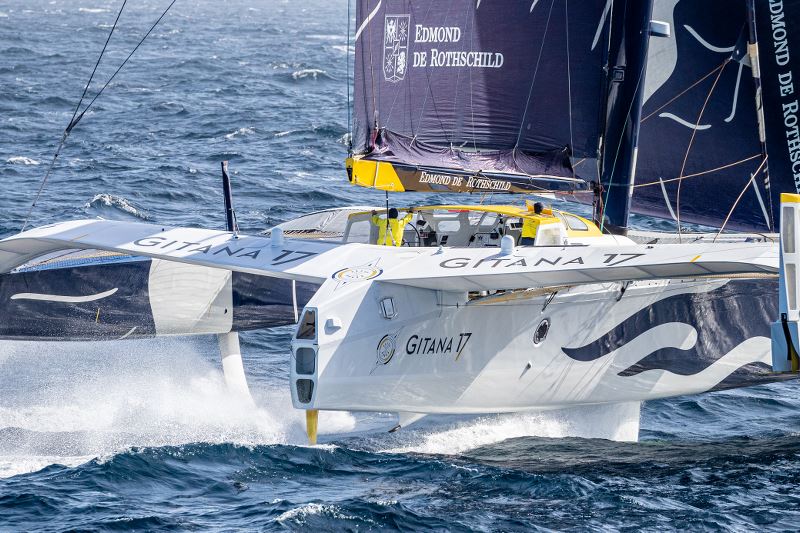
    On 16 September 2019, the Maxi Edmond de Rothschild was relaunched after a few days on land for an express refit. On exiting the yard, one new feature didn’t go unnoticed; indeed a fairing had put in an appearance on the aft beam of the 32-metre giant. This canvas structure spanning 32m2, an introduction that had always been part of the design penned by the naval architect Guillaume Verdier, is a first for an offshore racing boat of this kind. Beyond the highly successful aesthetic value, this innovation is the new hallmark of the pioneering spirit that drives the Gitana Team in its quest for performance.


    It’s a fairing located on the aft section of the aft beam which adds the finishing touch to the beam profile in the same way as a plane wing. This fairing was made of Oratex, which is a flexible canvas the likes of which you find on the wings of a glider or microlight. The aim of this addition is to reduce the drag, by pulling the flow of air tightly around it, and consequently to gain both speed and performance.
    “Over recent years it’s become standard to have a fairing on the forward beam, which is supported by the trampoline. However, it’s fair to say that it was a first on the aft beam. Furthermore, the gain is at least as significant as you can get on the forward beam,” explained Franck Cammas.
    Put to the test offshore and in the open ocean

    “Ultimately, the major work on the fairing consisted of finding the right balance between structure and weight, so as to make it hard-wearing. Our specifications were that it has to be capable of doing a round the world,” explained Sébastien Sainson, head of Gitana’s design office.

    In fact, this type of fairing has become common practice on the America’s Cup boats, but it’s the first time that an offshore racing team has put in place a structure of this kind on a boat dedicated to the open ocean: “Godzilla, the multihull with which the Americans from Oracle won the Cup in Valencia, was the first to brave this new development. After that, all the AC 72s and more recently the F50s in the last Cup were equipped with them. In our case, it’s more the implementation and the realisation which prompted studies, because contrary to the America’s Cup boats, we cannot allow ourselves to dismantle or redo the system every evening. As a result, our challenge centred on solidity as we needed to come up with a structure capable of withstanding days and days of sailing at high speed. The timing seemed right to us, especially as the addition of this fairing has no impact on the reliability of the Maxi. If it were to be damaged at sea, that would of course be regrettable, but it would have no influence on the intrinsic performance of the boat.”

    Reduction of drag, gain in performance

    For over two years, the Gitana Team has been breaking new ground with the Maxi Edmond de Rothschild and clearing the way forward for the still little-known technical aspects related to flight in the open ocean and high speed. Though the tests and simulations are initially digital, nothing will ever replace the reality of sailing offshore and the elements for checking and backing up the studies. In this way, the coming weeks of sailing and in particular the Brest Atlantiques and its 14,000 mile course, will provide us with a definitive validation of the pertinence of this innovation in terms of gains.

    “Theoretically, this aft beam fairing is a real plus for the boat, particularly as it considerably reduces the drag. Studies show that there are significant gains and now we’re in the process of finding out if that’s actually the case! Above all, we’re observing how the Maxi Edmond de Rothschild handles because often on a computer there are no waves, gusts or unexpected heeling… What we can say from our initial observations is that this new feature changes the boat’s attitude, making it a little more spirited, a bit more flighty. We need to see how it holds up in boisterous conditions and over the long term, before we can draw a proper conclusion regarding performance,” admitted Charles Caudrelier.