








Heritage

Season 26
Types de médias
  • Photos
  • Vidéos
  • Sons
Années
  • 2026
  • 2024
  • 2023
  • 2022
  • 2021
  • 2020
  • 2019
  • 2018
  • 2017
  • 2016
  • 2015
  • 2014
Afficher les résultats (121)
supprimer tous les filtres
  • News
  • Gallery
  • Gitana 18
  • Team
  • Retractable Y-shaped foils, adjustable in three dimensions

    Inspired by the appendages of the America's Cup foiling monohulls, these Y-shaped foils have a wingspan of over 5 metres. They are designed to generate powerful lift, increase power and offer a wide range of adjustments to optimise flight at every point of sail and in all conditions. Beyond their impressive size, these foils feature many unique innovations.

    Revolutionary U-shaped rudders

    These are probably the most visually striking innovations on the new Maxi Edmond de Rothschild. To fly high above rough seas while maintaining control, the team wanted very long rudders that would remain in contact with the water. The challenge is that longer rudders tend to flex under load, severely affecting steering and the efficiency of their lifting surfaces. A new geometry was needed to give these appendages maximum stiffness, resist cavitation and ultimately improve control of the boat and make better use of its power. The result is a set of U-shaped rudders over 4 metres long, a metre longer than those on Gitana 17. Their shape, reminiscent of a tripod or an inverted π, is only the visible part of what makes them so distinctive.

    A daggerboard optimised to stabilise the boat and limit cavitation

    With its wide span, the daggerboard resembles an aircraft tail assembly, with two adjustable flaps: one on the vertical section and the other on the horizontal section, the distinctive “manta-ray wing”. On Gitana 18, the innovation is to position this wing behind the vertical part of the appendage, rather than directly beneath it, to minimise flow disturbance and cavitation.

    Gitana 18’s daggerboard

    Rig: adjustable spreaders to control mainsail power while sailing

    Gitana 18’s mast is 1.50 metres taller than its predecessor’s. The boom is also shorter, creating a more slender sail plan. The major innovation is a set of spreaders that can be adjusted while sailing to bend the mast fore and aft. Actuated by hydraulic rams, these spreaders can pivot through 35 degrees to adjust the bend in the middle of the mast. This unprecedented system allows the sailor to control mainsail power: adding depth in light winds to take off sooner, or flattening the sail to reduce power at high speed or in strong winds. Adjusting the depth, and therefore the power, of the mainsail can also save a solo sailor time and energy by reducing the need for risky manoeuvres or headsail changes.

    Central hull:
    an integrated, structural coachroof

    The naval architects and Gitana design team wanted an exceptionally stiff, structurally robust platform. This applies both to the floats, which must withstand heavy loads from the foils and rudders, and to the central hull, which is subject to torsion. The enclosed coachroof is integrated into the hull and contributes to its structural strength. Inside, the cockpit brings all sail-handling controls together, with ergonomics shaped by many hours of design and development. The coachroof also stands out for the number and size of its windows. This configuration meets the visibility requirements of the Ultim class rules and gives sailors the best possible view to keep a visual watch.

    Gitana 18’s coachroof

    03.11.2018

    Diving between two worlds.

    The one hundred and twenty-three solo sailors competing in the Route du Rhum - Destination Guadeloupe are experiencing their final day on land prior to the big day of the start tomorrow, Sunday 4 November, at 13:00 GMT offshore of Saint Malo. These last few moments always have a special flavour for these men and women preparing to set sail across t…

    par Gitana

    The one hundred and twenty-three solo sailors competing in the Route du Rhum – Destination Guadeloupe are experiencing their final day on land prior to the big day of the start tomorrow, Sunday 4 November, at 13:00 GMT offshore of Saint Malo. These last few moments always have a special flavour for these men and women preparing to set sail across the North Atlantic along a racetrack stretching over 3,500 miles. This course will see the smallest classes hook up with the Antilles arc in a few weeks’ time, while Sébastien Josse will likely take just a matter of days aboard the Maxi Edmond de Rothschild; the weather forecasts indicate the possibility of a time of nearly 6 days.


    From landlubber to sailor

    Since Tuesday, when the Maxi Edmond de Rothschildarrived in Saint Malo, Sébastien Josse has not had a lot of down-time between the organiser’s briefings, the team’s meetings to prepare the weather and the numerous media appointments. In the midst of all this hubbub, the sailor must be able to prepare everything and focus on the main event that awaits him. It is an exercise which he is now perfectly in phase with.

    A few hours before setting sail on his second solo transatlantic in a multihull, Sébastien shares with us his mindset and his ambitions: 

    “Naturally there’s some stress before a start like this but it’s good stress! You inevitably ask yourself a lot of questions – how you’re going to react, how things will play out? – as it’s never a trivial matter setting sail alone on a boat across the Atlantic. Competition pushes us further and enables us to push the envelope, but solo sailing itself is physically and psychologically testing and so it goes against nature in a way. We really like it when the race gets off to a ‘gentle’ start, and you can find your feet gradually, but whatever happens the switch from the status of landlubber to sailor is a brutal one. In the space of a few hours, you switch from one world to another. The first night at sea is one of the most tense, as you’re in a state of high stress. In a few days’ time, I’ll be in 35 knots of breeze with 5-metre waves and that will my reality at that time, having to face up to my responsibilities, with my seamanship enabling me to cope with it all.

    Sailing a multihull, especially singlehanded, really is a unique exercise. As soon as the starting gun fires, I can’t afford to make a mistake. On these very unstable machines, you always have to be on the look-out, you don’t eat or sleep calmly, you very quickly switch to a secondary state because you’re human and quickly tire… 

    When you look back at all that we’ve done over the past four years within Gitana Team and see where we’re at today, at the start of this race with this incredible Maxi, it’s inevitably a very proud moment and I have but one wish, to say thank you! Now it’s my responsibility to write the next stage of the story and I can’t wait.”


    Weather briefing: fast conditions to exit the English Channel and a big low 

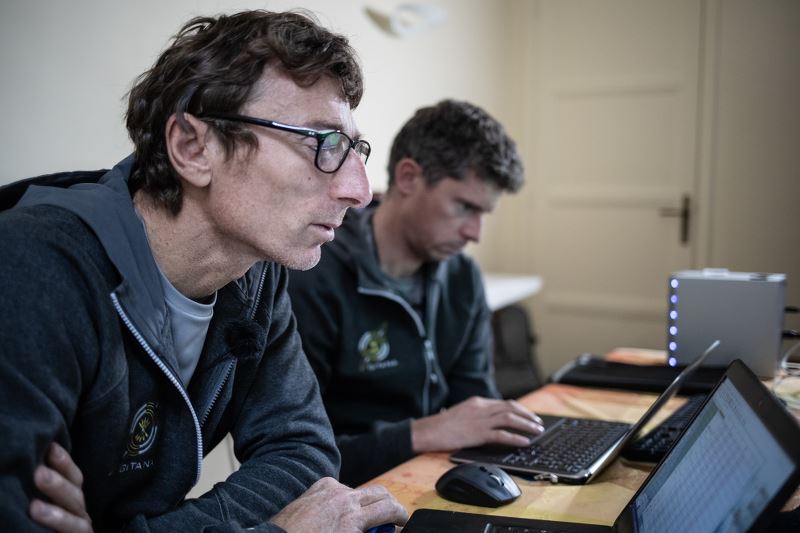
    A member of the routing cell for the Maxi Edmond de Rothschild, Olivier Douillard left Saint Malo this Saturday to join Gitana’s technical HQ in Lorient where the team’s four weather ‘gurus’ will be based. Before leaving, he gave us the low-down on the start and the first few days of this Route du Rhum – DestinationGuadeloupe. 

    “The models are becoming more refined for the first two days of the race. At the start, there will be a SSE’ly wind of between 15 and 20 knots. That will be excellent as these conditions mean we can be on a single port tack to Fréhel then on to the exit from the English Channel and the north-west tip of Brittany. The fleet will set sail on a reach and it will be very quick. The new generation boats like the Maxi Edmond de Rothschildmight even be able to fly between the Pointe du Grouin and Fréhel! For the next stage of play, the context is always the same with an initial small depression to deal with as soon as the English Channel is behind the Ultimes. The models seem to agree on its position and we should pass to the South of it in order to line ourselves up for the second depression, which is expected on Tuesday offshore of Portugal. This lunchtime, it doesn’t seem quite as strong as forecast, even though it remains very deep and active. The difficulty will relate to the sea state and we’ll need to find the balance in this regard. The timing will need to be adjusted once the first depression has rolled through, which will give us a bit of time to let the second phenomenon reposition itself and then review our course choices if need be.
    One thing for sure today is that this 2018 edition will be very quick! The start is tomorrow at 13:00 GMT and over the course of the evening the first Ultimes should already have Ushant in their wake. According to our routing, they’ll be at the latitude of Cape Finisterre on Monday morning and at the Azores on Tuesday… We still have a sub-six-day timing on the cards at the Tête à l’Anglais, even though it’s slightly complicated to gauge the Maxi Edmond de Rothschild’sability tokeep up with the speeds of the routing in heavy seas, hence some uncertainty regarding timing.”