









A promising debut
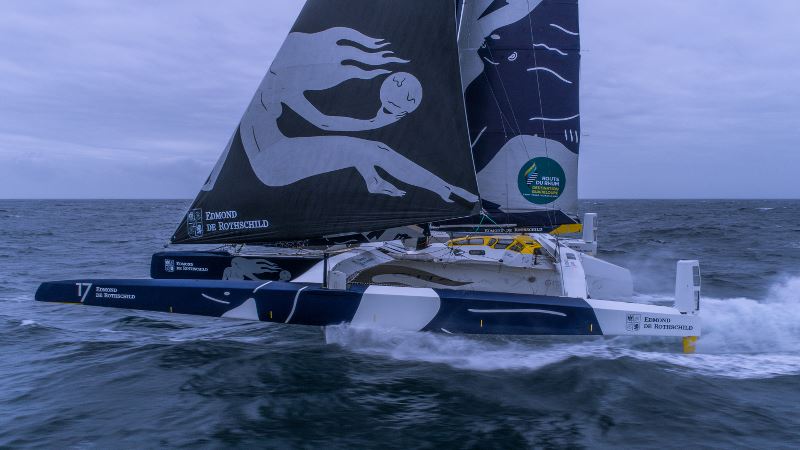
On Tuesday of this week, the Maxi Edmond de Rothschild cast off from her usual pontoon in Lorient for the latest training session, though this particular trip was rather different for Sébastien Josse and the members of the shore crew. Indeed, with 1,200 miles on the programme to the north-west of Brittany, the scenario included a beat up to the Irish Sea and a reach across the Bay of Biscay prior to powering up and heading back to the boat’s port of registry on a beam reach, for the skipper’s first ever singlehanded sail on this boat!
Sailing a multihull singlehanded on such large and powerful machines is, and will always be, an extraordinary exercise which few sailors can claim to have done. True to form and to his sailing philosophy, Sébastien Josse has taken his time to head out to sea on his own aboard the Maxi Edmond de Rothschild: “I didn’t want to set sail without being properly singlehanded, because even if the members of the team don’t touch a thing in this configuration, the fact that they are aboard changes everything. I really wanted to face up to the reality of singlehanded sailing so I’m as close as I can possibly be to what awaits me on 4 November. Equally though, I didn’t want to complete my qualification in light airs. On a boat like this, all the sailing you do is very important as you learn a huge amount on any outing you undertake. This is especially true in solo sailing; it’s the fast track to learning!” admitted the skipper on his return to land. “Before I set sail, I was really looking forward to it but inevitably I felt a little apprehensive, which is healthy I think! I hadn’t sailed a multihull singlehanded for more than four years as my last experience was in the Route du Rhum 2014. With this new boat it’s very different, but it’s also more reassuring in terms of stability than the Multi70 Edmond de Rothschild (a 70-foot multihull from the MOD series). These maxi-multihulls are powerful and hence very physical, which requires a great deal of anticipation with regards managing the machine, though the size is really comforting. Gitana 17 is a very pleasant, seaworthy boat and you can feel that she’s really geared up for offshore sailing so I quickly got my bearings and developed my automatic reflexes. It was the perfect course for a qualifier.”
For all that, Sébastien is very aware that he will have his work cut out at the race start in Saint Malo given the exceptional line-up in the Ultime category. Up against him will be today’s very best sailor/boat combinations, starting with François Gabart, the latest solo round the world record holder, Francis Joyon, Jules Verne Trophy holder and of course Thomas Coville, from whom the skipper of Macif snatched the round the world record last winter and who still holds the record for the fastest transatlantic record. Of course, we mustn’t forget Armel Le Cléac’h either. Winner of the last Vendée Globe, he’s had to face up to a tricky and frustrating period of preparation following the capsize of his boat back in April, though he remains a formidable adversary. “I remain very humble in light of the exercise of singlehanded sailing in general, and even more so on a multihull. My rivals are great specialists; the best of their kind. I know that I still have a lot to learn to compete against them but that’s part of what makes this such a thrilling challenge,” explains Sébastien.
“The qualification may seem like a mere formality, but it’s never a trivial matter. To my mind, it sets in motion the pre-Rhum process and specific singlehanded preparation…” he says. It is evident in this statement that Sébastien Josse is already fully geared up for the legendary transatlantic race and focused on the home straight.
New appendages for late September
The latest generation maxi-multihulls like Gitana 17 are, as we know, concentrates of technologies and innovations, which call for a series of fine-tuning that is as stringent as it is long. Every trip out on the water provides valuable lessons and the boat is constantly evolving from one session to the next. In this way, the shore crew is continually having to adapt itself to modify and repair the parts, which due to a lack of knowledge or experience at such operating speeds – around 40 knots! – have been undersized and so on.
After a first year of sailing, the Gitana Team in collaboration with Guillaume Verdier’s team of naval architects has been able to draw some conclusions from the numerous miles racked up and has literally gone back to the drawing board with certain appendages. For this reason, over the coming weeks, the Maxi Edmond de Rothschild will be equipped with a new set of rudders on the floats and central hull.

Two months away from the ramparts of Saint Malo
On 24 October 2018, the official race village for the 11th Route du Rhum Destination Guadeloupe will open its doors at the foot of the famous ramparts of Saint Malo. In the run-up to this major meeting, which will herald the start of festivities designed to celebrate the 40th anniversary of the legendary transatlantic race from Saint Malo in northern France to Pointe-à-Pitre in Guadeloupe, the team equipped by Ariane and Benjamin de Rothschild knows that there is still a long way to go and a lot of work to be done to ensure it’s ready to go on the big day.