








Heritage

Season 26
Types de médias
  • Photos
  • Vidéos
  • Sons
Années
  • 2026
  • 2024
  • 2023
  • 2022
  • 2021
  • 2020
  • 2019
  • 2018
  • 2017
  • 2016
  • 2015
  • 2014
Afficher les résultats (121)
supprimer tous les filtres
  • News
  • Gallery
  • Gitana 18
  • Team
  • Retractable Y-shaped foils, adjustable in three dimensions

    Inspired by the appendages of the America's Cup foiling monohulls, these Y-shaped foils have a wingspan of over 5 metres. They are designed to generate powerful lift, increase power and offer a wide range of adjustments to optimise flight at every point of sail and in all conditions. Beyond their impressive size, these foils feature many unique innovations.

    Revolutionary U-shaped rudders

    These are probably the most visually striking innovations on the new Maxi Edmond de Rothschild. To fly high above rough seas while maintaining control, the team wanted very long rudders that would remain in contact with the water. The challenge is that longer rudders tend to flex under load, severely affecting steering and the efficiency of their lifting surfaces. A new geometry was needed to give these appendages maximum stiffness, resist cavitation and ultimately improve control of the boat and make better use of its power. The result is a set of U-shaped rudders over 4 metres long, a metre longer than those on Gitana 17. Their shape, reminiscent of a tripod or an inverted π, is only the visible part of what makes them so distinctive.

    A daggerboard optimised to stabilise the boat and limit cavitation

    With its wide span, the daggerboard resembles an aircraft tail assembly, with two adjustable flaps: one on the vertical section and the other on the horizontal section, the distinctive “manta-ray wing”. On Gitana 18, the innovation is to position this wing behind the vertical part of the appendage, rather than directly beneath it, to minimise flow disturbance and cavitation.

    Gitana 18’s daggerboard

    Rig: adjustable spreaders to control mainsail power while sailing

    Gitana 18’s mast is 1.50 metres taller than its predecessor’s. The boom is also shorter, creating a more slender sail plan. The major innovation is a set of spreaders that can be adjusted while sailing to bend the mast fore and aft. Actuated by hydraulic rams, these spreaders can pivot through 35 degrees to adjust the bend in the middle of the mast. This unprecedented system allows the sailor to control mainsail power: adding depth in light winds to take off sooner, or flattening the sail to reduce power at high speed or in strong winds. Adjusting the depth, and therefore the power, of the mainsail can also save a solo sailor time and energy by reducing the need for risky manoeuvres or headsail changes.

    Central hull:
    an integrated, structural coachroof

    The naval architects and Gitana design team wanted an exceptionally stiff, structurally robust platform. This applies both to the floats, which must withstand heavy loads from the foils and rudders, and to the central hull, which is subject to torsion. The enclosed coachroof is integrated into the hull and contributes to its structural strength. Inside, the cockpit brings all sail-handling controls together, with ergonomics shaped by many hours of design and development. The coachroof also stands out for the number and size of its windows. This configuration meets the visibility requirements of the Ultim class rules and gives sailors the best possible view to keep a visual watch.

    Gitana 18’s coachroof

    08.11.2017

    An African low pressure system set to colour play.

    Having covered over 1,600 miles of the 4,350 that make up the route between Le Havre and Salvador de Bahia, the Josse-Rouxel duo has already sailed over a third of the course after just three days at sea. The weather conditions the leaders of this Transat Jacques Vabre have encountered thus far have certainly favoured their ability to slip along at…

    par Gitana

    Having covered over 1,600 miles of the 4,350 that make up the route between Le Havre and Salvador de Bahia, the Josse-Rouxel duo has already sailed over a third of the course after just three days at sea. The weather conditions the leaders of this Transat Jacques Vabre have encountered thus far have certainly favoured their ability to slip along at speed and the sailors are lapping it up. Since yesterday evening and her passage abeam of the Azores, the Maxi Edmond de Rothschild has been slipping along the edge of the zone of high pressure and is now sailing in the trade winds of the northern hemisphere. This Wednesday 8 November, at the 15:00 UTC ranking, the Maxi Edmond de Rothschild has held onto her lead and is still being shadowed by Sodebo Ultim’, which has repositioned itself to the west some 75 miles stray of Gitana 17.
    Squalls along the southern expressway

    The route leading to the equator is certainly quick, but it’s rarely a long, calm river. The account of last night’s adventures, as told by Thomas Rouxel at the official midday radio session, testifies to this: “We’re going fast but you don’t get something for nothing. You have to be on top of things! We had a complicated zone last night. On the whole, there was a lot of wind, around 30 knots, and the associated seas were very chaotic, but we also got a pasting from a squall with rain and not much wind. This zone of light patches wasn’t forecast on the routing and it put paid to our plans. In fact, we’d favoured a certain sail configuration, which didn’t prove to be as effective as we’d imagined.”

    Increased lateral separation

    Since Sunday and the start in Le Havre, the trajectories of the two leaders of this 13th Transat Jacques Vabre, namely the Maxi Edmond de Rothschild and Sodebo Ultim’, have been virtually identical. However, this sailing in convoy came to an end 24 hours ago on passing the Azores archipelago. Indeed, today Thomas Coville and Jean-Luc Nélias are positioned further to the west with a lateral separation of over 100 miles in relation to the crew of Gitana Team. With the race having clearly turned into a duel since Prince de Bretagne suffered damage on Monday evening as the front rolled through, Sébastien Josse and Thomas Rouxel are keeping a close eye on the route adopted by their direct rival: “Naturally, we’re monitoring their position very closely! Their choice is interesting and in fact we too had planned to make a little more westing before we hit a zone of squalls. We’ll see how things play out between now and tomorrow.” 

    For the time being, the effects of a low pressure system between the Canaries and the Cape Verde archipelago are the sailors’ main focus aboard the Maxi Edmond de Rothschild: “Right now, we’re more concerned by the negotiation of a low pressure system rolling across from Africa, which will bring with it light winds so our focus is on avoiding getting caught up by this zone. That’s our priority at the moment, though naturally we’re also beginning to look ahead as the Doldrums loom.”
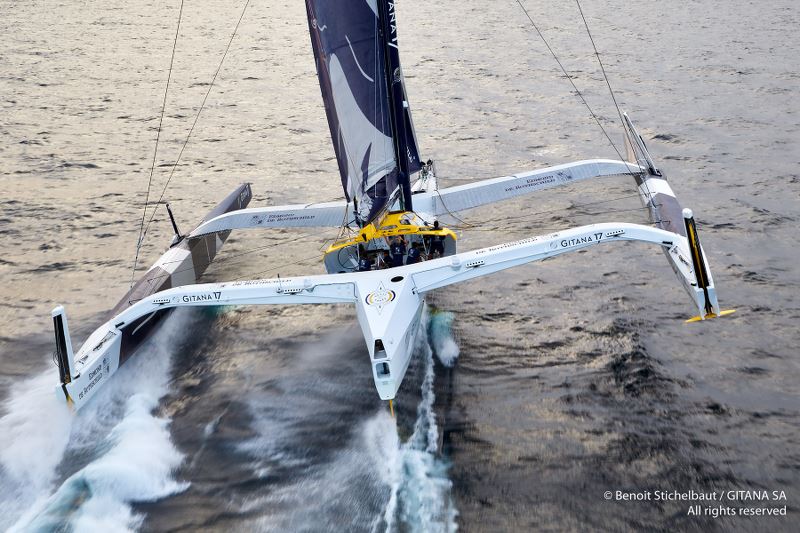
     

    After three days at sea and over 1,600 miles already covered, life aboard is becoming organised and most importantly the two sailors are now benefiting from much warmer temperatures as Thomas Rouxel confirmed: “We removed our boots and foulies yesterday. It’s beginning to get pretty hot under our cockpit roof window.”

    Ranking at 15:00 UTC, Ultime category – Wednesday 8 November

    1 – Maxi Edmond de Rothschild – 2,771.3 miles from the finish, 29.7 knots over 1hr
    2 – Sodebo Ultim’ – 75 miles behind the leader, 30.3 knots over 1hr
    3 – Prince de Bretagne – 563.04 miles, 25.6 knots over 1hr