








Heritage

Season 26
Types de médias
  • Photos
  • Vidéos
  • Sons
Années
  • 2026
  • 2024
  • 2023
  • 2022
  • 2021
  • 2020
  • 2019
  • 2018
  • 2017
  • 2016
  • 2015
  • 2014
Afficher les résultats (121)
supprimer tous les filtres
  • News
  • Gallery
  • Gitana 18
  • Team
  • Retractable Y-shaped foils, adjustable in three dimensions

    Inspired by the appendages of the America's Cup foiling monohulls, these Y-shaped foils have a wingspan of over 5 metres. They are designed to generate powerful lift, increase power and offer a wide range of adjustments to optimise flight at every point of sail and in all conditions. Beyond their impressive size, these foils feature many unique innovations.

    Revolutionary U-shaped rudders

    These are probably the most visually striking innovations on the new Maxi Edmond de Rothschild. To fly high above rough seas while maintaining control, the team wanted very long rudders that would remain in contact with the water. The challenge is that longer rudders tend to flex under load, severely affecting steering and the efficiency of their lifting surfaces. A new geometry was needed to give these appendages maximum stiffness, resist cavitation and ultimately improve control of the boat and make better use of its power. The result is a set of U-shaped rudders over 4 metres long, a metre longer than those on Gitana 17. Their shape, reminiscent of a tripod or an inverted π, is only the visible part of what makes them so distinctive.

    A daggerboard optimised to stabilise the boat and limit cavitation

    With its wide span, the daggerboard resembles an aircraft tail assembly, with two adjustable flaps: one on the vertical section and the other on the horizontal section, the distinctive “manta-ray wing”. On Gitana 18, the innovation is to position this wing behind the vertical part of the appendage, rather than directly beneath it, to minimise flow disturbance and cavitation.

    Gitana 18’s daggerboard

    Rig: adjustable spreaders to control mainsail power while sailing

    Gitana 18’s mast is 1.50 metres taller than its predecessor’s. The boom is also shorter, creating a more slender sail plan. The major innovation is a set of spreaders that can be adjusted while sailing to bend the mast fore and aft. Actuated by hydraulic rams, these spreaders can pivot through 35 degrees to adjust the bend in the middle of the mast. This unprecedented system allows the sailor to control mainsail power: adding depth in light winds to take off sooner, or flattening the sail to reduce power at high speed or in strong winds. Adjusting the depth, and therefore the power, of the mainsail can also save a solo sailor time and energy by reducing the need for risky manoeuvres or headsail changes.

    Central hull:
    an integrated, structural coachroof

    The naval architects and Gitana design team wanted an exceptionally stiff, structurally robust platform. This applies both to the floats, which must withstand heavy loads from the foils and rudders, and to the central hull, which is subject to torsion. The enclosed coachroof is integrated into the hull and contributes to its structural strength. Inside, the cockpit brings all sail-handling controls together, with ergonomics shaped by many hours of design and development. The coachroof also stands out for the number and size of its windows. This configuration meets the visibility requirements of the Ultim class rules and gives sailors the best possible view to keep a visual watch.

    Gitana 18’s coachroof

    31.10.2017

    Maxi Edmond de Rothschild, a pioneer of its kind.

    On 17 July 2017, after a twenty-month build and over 35,000 hours of studies, Ariane and Benjamin de Rothschild launched the latest addition to their offshore racing stable. The Maxi Edmond de Rothschild, a large oceanic trimaran measuring 32 metres long and 23 metres wide is now part of the long and rather illustrious line of Gitanas. This Sunday…

    par Gitana

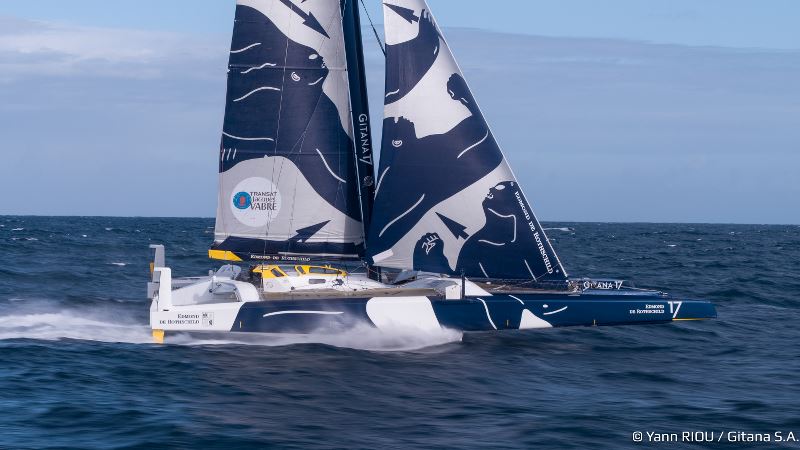
    On 17 July 2017, after a twenty-month build and over 35,000 hours of studies, Ariane and Benjamin de Rothschild launched the latest addition to their offshore racing stable. The Maxi Edmond de Rothschild, a large oceanic trimaran measuring 32 metres long and 23 metres wide is now part of the long and rather illustrious line of Gitanas. This Sunday in Le Havre, Gitana 17 will be the first multihull designed to fly offshore to set sail on a transatlantic race. On-board will be two oceanic pioneers, Sébastien Josse and Thomas Rouxel.

    Paving the way

    Featuring an aggressive and sleek outline with smooth lines, the Maxi Edmond de Rothschild forces admiration. Indeed, this flying ‘fighter plane’ is a one-off in the looks department thanks to her unique floats and central hull and to the underwater sections of her beams, which are reminiscent of a plane wing. With flat hull bottoms for the maximum lift, a very high freeboard to thwart the torsion stresses of the float foils and rectangular beams for optimum stiffness, her streamlined wing-style sail plan and boat profile blend into one. Hydrodynamics and aerodynamics have been the key points in the development of this ‘two in one’ craft according to her architect Guillaume Verdier. From the design to the construction, the Maxi Edmond de Rothschild is the result of a mastery of innovation and new technologies, shaped by the strictest quality control. A precursor, this giant of the seas is paving the way forward for a new generation of large multihulls, designed to negotiate heavy seas in the open ocean.
     

    Video – It was a rather odd carbon bird that was tied to the dock in the Bassin de l’Eure last Friday for the opening of the Transat Jacques Vabre race village. The locals weren’t impervious to her charm!

    Objective: apprenticeship and fine-tuning on the finest of playgrounds!

    Since the launch of the Maxi Edmond de Rothschild, the timing has been tight and every session on the water has been carefully optimised by the members of the Gitana Team to enable the Edmond de Rothschild duo to set sail from Le Havre with the optimum amount of preparation under their belts. The estimated eight to ten days for the crossing and the numerous associated miles in race configuration are an accelerated learning experience that greatly appeals to Sébastien Josse:“Gitana 17 is a highly specialised prototype, which brings together a series of innovative technologies where there is no shortcut to the discovery and fine-tuning phase! Naturally I’m thinking here about the foils and the various appendages and systems necessary for flight, but that’s not all. Innovation has a place all over the boat. In fact, we’re developing some unique solutions with Pixel sur Mer regarding all the on-board intelligence. With Gitana Team we’re pioneers, we’re preparing the way forward and what we learn from these miles in race configuration is extremely precious for the next stage of the programme and particularly for the single-handed racing in 2018 and 2019.”

    The Edmond de Rothschild duo has had a short yet intense period of preparation. However, the two men fully intend to benefit from the 4,350 miles that lay ahead of the latest addition to the Gitana fleet to fine tune her and show off her exceptional potential.


    Video – On 17 August 2017, just one month after exiting the yard, the Maxi Edmond de Rothschild enjoyed her debut flight. See the images of this intense moment that is sure to remain etched in our memories.