








Heritage

Season 26
Types de médias
  • Photos
  • Vidéos
  • Sons
Années
  • 2026
  • 2024
  • 2023
  • 2022
  • 2021
  • 2020
  • 2019
  • 2018
  • 2017
  • 2016
  • 2015
  • 2014
Afficher les résultats (121)
supprimer tous les filtres
  • News
  • Gallery
  • Gitana 18
  • Team
  • Retractable Y-shaped foils, adjustable in three dimensions

    Inspired by the appendages of the America's Cup foiling monohulls, these Y-shaped foils have a wingspan of over 5 metres. They are designed to generate powerful lift, increase power and offer a wide range of adjustments to optimise flight at every point of sail and in all conditions. Beyond their impressive size, these foils feature many unique innovations.

    Revolutionary U-shaped rudders

    These are probably the most visually striking innovations on the new Maxi Edmond de Rothschild. To fly high above rough seas while maintaining control, the team wanted very long rudders that would remain in contact with the water. The challenge is that longer rudders tend to flex under load, severely affecting steering and the efficiency of their lifting surfaces. A new geometry was needed to give these appendages maximum stiffness, resist cavitation and ultimately improve control of the boat and make better use of its power. The result is a set of U-shaped rudders over 4 metres long, a metre longer than those on Gitana 17. Their shape, reminiscent of a tripod or an inverted π, is only the visible part of what makes them so distinctive.

    A daggerboard optimised to stabilise the boat and limit cavitation

    With its wide span, the daggerboard resembles an aircraft tail assembly, with two adjustable flaps: one on the vertical section and the other on the horizontal section, the distinctive “manta-ray wing”. On Gitana 18, the innovation is to position this wing behind the vertical part of the appendage, rather than directly beneath it, to minimise flow disturbance and cavitation.

    Gitana 18’s daggerboard

    Rig: adjustable spreaders to control mainsail power while sailing

    Gitana 18’s mast is 1.50 metres taller than its predecessor’s. The boom is also shorter, creating a more slender sail plan. The major innovation is a set of spreaders that can be adjusted while sailing to bend the mast fore and aft. Actuated by hydraulic rams, these spreaders can pivot through 35 degrees to adjust the bend in the middle of the mast. This unprecedented system allows the sailor to control mainsail power: adding depth in light winds to take off sooner, or flattening the sail to reduce power at high speed or in strong winds. Adjusting the depth, and therefore the power, of the mainsail can also save a solo sailor time and energy by reducing the need for risky manoeuvres or headsail changes.

    Central hull:
    an integrated, structural coachroof

    The naval architects and Gitana design team wanted an exceptionally stiff, structurally robust platform. This applies both to the floats, which must withstand heavy loads from the foils and rudders, and to the central hull, which is subject to torsion. The enclosed coachroof is integrated into the hull and contributes to its structural strength. Inside, the cockpit brings all sail-handling controls together, with ergonomics shaped by many hours of design and development. The coachroof also stands out for the number and size of its windows. This configuration meets the visibility requirements of the Ultim class rules and gives sailors the best possible view to keep a visual watch.

    Gitana 18’s coachroof

    21.11.2016

    A question of tempo.

    Making headway along the course, fast, as fast as possible, whilst taking care of your steed, is a tricky equation for the solo sailors at the head of the fleet, who are powered up at an average of 20 knots bound for Good Hope. Still some 1,400 miles ahead of the Mono60 Edmond de Rothschild, the first of the three capes in this Vendée Globe will pu…

    par Gitana

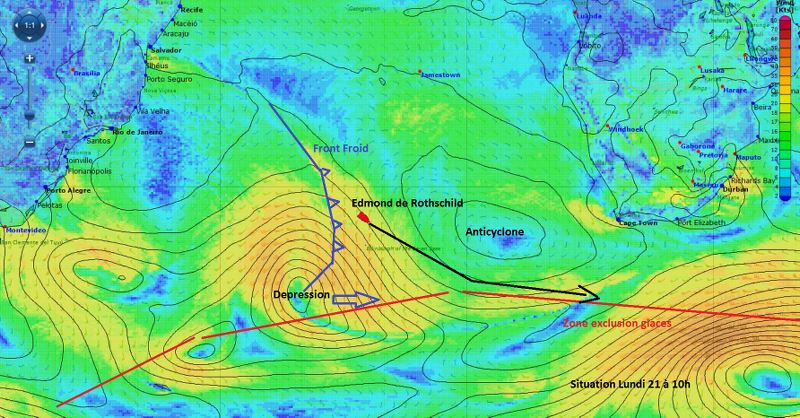
    Making headway along the course, fast, as fast as possible, whilst taking care of your steed, is a tricky equation for the solo sailors at the head of the fleet, who are powered up at an average of 20 knots bound for Good Hope. Still some 1,400 miles ahead of the Mono60 Edmond de Rothschild, the first of the three capes in this Vendée Globe will punctuate what has been a thrilling descent of the Atlantic at the end of the week. In the meantime, the rush eastwards is continuing apace. Still being propelled along by the cold front, which has been accompanying him since last Friday, Sébastien Josse is applying himself. Indeed, the skipper of Gitana Team is making every effort to keep a cool head in this drag race, though he’s certainly not hanging about. And it’s important he doesn’t waste any time too! In fact, once this low has cleared away and as they await a ride on the next system, the front runners could well stumble into a transition zone.

    This Monday, the top trio boast a lateral spread of nearly 130 miles from North to South. The most recent of the Gitanas is still sailing the furthest North. He’s made up one place and is now lying in second some 85 miles behind the leader Alex Thomson, who has remained to the South. Between the two, Armel Le Cléac’h has got a little closer to Sébastien Josse and is making headway around thirty miles or so downwind of him. All three are currently utilising a well-fuelled N’ly breeze of 25-30 knots. “These are perfect conditions for sailing very tight trajectories, which really suit our boats and translate as super fast speeds,” admitted Sébastien at the morning radio link-up for the Vendée Globe.

    Knowing how to be happy with what you’ve got  

    The weekend was marked by Saturday’s breakage of the starboard foil on Hugo Boss, following a collision with a UFO. Leading the way when this incident took place, the Briton has naturally slowed up and lost a fair amount of his lead over his rivals. “Despite his setbacks though, Alex (Thomson) is holding up well. He has breeze and he’s maintaining good speeds at these angles,” added Sébastien, who feels good about the balance he’s managed to strike as he currently drives Gitana 16. “Conditions are good so the boat isn’t being damaged. When we’re making twenty knots, that in itself is good going so there’s no point pushing it.”

    A drag race at medium speed 

    Since leaving Les Sables d’Olonne, the skipper of Gitana Team has been sailing with the same mind set. He knows just how long and trying the Vendée Globe is for both man and machine. Together with the Mono60 Edmond de Rothschild, he forms a solid duo, which still has some 19,000 miles to cover in all, which equates to over 35,000 kilometres. As such, you have to look at the bigger picture, control your speed according to your priorities and avoid going into the red too early. That hasn’t yet happened since 6 November but, over this the most extreme course there is, the elements may well rage at a given point. In times like these, you need to be able to dig deep and exceed certain limits. “It’s a drag race at medium speed,” he explained this morning. “We allow ourselves one speed. You line the boat up for that and you endeavour to stick to it.” This is particularly true given that the current weather in the South Atlantic calls for a philosophical approach. “We’ve seen that the boat can reach peak speeds of 25 knots, but now is not the time for that. This weather system means that 20 knots is enough and anyway we’re set to slow up as we pass the Cape of Good Hope. There will be a day of transition before we hook onto another low that will carry us along with it.”

    Ranking on 21 November at 14:00 GMT

    1. Alex Thomson (Hugo Boss) 18,913.4 miles from the finish
    2. Sébastien Josse (Edmond de Rothschild) 85.7 miles behind the leader
    3. Armel Le Cleac’h (Banque Populaire VIII) 94.8 miles behind the leader
    4. Morgan Lagravière (Safran) 168.6 miles behind the leader
    5. Vincent Riou (PRB) 180.5 miles behind the leader
    6. Paul Meilhat (SMA) 233.8 miles behind the leader
    7. Jérémie Beyou (Maître CoQ) 300.7 miles behind the leader
    8. Yann Eliès (Quéguiner Leucémie Espoir) 763.4 miles behind the leader