








Heritage

Season 26
Types de médias
  • Photos
  • Vidéos
  • Sons
Années
  • 2026
  • 2024
  • 2023
  • 2022
  • 2021
  • 2020
  • 2019
  • 2018
  • 2017
  • 2016
  • 2015
  • 2014
Afficher les résultats (121)
supprimer tous les filtres
  • News
  • Gallery
  • Gitana 18
  • Team
  • Retractable Y-shaped foils, adjustable in three dimensions

    Inspired by the appendages of the America's Cup foiling monohulls, these Y-shaped foils have a wingspan of over 5 metres. They are designed to generate powerful lift, increase power and offer a wide range of adjustments to optimise flight at every point of sail and in all conditions. Beyond their impressive size, these foils feature many unique innovations.

    Revolutionary U-shaped rudders

    These are probably the most visually striking innovations on the new Maxi Edmond de Rothschild. To fly high above rough seas while maintaining control, the team wanted very long rudders that would remain in contact with the water. The challenge is that longer rudders tend to flex under load, severely affecting steering and the efficiency of their lifting surfaces. A new geometry was needed to give these appendages maximum stiffness, resist cavitation and ultimately improve control of the boat and make better use of its power. The result is a set of U-shaped rudders over 4 metres long, a metre longer than those on Gitana 17. Their shape, reminiscent of a tripod or an inverted π, is only the visible part of what makes them so distinctive.

    A daggerboard optimised to stabilise the boat and limit cavitation

    With its wide span, the daggerboard resembles an aircraft tail assembly, with two adjustable flaps: one on the vertical section and the other on the horizontal section, the distinctive “manta-ray wing”. On Gitana 18, the innovation is to position this wing behind the vertical part of the appendage, rather than directly beneath it, to minimise flow disturbance and cavitation.

    Gitana 18’s daggerboard

    Rig: adjustable spreaders to control mainsail power while sailing

    Gitana 18’s mast is 1.50 metres taller than its predecessor’s. The boom is also shorter, creating a more slender sail plan. The major innovation is a set of spreaders that can be adjusted while sailing to bend the mast fore and aft. Actuated by hydraulic rams, these spreaders can pivot through 35 degrees to adjust the bend in the middle of the mast. This unprecedented system allows the sailor to control mainsail power: adding depth in light winds to take off sooner, or flattening the sail to reduce power at high speed or in strong winds. Adjusting the depth, and therefore the power, of the mainsail can also save a solo sailor time and energy by reducing the need for risky manoeuvres or headsail changes.

    Central hull:
    an integrated, structural coachroof

    The naval architects and Gitana design team wanted an exceptionally stiff, structurally robust platform. This applies both to the floats, which must withstand heavy loads from the foils and rudders, and to the central hull, which is subject to torsion. The enclosed coachroof is integrated into the hull and contributes to its structural strength. Inside, the cockpit brings all sail-handling controls together, with ergonomics shaped by many hours of design and development. The coachroof also stands out for the number and size of its windows. This configuration meets the visibility requirements of the Ultim class rules and gives sailors the best possible view to keep a visual watch.

    Gitana 18’s coachroof

    19.11.2016

    On the leading edge of the front.

    As expected, the leading boats have hooked onto the back of a low offshore of Rio de Janeiro, which is enabling them to bend their course round towards the Cape of Good Hope. Most importantly though, with this phenomenon, where the wind has strengthened to between 20 and 25 knots as it gradually shifts round to the North, Sébastien Josse and his ad…

    par Gitana

    As expected, the leading boats have hooked onto the back of a low offshore of Rio de Janeiro, which is enabling them to bend their course round towards the Cape of Good Hope. Most importantly though, with this phenomenon, where the wind has strengthened to between 20 and 25 knots as it gradually shifts round to the North, Sébastien Josse and his adversaries have been able to pick up the pace. Since last night, the speeds have been constantly increasing and they’ve switched things up a gear in relation to what was already a very steady pace. As a result, the 24hr record* held by François Gabart since 2012 may well fall! At the 14:00 GMT ranking, Edmond de Rothschild was lying in 3rd place in a fleet still led by Alex Thomson. The Briton has made his first break this Saturday afternoon with a lead of 130 miles but via his website we’ve learnt that the latter has been experiencing issues with his starboard foil following a collision with an unidentified floating object this morning.

    The phenomenon was identified several days ago but it was still necessary to respect the timing that would enable them to make the most of the system. For those leading the way in this Vendée Globe, it’s job done in that regard, as testified by the speeds recorded by the top boats since this morning. From Hugo Boss to Maître CoQ, this group of seven – of which five are foilers – has managed to hitch a ride down to South Africa, carried along by a stormy low that was generated in the bay of Rio de Janeiro. For now, they’re making headway on the leading edge of this front, but we’ll have to wait for the coming days to see if everyone manages to hang on in there and use this express ride to its full potential.

    “Since the start, the conditions we’ve been benefiting from have been perfect for getting the boat making headway. It puts pressure on the sailor, but at least we’re making good speed and devouring the miles!” admitted Sébastien Josse. Besides the sharp movements generated by the Imocas at such speeds, life aboard is becoming more than tricky and the solo sailors are stepping up the vigilance in a bid to prevent injury: “I’ve been making peak speeds of 30 knots since this morning! In these conditions, you limit your movement around the boat as much as possible and you wedge yourself in where you can down below or under the cuddy. That said, the sea is already smoother, which is quite a help,” explained the skipper of the five-arrow racing stable.
    Keeping pace 
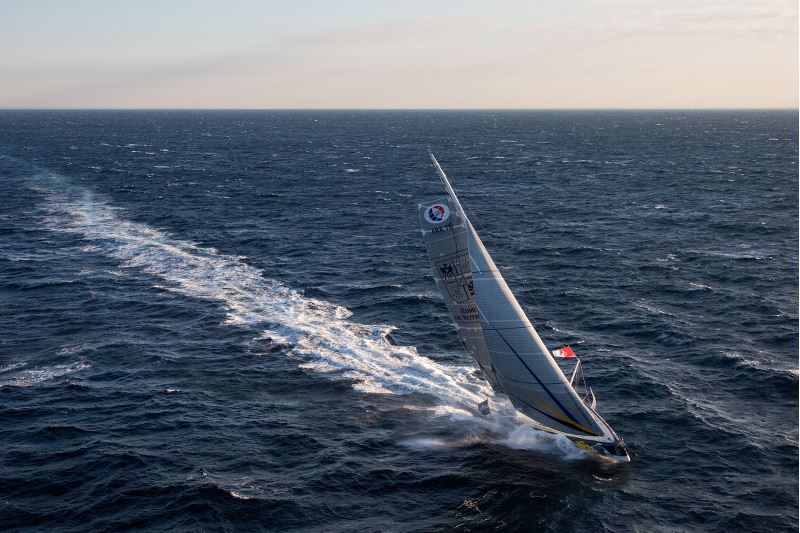
    Boasting an average speed over the past four hours of 23.3 knots at the last position report, Edmond de Rothschild is unquestionably the fastest of the fleet, closely followed by PRB and Safran. The rhythm set by Sébastien Josse since this morning has enabled them to make up a little ground on the leader with some 18 miles clawed back since the 08:00 GMT ranking. All the more so given that Alex Thomson has reduced his speed substantially over recent hours following a collision with a non-identified floating object this morning, which has caused some pretty significant damage to his starboard foil. 
    Watching how things play out
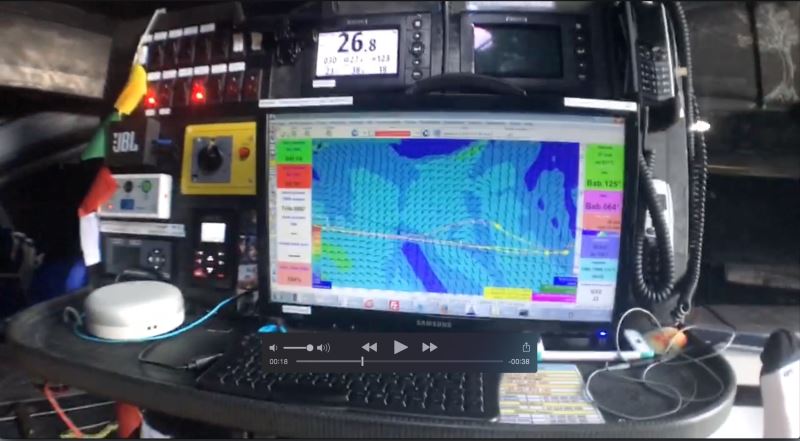
    In front of Edmond de Rothschild, the weather situation appears to be rather complex as the Saint Helena High is still positioned a long way South and right out to the East. In this way, though the negotiation of the South Atlantic promises to be quick, the passage of Good Hope and the entry into the Indian Ocean is likely to be tough for the leading solo sailors. From his chart table, Sébastien Josse is already examining the forecasts, even though for now the main focus aboard the latest of the Gitana fleet is to slip along as quickly as he can to the South-East, keeping man and machine safe.

    Today’s figures

    At 14:00 GMT, Edmond de Rothschild in 3rd place
    130 miles behind the leader Alex Thomson
    Distance covered over the past 24 hours: 487.58 miles at an average speed of 20.3 knots
    Distance covered over the ground since the start: 4,872.39 miles at an average speed of 15.5 knots

    Ranking on 19 November at 14:00 GMT
    1. Alex Thomson (Hugo Boss) 19,860.7 miles from the finish
    2. Armel Le Cleac’h (Banque Populaire VIII) 125.6 miles behind the leader
    3. Sébastien Josse (Edmond de Rothschild) 130.9 miles behind the leader
    4. Vincent Riou (PRB) 190.9 miles behind the leader
    5. Morgan Lagravière (Safran) 228.7 miles behind the leader
    6. Paul Meilhat (SMA) 290.3 miles behind the leader
    7. Jérémie Beyou (Maître CoQ) 370.7 miles behind the leader
    8. Yann Eliès (Quéguiner Leucémie Espoir) 624.5 miles behind the leader
      …