








A record time at the equator
“The reference times are tumbling and that’s just the start!” said Sébastien Josse.Leader of the Vendée Globe fleet for the past four days, Alex Thomson was logically first across the equator yesterday shortly after 19:00 GMT. In addition to being top of the leaderboard, the Welsh skipper treated himself to a stellar reference time, improving on the record held since 2004 by Jean Le Cam by 1 day and 4 hours. The fourth solo sailor in his wake, Sébastien Josse also posted a fine performance, making it into the southern hemisphere after just 9 days 12 hours and 1 minute of racing.
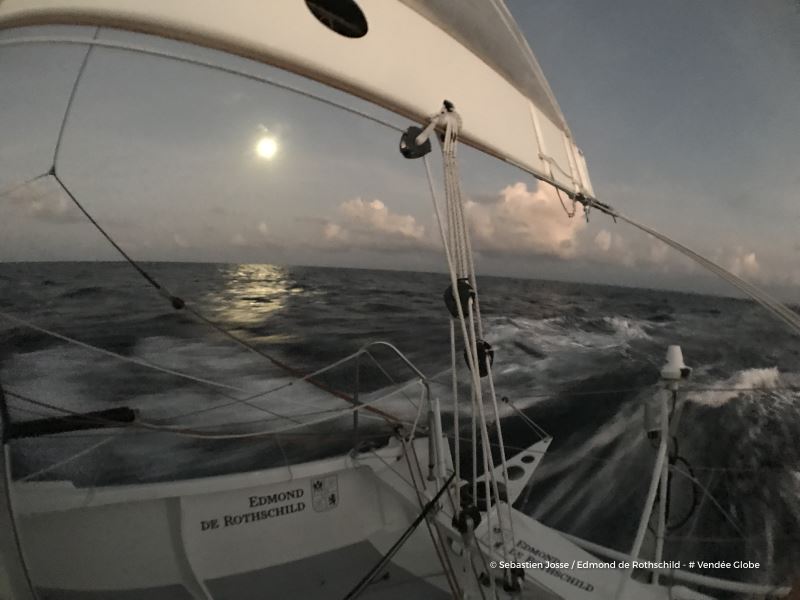
Beyond these speedy times, which given the performances of the new IMOCAs and the fine-tuning of the older generation boats, don’t come as a massive surprise, what’s particularly striking is how close the top five are to one another. Indeed, less than six hours (5hr 47’) separate Hugo Boss and SMA; times which serve as a perfect illustration of the close-contract racing the solo sailors have been embroiled in since 6 November, when they set sail from Les Sables d’Olonne. In a bid to try to emulate one another, the solo sailors are “putting themselves in the red” to really get the best out of their machine: “This is exactly the rhythm I was expecting of the Atlantic! The Vendée Globe is an endurance race and you have to manage the effort and know where to set the bar,”explained the skipper of Edmond de Rothschild.
Eight souls in the southern hemisphere
After the negotiation of the Bay of Biscay, the crossing of the Doldrums became the second tricky section ticked off in this 8th Vendée Globe. And, at the start of this eleventh day of racing, an initial hierarchy has been established.
Of the twenty-nine competitors in the race, eight boats are sailing in the southern hemisphere this Wednesday afternoon, starting with Hugo Boss, then Banque Populaire, PRB, Edmond de Rothschild, SMA, Maître Coq and further back Quéguiner Leucémie Espoir. In this leading group, the top five are bunched into less than 100 miles and are sailing on port tack this afternoon, abeam of the Fernando de Noronha archipelago, in a SE’ly trade wind, whose intensity varies considerably according to the latitude. The latest forecasts indicate that this breeze will flesh out over the coming hours the further South they get, reaching as much as 20 knots tonight.
This club of ‘southerners’ has managed to make a break from its pursuers. Not far from the equator, Jean Le Cam is 9th and laments a 350-mile deficit.

What does Saint Helena have in store for them?
The Saint Helena High, which owes its name to the island where Napoleon 1st was exiled in 1815 and died in 1821, is responsible for the rain and the fine weather in the South Atlantic. Indeed, its position and scope dictate the fate of the sailors heading down towards the Southern Ocean.
The initial forecasts in this zone seem to indicate a rather intriguing passage for the first pack of Vendée Globe sailors: “It’s not completely in line yet, but for now the zone of high pressure is a long way South and fairly spread out to the East. Right now a low is forming at the latitude of Rio and if we manage to slip along ahead of its warm front, we may be able to devour the South Atlantic pretty quickly and make our entry into the Deep South within a good week. It’s crucial we don’t miss the timing to benefit from this favourable sequence of systems.”
Before he can cast his mind to the Southern Ocean and its train of lows though, the skipper of the five-arrow racing stable is making the most of the tropical conditions to slip along on a beam reach offshore of Brazil: “The heat aboard is stifling. It’s over 40°C down below and outside it’s impossible to stay in the sunshine without protection as you just get burnt! We shouldn’t complain though, as we’ll soon hit the big chill.”
Times for the top five between Les Sables d’Olonne and the equator
1. Alex Thomson (Hugo Boss) 9 days 7 hours 2 minutes
2. Armel Le Cleac’h (Banque Populaire VIII) 9 days 9 hours and 56 minutes, 2hr 54’ behind the leader
3. Vincent Riou (PRB) 9 days 10 hours and 24 minutes, 3hr 22’ behind the leader
4. Sébastien Josse (Edmond de Rothschild) 9 days 12 hours and 1 minute, 4hr 59’ behind the leader
5. Paul Meilhat (SMA) 9 days 12 hours and 49 minutes, 5hr 47’ behind the leader
Today’s figures
At 14:00 GMT, Edmond de Rothschild in 4th place
79.4 miles behind the leader Alex Thomson
Distance covered over the past 24 hours: 367.20 miles at an average speed of 15.3 knots
Distance covered over the ground since the start: 3,519.59 miles at an average speed of 14.6 knots
Ranking on 16 November at 14:00 GMT
1. Alex Thomson (Hugo Boss) 21,138.4 miles from the finish
2. Armel Le Cleac’h (Banque Populaire VIII) 58.4 miles behind the leader
3. Vincent Riou (PRB) 69.8 miles behind the leader
4. Sébastien Josse (Edmond de Rothschild) 79.4 miles behind the leader
5. Paul Meilhat (SMA) 99.3 miles behind the leader
6. Morgan Lagravière (Safran) 143.9 miles behind the leader
7. Jérémie Beyou (Maître CoQ) 158.6 miles behind the leader
8. Yann Eliès (Quéguiner Leucémie Espoir) 257.9 miles behind the leader
9. Jean Le Cam (Finistère Mer Vent) 360.3 miles behind the leader
…