








Heritage

Season 26
Types de médias
  • Photos
  • Vidéos
  • Sons
Années
  • 2026
  • 2024
  • 2023
  • 2022
  • 2021
  • 2020
  • 2019
  • 2018
  • 2017
  • 2016
  • 2015
  • 2014
Afficher les résultats (121)
supprimer tous les filtres
  • News
  • Gallery
  • Gitana 18
  • Team
  • Retractable Y-shaped foils, adjustable in three dimensions

    Inspired by the appendages of the America's Cup foiling monohulls, these Y-shaped foils have a wingspan of over 5 metres. They are designed to generate powerful lift, increase power and offer a wide range of adjustments to optimise flight at every point of sail and in all conditions. Beyond their impressive size, these foils feature many unique innovations.

    Revolutionary U-shaped rudders

    These are probably the most visually striking innovations on the new Maxi Edmond de Rothschild. To fly high above rough seas while maintaining control, the team wanted very long rudders that would remain in contact with the water. The challenge is that longer rudders tend to flex under load, severely affecting steering and the efficiency of their lifting surfaces. A new geometry was needed to give these appendages maximum stiffness, resist cavitation and ultimately improve control of the boat and make better use of its power. The result is a set of U-shaped rudders over 4 metres long, a metre longer than those on Gitana 17. Their shape, reminiscent of a tripod or an inverted π, is only the visible part of what makes them so distinctive.

    A daggerboard optimised to stabilise the boat and limit cavitation

    With its wide span, the daggerboard resembles an aircraft tail assembly, with two adjustable flaps: one on the vertical section and the other on the horizontal section, the distinctive “manta-ray wing”. On Gitana 18, the innovation is to position this wing behind the vertical part of the appendage, rather than directly beneath it, to minimise flow disturbance and cavitation.

    Gitana 18’s daggerboard

    Rig: adjustable spreaders to control mainsail power while sailing

    Gitana 18’s mast is 1.50 metres taller than its predecessor’s. The boom is also shorter, creating a more slender sail plan. The major innovation is a set of spreaders that can be adjusted while sailing to bend the mast fore and aft. Actuated by hydraulic rams, these spreaders can pivot through 35 degrees to adjust the bend in the middle of the mast. This unprecedented system allows the sailor to control mainsail power: adding depth in light winds to take off sooner, or flattening the sail to reduce power at high speed or in strong winds. Adjusting the depth, and therefore the power, of the mainsail can also save a solo sailor time and energy by reducing the need for risky manoeuvres or headsail changes.

    Central hull:
    an integrated, structural coachroof

    The naval architects and Gitana design team wanted an exceptionally stiff, structurally robust platform. This applies both to the floats, which must withstand heavy loads from the foils and rudders, and to the central hull, which is subject to torsion. The enclosed coachroof is integrated into the hull and contributes to its structural strength. Inside, the cockpit brings all sail-handling controls together, with ergonomics shaped by many hours of design and development. The coachroof also stands out for the number and size of its windows. This configuration meets the visibility requirements of the Ultim class rules and gives sailors the best possible view to keep a visual watch.

    Gitana 18’s coachroof

    08.11.2016

    I’m getting into the swing of my round the world race.

    They haven’t hung about! After two days at sea, the leading pack in the Vendée Globe is already closing on the latitude of Lisbon. However, Sébastien Josse has stuck to his word for the start of the race. Indeed, the skipper of the Mono60 Edmond de Rothschild was keen to set off in marathon’ rather than sprint’ mode given the marathon distance of t…

    par Gitana

    They haven’t hung about! After two days at sea, the leading pack in the Vendée Globe is already closing on the latitude of Lisbon. However, Sébastien Josse has stuck to his word for the start of the race. Indeed, the skipper of the Mono60 Edmond de Rothschild was keen to set off in marathon’ rather than sprint’ mode given the marathon distance of this round the world. In this way, he’s endeavoured not to put the five-arrow boat under too much pressure from the outset, especially amidst the lines of squalls that traversed the Bay of Biscay on Sunday night and through into Monday. With the wind oscillating between 10 and 25 knots, the solo sailor has opted to sail with his foils raised in a bid to manoeuvre correctly and calmly negotiate the tricky section off Cape Finisterre yesterday lunchtime. This Tuesday, in the early afternoon, Sébastien Josse was positioned in fifth place some 20.4 miles astern of Alex Thomson, who yesterday opted to position himself over to the East with the aim of holding onto more pressure along the coast of Portugal. On the approach to a ridge of high pressure, which is barring the fleet’s way to the South, the average speeds have dropped below 8 knots and the big question now is how this zone of light winds will evolve.

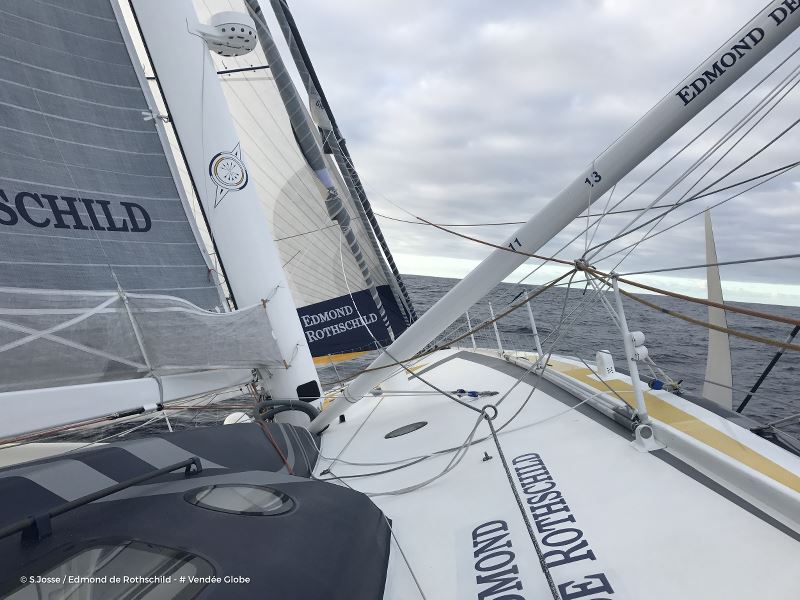
    The powerful images of the boats exiting the canal out of Les Sables d’Olonne and the great emotion of the start are now behind them, as is the biting cold, which has since given way to Portuguese sunshine. In more manageable conditions, Sébastien Josse was able to send his first images of the open ocean this morning and he also took the time to contact his shore crew: “Right now, the conditions are still fairly irregular and the wind is rather light. It’s set to stay that way throughout the day as the ridge of high pressure sprawls over us. It’s doing us good as the start of the race was rather tough. It was a boisterous exit from Biscay in the squalls and I’ve spared no effort. Conditions are such that you sleep little and eat little,” he explains. At the Vendée Globe radio link-up at midday, the skipper admitted that he’d managed to rack up just two hours’ sleep last night.

    Whoever wants to go far spares his steed

    This adage was seemingly written for the demanding Vendée Globe, the longest marathon in the history of offshore racing. “It was my idea to sail a prudent race at the start and that’s what I’ve done. The Vendée Globe is long and it isn’t won in the Bay of Biscay, though it can be lost there!” he pointed out. “I’ve been sailing with the foils raised and clearly the three boats that have made their escape at the front of the pack have not done the same. I have absolutely no regrets about that because today I’m just twenty miles or so behind that group. To my mind there was too much risk involved and not enough gain.”
    Sailing down the middle  

    Next up, the entire fleet, with the exception of the Japanese skipper Kojiro Shiraishi and the Dutch skipper Pieter Heerema, opted to pass between the TSS (Traffic Separation System, through which it is prohibited for the Vendée Globe competitors to sail) and the cliffs of La Coruña. Though this course is shorter, the sailor always approaches the zone with a certain apprehension, both in terms of the significant undertow there and the dense maritime shipping, which calls for the utmost vigilance on deck.

    Aboard Edmond de Rothschild, Sébastien treated himself to two stellar pirouettes in this zone: “On exiting the TSS at Cape Finisterre, under the gaze of Morgan (Lagravière), the automatic pilot malfunctioned and I crash gybed. Morgan called me up to check I hadn’t hurt myself, but no, no injuries, just a stanchion that didn’t appreciate the freestyling,” explained Sébastien.

    In the top trio level with Porto, Alex Thomson and Jean-Pierre Dick chose to gybe in a bid to hunt down more breeze near the coast. “I considered gybing along the coast of Portugal like St Michel and Hugo Boss, but there weren’t any real gains to be had. At the start, you could hold onto more pressure but, ultimately, you still have to get in some westing. I’ve just run the routing on Jean-Pierre’s course and our routes are very similar,” he continues. The wind is due to kick back in soon and tomorrow the zone of high pressure should have retracted over to the West, opening the door to the tradewinds. In view of the long term strategy, the competitors are already beginning to position themselves for the section encompassing Madeira and the Canaries, which is one of the reasons why a westerly trajectory is appealing.

    Close-contact racing
    In his video today, the skipper of Edmond de Rothschild offers us a panorama of the skippers within his vicinity. Like us, Sébastien is watching which sails his close rivals are carrying whenever he gets the chance. This source of interrogation will doubtless colour the coming weeks of close-contact racing given how different the forms and the possible sail combinations are from one boat to the next. “Right now, we’re bunched together with Vincent (Riou) and Yann (Eliès), within sight of one another, and it’s pretty funny because not one of us has the same headsail configuration… We’re now going to have to shake off the ridge of high pressure and it’ll be essential to get the timing right! For now, I’m gradually getting into the swing of things as a ‘round the world sailor’ and it’s rather enjoyable!” concluded Sébastien Josse.

    Today’s figures
    At 14:00 GMT, Edmond de Rothschild was in 5th position
    Some 20.4 miles behind leader Alex Thomson
    Distance covered over the last 24 hours: 287.05 miles
    Distance covered over the ground since the start: 692.10 miles 

    Ranking on 8 November at 14:00 GMT

    1. Alex Thomson (Hugo Boss) 23,774.2 miles from the finish
    2. Jean-Pierre Dick (St Michel – Virbac) 7.1 miles behind the leader
    3. Armel Le Cleac’h (Banque Populaire VIII) 7.2 miles behind the leader
    4. Vincent Riou (PRB) 19.6 miles behind the leader
    5.  Sébastien Josse (Edmond de Rothschild) 20.4 miles behind the leader
    6. Jérémie Beyou (Maître CoQ) 24.9 miles behind the leader
    7. Yann Eliès (Gueguiner – Leucémie Espoir) 30 miles behind the leader
    8. Paul Meilhat (SMA) 31.2 miles behind the leader
    9. Morgan Lagravière (Safran) 37 miles behind the leader
    10. Tanguy de Lamotte (Initiatives-Cœur) 42.9 miles behind the leader
      …