Heritage

Season 26
Types de médias
  • Photos
  • Vidéos
  • Sons
Années
  • 2026
  • 2024
  • 2023
  • 2022
  • 2021
  • 2020
  • 2019
  • 2018
  • 2017
  • 2016
  • 2015
  • 2014
Afficher les résultats (121)
supprimer tous les filtres
  • News
  • Gallery
  • Gitana 18
  • Team
  • Retractable Y-shaped foils, adjustable in three dimensions

    Inspired by the appendages of the America's Cup foiling monohulls, these Y-shaped foils have a wingspan of over 5 metres. They are designed to generate powerful lift, increase power and offer a wide range of adjustments to optimise flight at every point of sail and in all conditions. Beyond their impressive size, these foils feature many unique innovations.

    Revolutionary U-shaped rudders

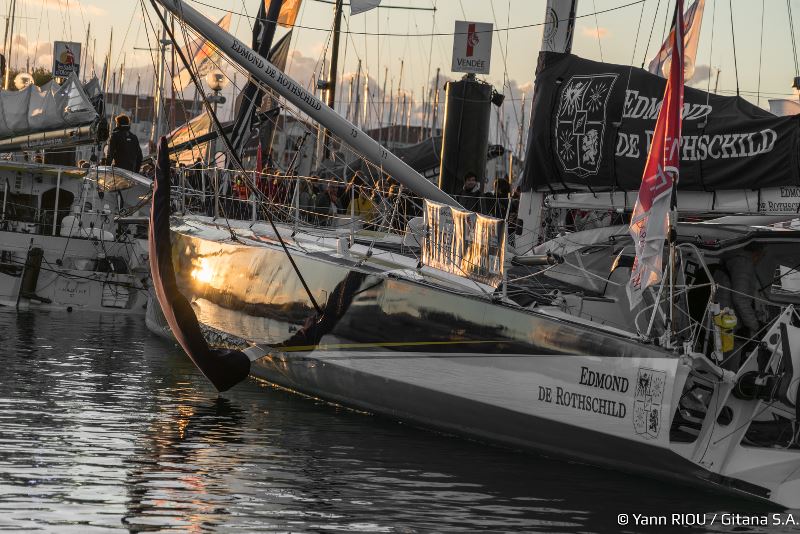
    These are probably the most visually striking innovations on the new Maxi Edmond de Rothschild. To fly high above rough seas while maintaining control, the team wanted very long rudders that would remain in contact with the water. The challenge is that longer rudders tend to flex under load, severely affecting steering and the efficiency of their lifting surfaces. A new geometry was needed to give these appendages maximum stiffness, resist cavitation and ultimately improve control of the boat and make better use of its power. The result is a set of U-shaped rudders over 4 metres long, a metre longer than those on Gitana 17. Their shape, reminiscent of a tripod or an inverted π, is only the visible part of what makes them so distinctive.

    A daggerboard optimised to stabilise the boat and limit cavitation

    With its wide span, the daggerboard resembles an aircraft tail assembly, with two adjustable flaps: one on the vertical section and the other on the horizontal section, the distinctive “manta-ray wing”. On Gitana 18, the innovation is to position this wing behind the vertical part of the appendage, rather than directly beneath it, to minimise flow disturbance and cavitation.

    Gitana 18’s daggerboard

    Rig: adjustable spreaders to control mainsail power while sailing

    Gitana 18’s mast is 1.50 metres taller than its predecessor’s. The boom is also shorter, creating a more slender sail plan. The major innovation is a set of spreaders that can be adjusted while sailing to bend the mast fore and aft. Actuated by hydraulic rams, these spreaders can pivot through 35 degrees to adjust the bend in the middle of the mast. This unprecedented system allows the sailor to control mainsail power: adding depth in light winds to take off sooner, or flattening the sail to reduce power at high speed or in strong winds. Adjusting the depth, and therefore the power, of the mainsail can also save a solo sailor time and energy by reducing the need for risky manoeuvres or headsail changes.

    Central hull:
    an integrated, structural coachroof

    The naval architects and Gitana design team wanted an exceptionally stiff, structurally robust platform. This applies both to the floats, which must withstand heavy loads from the foils and rudders, and to the central hull, which is subject to torsion. The enclosed coachroof is integrated into the hull and contributes to its structural strength. Inside, the cockpit brings all sail-handling controls together, with ergonomics shaped by many hours of design and development. The coachroof also stands out for the number and size of its windows. This configuration meets the visibility requirements of the Ultim class rules and gives sailors the best possible view to keep a visual watch.

    Gitana 18’s coachroof

    05.11.2016

    Set off Fast’ but not Furious’.

    Aboard the Mono60 Edmond de Rothschild, a calm is gradually taking hold. Sébastien Josse has loaded his bag aboard and each of the members of Gitana Team are checking that everything’s in position one last time. In Port Olona, the boat will spend a final night alone before she takes on the round the world adventure with her skipper. Sunday will beg…

    par Gitana

    Aboard the Mono60 Edmond de Rothschild, a calm is gradually taking hold. Sébastien Josse has loaded his bag aboard and each of the members of Gitana Team are checking that everything’s in position one last time. In Port Olona, the boat will spend a final night alone before she takes on the round the world adventure with her skipper. Sunday will begin with a series of emotional goodbyes, before launching into the canal out of Les Sables d’Olonne where hundreds of thousands of people will be out in force to wish these much cherished sailors all the best. The forecast promises to be mild for the kick-off at 12:02 GMT. Indeed, a N’ly wind of around fifteen knots will send the twenty-nine competitors on their way. Escorted by their shore crew and numerous spectator boats, the monohulls will likely take off quickly, slipping along downwind on what will still be fairly gentle seas in order to get their sea legs. From the end of the day, the wind is set to build across the Bay of Biscay as far as Cape Finisterre; the first important passage point which the front runners could reach on Monday, before first light. Perfect conditions for making good speed, they certainly won’t be simple and the sailors will have to be precise without being overly hasty.

    Staying ‘relaxed’ is easier said than done. Charging oneself up with positive emotion without letting yourself get overwhelmed. It’s a fine line which you’re never quite sure how to walk. “My mind set involves going about it with equanimity,” Sébastien Josse admits. “We’re setting off on a round the world. My aim in this first part of the race is to be on the pace when I hit the southern hemisphere, with a boat in good condition. You know that along the coast of Brazil, our foiling boat will be in their element and able to open up a lead. My priority is to make it into the Deep South feeling comfortable and right on my game.”


    A clear, but no less challenging forecast

    “With a N’ly breeze and hence cold air, the meteorological precision often underestimates the strength of the wind. Added to that, this NNW’ly will likely be shifty with lines of squalls that might well reach 25 knots in the Bay of Biscay, filling to 30 knots at Cape Finisterre, which we could well overtake at around 3:00 or 4:00 GMT on Monday morning,” explains the skipper.

    Antoine Koch is head of the Gitana Team Design Office. A sailor, he is also a member of the performance cell within the five-arrow stable. He’s supporting Sébastien in these final hours on shore so as prepare for the start of the race as best as possible. “We’re not in a position where we have a violent start with gales in the Bay of Biscay, nor are we in a tactically complex situation,” he explains. “Nevertheless, the competitors will have to put in a string of manoeuvres in order to adapt the sail area that deals with variations in the wind strength. Next, along the length of Portugal, they’ll come level with a small ridge of high pressure. At that point, it’ll be necessary to choose between heading along the coast to keep up the speed, or distance oneself from there, prepared to stumble slightly in the zone of light winds, but with some westerly separation that should pay off over the long term. The next section should be quick, straight towards the Doldrums. In the steady tradewinds, the skipper will need to link together a series of gybes, which are always very demanding in solo configuration. As such, if the situation presents itself in classic fashion, it will require a lot of energy from the sailors.”