








Heritage

Season 26
Types de médias
  • Photos
  • Vidéos
  • Sons
Années
  • 2026
  • 2024
  • 2023
  • 2022
  • 2021
  • 2020
  • 2019
  • 2018
  • 2017
  • 2016
  • 2015
  • 2014
Afficher les résultats (121)
supprimer tous les filtres
  • News
  • Gallery
  • Gitana 18
  • Team
  • Retractable Y-shaped foils, adjustable in three dimensions

    Inspired by the appendages of the America's Cup foiling monohulls, these Y-shaped foils have a wingspan of over 5 metres. They are designed to generate powerful lift, increase power and offer a wide range of adjustments to optimise flight at every point of sail and in all conditions. Beyond their impressive size, these foils feature many unique innovations.

    Revolutionary U-shaped rudders

    These are probably the most visually striking innovations on the new Maxi Edmond de Rothschild. To fly high above rough seas while maintaining control, the team wanted very long rudders that would remain in contact with the water. The challenge is that longer rudders tend to flex under load, severely affecting steering and the efficiency of their lifting surfaces. A new geometry was needed to give these appendages maximum stiffness, resist cavitation and ultimately improve control of the boat and make better use of its power. The result is a set of U-shaped rudders over 4 metres long, a metre longer than those on Gitana 17. Their shape, reminiscent of a tripod or an inverted π, is only the visible part of what makes them so distinctive.

    A daggerboard optimised to stabilise the boat and limit cavitation

    With its wide span, the daggerboard resembles an aircraft tail assembly, with two adjustable flaps: one on the vertical section and the other on the horizontal section, the distinctive “manta-ray wing”. On Gitana 18, the innovation is to position this wing behind the vertical part of the appendage, rather than directly beneath it, to minimise flow disturbance and cavitation.

    Gitana 18’s daggerboard

    Rig: adjustable spreaders to control mainsail power while sailing

    Gitana 18’s mast is 1.50 metres taller than its predecessor’s. The boom is also shorter, creating a more slender sail plan. The major innovation is a set of spreaders that can be adjusted while sailing to bend the mast fore and aft. Actuated by hydraulic rams, these spreaders can pivot through 35 degrees to adjust the bend in the middle of the mast. This unprecedented system allows the sailor to control mainsail power: adding depth in light winds to take off sooner, or flattening the sail to reduce power at high speed or in strong winds. Adjusting the depth, and therefore the power, of the mainsail can also save a solo sailor time and energy by reducing the need for risky manoeuvres or headsail changes.

    Central hull:
    an integrated, structural coachroof

    The naval architects and Gitana design team wanted an exceptionally stiff, structurally robust platform. This applies both to the floats, which must withstand heavy loads from the foils and rudders, and to the central hull, which is subject to torsion. The enclosed coachroof is integrated into the hull and contributes to its structural strength. Inside, the cockpit brings all sail-handling controls together, with ergonomics shaped by many hours of design and development. The coachroof also stands out for the number and size of its windows. This configuration meets the visibility requirements of the Ultim class rules and gives sailors the best possible view to keep a visual watch.

    Gitana 18’s coachroof

    29.04.2016

    The Transat, the history of a giant.

    Created in 1960 by the RWYC (Royal Western Yacht Club), the mother of solo offshore racing has stood the test of time, changing its name on many occasions but with few alterations to the concept. Traditionally open to multihulls and monohulls, its course sets sail from the south of England, first Portsmouth, now Plymouth, to make for America’s east…

    par Gitana

    Created in 1960 by the RWYC (Royal Western Yacht Club), the mother of solo offshore racing has stood the test of time, changing its name on many occasions but with few alterations to the concept. Traditionally open to multihulls and monohulls, its course sets sail from the south of England, first Portsmouth, now Plymouth, to make for America’s eastern seaboard and what was originally Newport, then Boston and today New York.

    Sponsored by the Observer newspaper, it took the name OSTAR (Observer Single-handed Trans-Atlantic Race), before switching title according to the sponsors. Most notable was the name Europe 1 Star then Europe 1New ManStar when it was backed by the famous French radio station from 1992 to 2000. More commonly known as The Transat on British soil, French sailors are more accustomed to saying the Transat Anglaise, to distinguish it from the races organised from metropolitan France and the Route du Rhum in particular. Indeed, the latter was created in 1978 to take the opposite course to its big English sister, whose measurement rules and accepted boat sizes were limited. As such, the French opted to open the route to the West Indies with complete architectural freedom.

    It has to be said that in the sixties and early seventies, the British daring was a symbol for the ultimate adventure, that of pioneering racers, setting sail into the great unknown aboard all types of boats and with practically no weather information. It was a scenario that delighted the media and listening to the virtually inaudible radio conversations picked up in the very middle of the ocean sent shivers down the spine of the public audience. 

    In this way, Éric Tabarly came out of obscurity in more ways than one, emerging out of the fog off Newport on 18 June 1964. Aboard Pen Duick II, a 13.6-metre ketch, whose automatic pilot had failed after 8 days at sea, the sailor had no idea he was leading. In this way, he won the race after a 27-day crossing and took the win ahead of English sailor, Francis Chichester, winner of the first edition in 1960 in over 40 days! At that point, offshore racing saw reason for the first time in France. Tabarly became a national hero and Charles de Gaulle awarded him the Légion d’Honneur. Another Frenchman, Alain Colas took victory in the race in 1972. In 1976, the ill-assorted fleet culminated at 125 boats. Colas fitted out the massive Club Méditerranée, some 72 metres in length, whilst Tabarly secured a second victory with Pen Duick VI, a boat designed for crewed configuration.

    Next came the dawning of the multihull age with victory going to American Phil Weld, then a long string of French successes with that of Yvon Fauconnier in 1984, Philippe Poupon in 1988, Loïck Peyron in 1992 and 1996, Francis Joyon in 2000 and Michel Desjoyeaux in 2004. After a 2008 edition reserved for 60 and 50-foot monohulls, which saw Loïck Peyron secure a third title, the race did not take place in 2012 due to the lack of budget. As a result, this 2016 edition is something of a renaissance. With a Franco-British organisation and a line-up of some twenty or so boats, The Transat is adopting a new image and now goes by the name of The Transat bakerly.

    10 out of 13 victories are French!
    1960 – Sir Francis Chichester (Gipsy Moth III) / 40d 12h 30 min
    1964 – Eric Tabarly (Pen Duick II) / 27d 03h 56 min
    1968 – Geoffrey Williams (Sir Thomas Lipton) / 25d 20h 33 min
    1972 – Alain Colas (Pen Duick IV) / 20d 13h 15 min
    1976 – Eric Tabarly (Pen Duick VI) / 23d 20h 12 min
    1980 – Phil Weld (Moxie) – 17d 23h 12 min
    1984 – Yvon Fauconnier (Umupro Jardin) / 16d 6h 25 min
    1988 – Philippe Poupon (Fleury Michon IX) / 10d 09h 15  min
    1992 – Loïck Peyron (Fujicolor) / 11d 01h 35 min
    1996 – Loïck Peyron (Fujicolor) / 10d 10h 05 min
    2000- Francis Joyon (Eure-et-Loir) / 9d 23h 21 min
    2004 – Michel Desjoyeaux (Géant) / 8d 8h 29 min
    2008 – Loïck Peyron (Gitana Eighty) / 12d 11h 45 min 

    The epic 2008 edition
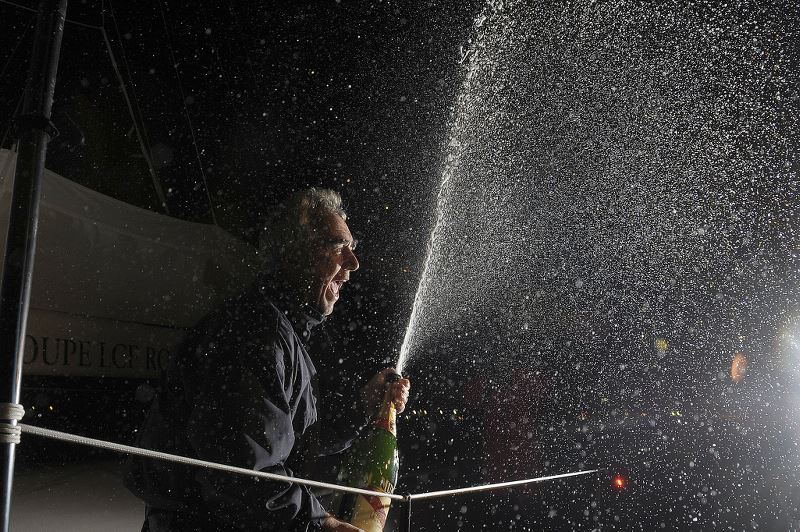

    Going by the name of the Artemis Transat at that time, the last edition of the oldest of the transatlantic races is marked by violent weather at the start of the race. Several retirements are to be lamented, including that of Sébastien Josse aboard the monohull BT, which suffers mast track damage whilst stealing a march at the head of the fleet. Vincent Riou has to resolve to retire his PRB from the race following a collision with a basking shark that damages his keel. Race Management asks Loïck Peyron to divert and go to his rival’s aid. He manages to recover Vincent Riou safe and sound aboard Gitana Eighty and extends his lead. Loïck Peyron takes the win in Boston with a race time of 12 days, 11 hours and 45 minutes, which is four weeks quicker than Sir Francis Chichester’s winning time in 1960. Following on from Mike Golding in 2004, the skipper from the Gitana racing stable sets the new and current event record for monohulls.