








Heritage

Season 26
Types de médias
  • Photos
  • Vidéos
  • Sons
Années
  • 2026
  • 2024
  • 2023
  • 2022
  • 2021
  • 2020
  • 2019
  • 2018
  • 2017
  • 2016
  • 2015
  • 2014
Afficher les résultats (121)
supprimer tous les filtres
  • News
  • Gallery
  • Gitana 18
  • Team
  • Retractable Y-shaped foils, adjustable in three dimensions

    Inspired by the appendages of the America's Cup foiling monohulls, these Y-shaped foils have a wingspan of over 5 metres. They are designed to generate powerful lift, increase power and offer a wide range of adjustments to optimise flight at every point of sail and in all conditions. Beyond their impressive size, these foils feature many unique innovations.

    Revolutionary U-shaped rudders

    These are probably the most visually striking innovations on the new Maxi Edmond de Rothschild. To fly high above rough seas while maintaining control, the team wanted very long rudders that would remain in contact with the water. The challenge is that longer rudders tend to flex under load, severely affecting steering and the efficiency of their lifting surfaces. A new geometry was needed to give these appendages maximum stiffness, resist cavitation and ultimately improve control of the boat and make better use of its power. The result is a set of U-shaped rudders over 4 metres long, a metre longer than those on Gitana 17. Their shape, reminiscent of a tripod or an inverted π, is only the visible part of what makes them so distinctive.

    A daggerboard optimised to stabilise the boat and limit cavitation

    With its wide span, the daggerboard resembles an aircraft tail assembly, with two adjustable flaps: one on the vertical section and the other on the horizontal section, the distinctive “manta-ray wing”. On Gitana 18, the innovation is to position this wing behind the vertical part of the appendage, rather than directly beneath it, to minimise flow disturbance and cavitation.

    Gitana 18’s daggerboard

    Rig: adjustable spreaders to control mainsail power while sailing

    Gitana 18’s mast is 1.50 metres taller than its predecessor’s. The boom is also shorter, creating a more slender sail plan. The major innovation is a set of spreaders that can be adjusted while sailing to bend the mast fore and aft. Actuated by hydraulic rams, these spreaders can pivot through 35 degrees to adjust the bend in the middle of the mast. This unprecedented system allows the sailor to control mainsail power: adding depth in light winds to take off sooner, or flattening the sail to reduce power at high speed or in strong winds. Adjusting the depth, and therefore the power, of the mainsail can also save a solo sailor time and energy by reducing the need for risky manoeuvres or headsail changes.

    Central hull:
    an integrated, structural coachroof

    The naval architects and Gitana design team wanted an exceptionally stiff, structurally robust platform. This applies both to the floats, which must withstand heavy loads from the foils and rudders, and to the central hull, which is subject to torsion. The enclosed coachroof is integrated into the hull and contributes to its structural strength. Inside, the cockpit brings all sail-handling controls together, with ergonomics shaped by many hours of design and development. The coachroof also stands out for the number and size of its windows. This configuration meets the visibility requirements of the Ultim class rules and gives sailors the best possible view to keep a visual watch.

    Gitana 18’s coachroof

    21.11.2021

    A second doldrums to finish.

    Last night, the Maxi Edmond de Rothschild slipped under the 1,000 miles to go mark with her sights firmly on the finish line. Franck Cammas and Charles Caudrelier are still dominating play in the Ultime category, leading the fleet for the 12th consecutive day out of the fourteen that so far make up this 2021 edition of the Transat Jacques Vabre. Ho…

    par Gitana

    Last night, the Maxi Edmond de Rothschild slipped under the 1,000 miles to go mark with her sights firmly on the finish line. Franck Cammas and Charles Caudrelier are still dominating play in the Ultime category, leading the fleet for the 12th consecutive day out of the fourteen that so far make up this 2021 edition of the Transat Jacques Vabre. However, the two skippers know that the last few hours separating them from Fort-de-France will feel like the longest. This is particularly true now as they have been embroiled in the doldrums again since this morning. Indeed, the intertropical convergence zone is stretching out its fingers a long way out to the west, immediately causing the head of the fleet to stall. Naturally this scenario favours Gitana 17’s pursuers, who will likely be able to squeeze back together with the five-arrow giant over this final section of the course. In the meantime, at the latest position report, the men of Gitana Team have been holding onto a lead of 400 miles or so over the Le Cléac’h – Escoffier duo and 500 over the crew on the latest addition to the Ultime fleet, SVR – Lazartigue.
    A Sunday in the doldrums, chapter 2 

    One week ago to the day, on Sunday 14 November, the five-arrow giant was the first to venture into the intertropical convergence zone. What ensued was twenty-four hours of sailing in light airs, grappling with the unknowns that characterise this passage and the stress it never fails to drum up among the sailors obliged to traverse it. One week on, history is repeating itself because since this morning, the Maxi Edmond de Rothschild has once again been sailing in the doldrums with the immediate stalling effect predicted for the end of the race. However, this second doldrums passage is less classic than the first and a long way out to the west and should have a different physiognomy: “For now, this latest doldrums passage looks easier to negotiate than it was in the outward leg. However, the next 24 hours will be important for us and pretty intense in terms of our observation of the satellite images so we can react quickly if a particular cell were to develop very quickly and cause the situation to deteriorate. There are still some lines of squalls possible on the way to Martinique,” warned Erwan Israël.     
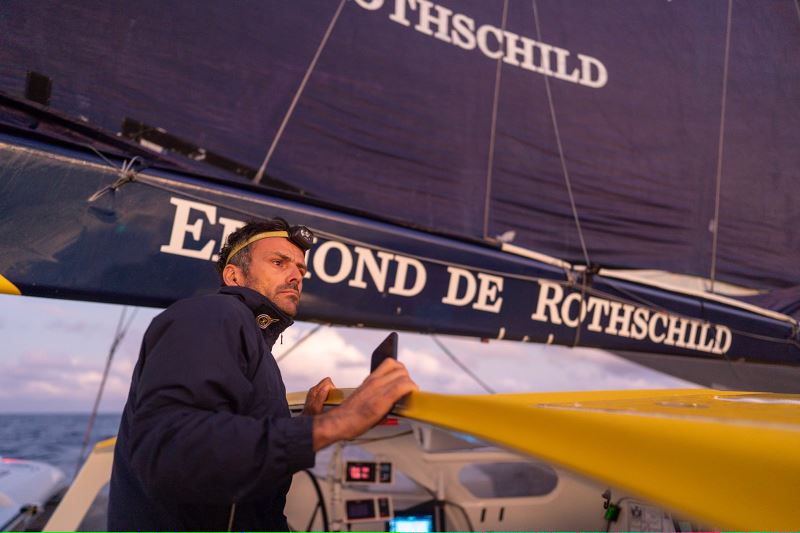
    In light of this situation and despite the obvious desire to make landfall on flower island as quickly as possible, the atmosphere aboard remains studious on the Maxi Edmond de Rothschild: “The end is nigh, but we need to stay focused on the boat in order to continue getting the best out of her. The latest forecasts are not indicating any major upsets ahead in terms of the weather, just light airs, but we are in the doldrums and by its very definition, we know that nothing can be taken for granted here and the unexpected cannot be ruled out”, admitted Franck Cammas.   

    Stalling at the front of the pack for the ‘sprint’ finale   

    “We are the first to enter the zone of light winds. Meantime, our pursuers will be able to hang onto a steadier breeze for longer so logically they’ll be able to catch up with us towards the end. The scenario favours them, but that’s racing for you. After passing São Pedro we were clearly better off than them. In relation to the wind, they had a less favourable angle than us for the long tack towards the no-go zone along the north coast of Brazil and had to launch into their series of gybes further south than Franck and Charles, which meant they had to manoeuvre more…” explained the router from his HQ in Lorient.     
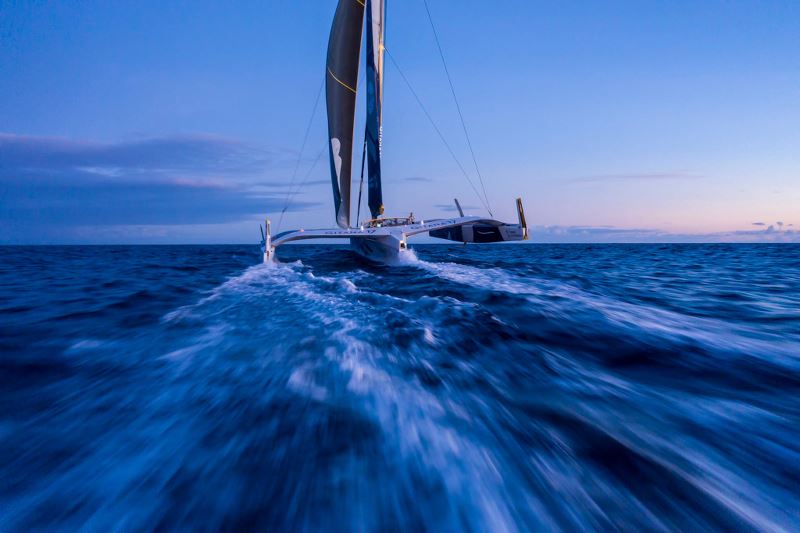
    The suggested pattern of light airs for the end of the race seems to be playing out then. However, for the Maxi Edmond de Rothschild’s weather cell, it’s still too early to give a precise and reliable ETA: “according to the latest weather model (GFS, CEP or Arpege) there may be a 24-hour discrepancy ranging between the morning of 23 and the night of the 24 November…”   

    In this way, it will all depend on what breeze the flying maxi-trimarans manage to latch onto upon exiting their second doldrums. If the trade wind plays ball a little, a finish on the morning of 23 is possible in the bay of Fort-de-France. However, if this is not the case, we’ll have to wait a few more hours to celebrate the 2021 winners of the Transat Jacques Vabre in the Ultime category. Will they be the first across the finish line? Right now, it’s hard to know.     

    Positions on Sunday 21 November at 10:00 UTC 

    1. Maxi Edmond de Rothschild (F. Cammas / C. Caudrelier) 841.7 miles from the finish 
    2. Banque Populaire XI (A. Le Cléac’h / K. Escoffier) + 418.9 miles 
    3. SVR – Lazartigue (F. Gabart / T. Laperche) + 507.1 miles 
    4. Actual (Y. Le Blevec / A. Marchand) + 1,039.4 miles 
    5. Sodebo (T. Coville / T.Rouxel) + 1,198.1 miles