








Heritage

Season 26
Types de médias
  • Photos
  • Vidéos
  • Sons
Années
  • 2026
  • 2024
  • 2023
  • 2022
  • 2021
  • 2020
  • 2019
  • 2018
  • 2017
  • 2016
  • 2015
  • 2014
Afficher les résultats (121)
supprimer tous les filtres
  • News
  • Gallery
  • Gitana 18
  • Team
  • Retractable Y-shaped foils, adjustable in three dimensions

    Inspired by the appendages of the America's Cup foiling monohulls, these Y-shaped foils have a wingspan of over 5 metres. They are designed to generate powerful lift, increase power and offer a wide range of adjustments to optimise flight at every point of sail and in all conditions. Beyond their impressive size, these foils feature many unique innovations.

    Revolutionary U-shaped rudders

    These are probably the most visually striking innovations on the new Maxi Edmond de Rothschild. To fly high above rough seas while maintaining control, the team wanted very long rudders that would remain in contact with the water. The challenge is that longer rudders tend to flex under load, severely affecting steering and the efficiency of their lifting surfaces. A new geometry was needed to give these appendages maximum stiffness, resist cavitation and ultimately improve control of the boat and make better use of its power. The result is a set of U-shaped rudders over 4 metres long, a metre longer than those on Gitana 17. Their shape, reminiscent of a tripod or an inverted π, is only the visible part of what makes them so distinctive.

    A daggerboard optimised to stabilise the boat and limit cavitation

    With its wide span, the daggerboard resembles an aircraft tail assembly, with two adjustable flaps: one on the vertical section and the other on the horizontal section, the distinctive “manta-ray wing”. On Gitana 18, the innovation is to position this wing behind the vertical part of the appendage, rather than directly beneath it, to minimise flow disturbance and cavitation.

    Gitana 18’s daggerboard

    Rig: adjustable spreaders to control mainsail power while sailing

    Gitana 18’s mast is 1.50 metres taller than its predecessor’s. The boom is also shorter, creating a more slender sail plan. The major innovation is a set of spreaders that can be adjusted while sailing to bend the mast fore and aft. Actuated by hydraulic rams, these spreaders can pivot through 35 degrees to adjust the bend in the middle of the mast. This unprecedented system allows the sailor to control mainsail power: adding depth in light winds to take off sooner, or flattening the sail to reduce power at high speed or in strong winds. Adjusting the depth, and therefore the power, of the mainsail can also save a solo sailor time and energy by reducing the need for risky manoeuvres or headsail changes.

    Central hull:
    an integrated, structural coachroof

    The naval architects and Gitana design team wanted an exceptionally stiff, structurally robust platform. This applies both to the floats, which must withstand heavy loads from the foils and rudders, and to the central hull, which is subject to torsion. The enclosed coachroof is integrated into the hull and contributes to its structural strength. Inside, the cockpit brings all sail-handling controls together, with ergonomics shaped by many hours of design and development. The coachroof also stands out for the number and size of its windows. This configuration meets the visibility requirements of the Ultim class rules and gives sailors the best possible view to keep a visual watch.

    Gitana 18’s coachroof

    14.11.2021

    A Sunday in the doldrums.

    Yesterday was a studious day aboard the Maxi Edmond de Rothschild. Despite some lively hours on Friday night through into Saturday to repair some mechanical damage to the engine, which could have forced them to make a stopover in Cape Verde, Franck Cammas and Charles Caudrelier have not reduced the tempo they’re setting at the head of the race. Qui…

    par Gitana

    Yesterday was a studious day aboard the Maxi Edmond de Rothschild. Despite some lively hours on Friday night through into Saturday to repair some mechanical damage to the engine, which could have forced them to make a stopover in Cape Verde, Franck Cammas and Charles Caudrelier have not reduced the tempo they’re setting at the head of the race. Quite the contrary in fact. Their objective was clear: to rack up all the miles they could to benefit from a significant cushion ahead of their opponents on entering the intertropical convergence zone. This morning, the sailors of Gitana Team were logically the first to suffer the trials and tribulations of the doldrums, as evidenced by their average speed over 4hrs, which has dipped below the 20-knot mark. In their wake, the other giants are still lengthening their stride but they too should start to stall over the next few hours. That is what the Caudrelier-Cammas duo are hoping will happen at least.
    Initial signs!

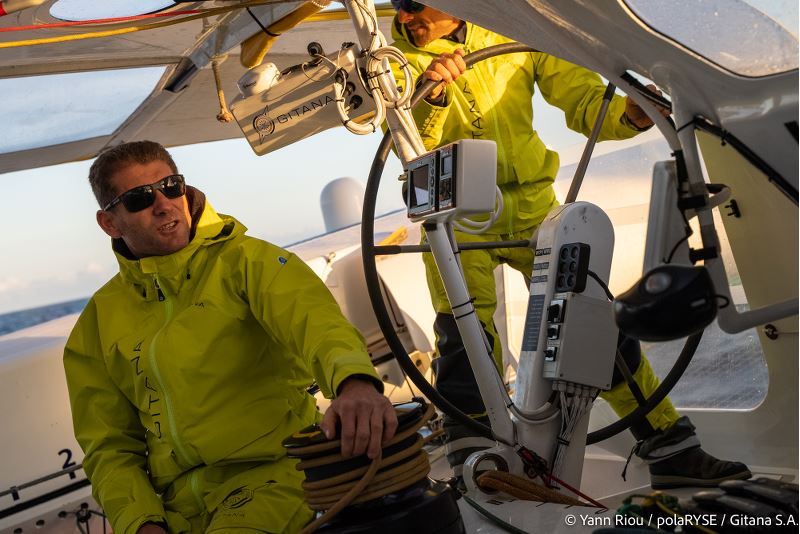
    The atmosphere is one of concentration aboard the Maxi Edmond de Rothschild, as well as in Lorient, at the heart of Gitana Team’s weather cell this Sunday 14 November, exactly a week since the start. The doldrums is never a trivial matter, and as Charles Caudrelier often says: “a race can be lost and won here!” For the past forty-eight hours, all eyes have been on this intertropical convergence zone so dreaded by sailors. It has to be said that here, where the air masses of the two hemispheres collide, the logical and the rational are not common currency: “That’s it! The Maxi Edmond de Rothschild is the first to enter the doldrums. That’s good news as we’re at the front of the fleet, but it’s still stressful to be leading the way into this zone we’re always so careful about. It can be very unfair at times the doldrums. We all recall and bear in mind what happened to Charal in the last Transat Jacques Vabre. They had a big lead on entering and a big deficit on exiting! We need to remain focused and get the boat making headway towards the exit. We’re at the heart of the matter in a fairly light breeze, but we’re still making headway, which is something. You have to take things one at a time here and be opportunistic as far as the exit,” admitted Charles Caudrelier from the cockpit of the Maxi Edmond de Rothschild.
     

    From Le Havre to the doldrums, one week of racing!

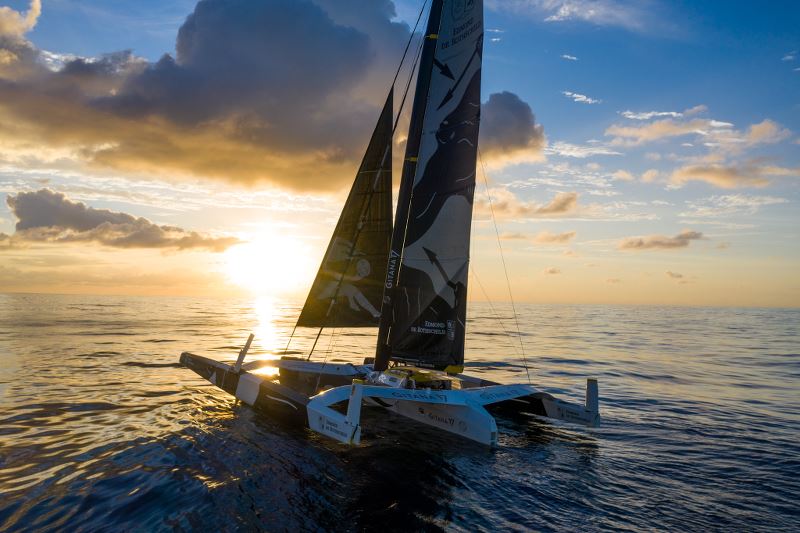
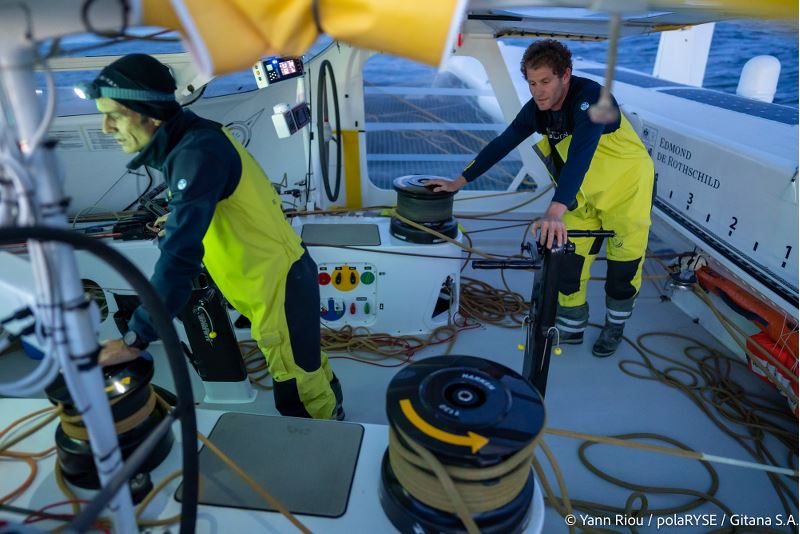
    On 7 November at 12:27 UTC, the Transat Jacques Vabre fleet set off to take on the 15th edition with Fort-de-France as the final destination for the first time in the race’s history. The seventy-nine competing duos made the most of the boisterous but ideal weather conditions to put on a great show along the cliffs of Normandy. The aerial shots of the Ultimes mid-flight offshore of Etretat will attest to this fact for a long time to come. Enjoying an excellent start, Franck Cammas and Charles Caudrelier immediately got the Maxi Edmond de Rothschild up to the head of the fleet and she is still there now after one week of racing, albeit as a result of a great deal of hard work. On deck and at the helm of the five-arrow maxi-trimaran, our duo has been performing brilliantly since the start, safe in the knowledge that on land it can count on the remarkable work of its routing cell.


    “We’re proud of the way we’ve sailed the first part of the race and what we’ve done to get this far. Our pursuers have made up ground on us several times, but we’ve always managed to get away again to benefit from a small lead today. The Maxi Edmond de Rothschild is in perfect condition and that’s the first time we’re arrived at the equator with the boat in such good shape. The shore crew has given their all during recent months and that’s paying off! Congratulations to them. With regards the weather, our onshore routing team has been doing a fantastic job since the start. It was a very complicated descent, with a lot of choices to be made and I feel that we’ve often made the right ones. We haven’t made a lot of errors… perhaps the only one being that we wanted to take the inside track at Ushant, whilst at the start we planned to make an offshore rounding. We quickly made up for that though,” concluded the skipper of the blue maxi-trimaran.
    Positions on Sunday 14 November at 17:00 UTC
    1. Maxi Edmond de Rothschild (F. Cammas / C. Caudrelier) 4,905 miles from the finish
    2. SVR – Lazartigue (F. Gabart / T. Laperche) + 183,8 miles
    3. Banque Populaire XI (A. Le Cléac’h / K. Escoffier) + 292,5 miles
    4. Actual (Y. Le Blevec / A. Marchand) + 341,2 miles
      Sodebo (T. Coville / T.Rouxel) + 673,6 miles