








Heritage

Season 26
Types de médias
  • Photos
  • Vidéos
  • Sons
Années
  • 2026
  • 2024
  • 2023
  • 2022
  • 2021
  • 2020
  • 2019
  • 2018
  • 2017
  • 2016
  • 2015
  • 2014
Afficher les résultats (121)
supprimer tous les filtres
  • News
  • Gallery
  • Gitana 18
  • Team
  • Retractable Y-shaped foils, adjustable in three dimensions

    Inspired by the appendages of the America's Cup foiling monohulls, these Y-shaped foils have a wingspan of over 5 metres. They are designed to generate powerful lift, increase power and offer a wide range of adjustments to optimise flight at every point of sail and in all conditions. Beyond their impressive size, these foils feature many unique innovations.

    Revolutionary U-shaped rudders

    These are probably the most visually striking innovations on the new Maxi Edmond de Rothschild. To fly high above rough seas while maintaining control, the team wanted very long rudders that would remain in contact with the water. The challenge is that longer rudders tend to flex under load, severely affecting steering and the efficiency of their lifting surfaces. A new geometry was needed to give these appendages maximum stiffness, resist cavitation and ultimately improve control of the boat and make better use of its power. The result is a set of U-shaped rudders over 4 metres long, a metre longer than those on Gitana 17. Their shape, reminiscent of a tripod or an inverted π, is only the visible part of what makes them so distinctive.

    A daggerboard optimised to stabilise the boat and limit cavitation

    With its wide span, the daggerboard resembles an aircraft tail assembly, with two adjustable flaps: one on the vertical section and the other on the horizontal section, the distinctive “manta-ray wing”. On Gitana 18, the innovation is to position this wing behind the vertical part of the appendage, rather than directly beneath it, to minimise flow disturbance and cavitation.

    Gitana 18’s daggerboard

    Rig: adjustable spreaders to control mainsail power while sailing

    Gitana 18’s mast is 1.50 metres taller than its predecessor’s. The boom is also shorter, creating a more slender sail plan. The major innovation is a set of spreaders that can be adjusted while sailing to bend the mast fore and aft. Actuated by hydraulic rams, these spreaders can pivot through 35 degrees to adjust the bend in the middle of the mast. This unprecedented system allows the sailor to control mainsail power: adding depth in light winds to take off sooner, or flattening the sail to reduce power at high speed or in strong winds. Adjusting the depth, and therefore the power, of the mainsail can also save a solo sailor time and energy by reducing the need for risky manoeuvres or headsail changes.

    Central hull:
    an integrated, structural coachroof

    The naval architects and Gitana design team wanted an exceptionally stiff, structurally robust platform. This applies both to the floats, which must withstand heavy loads from the foils and rudders, and to the central hull, which is subject to torsion. The enclosed coachroof is integrated into the hull and contributes to its structural strength. Inside, the cockpit brings all sail-handling controls together, with ergonomics shaped by many hours of design and development. The coachroof also stands out for the number and size of its windows. This configuration meets the visibility requirements of the Ultim class rules and gives sailors the best possible view to keep a visual watch.

    Gitana 18’s coachroof

    08.01.2021

    A window named desire!.

    To take on the Jules Verne Trophy, you obviously need an excellent boat, an equally exceptional crew to drive her at her true potential, as well as a certain composure and nerves of steel to endure the wait for the right weather window. Since Monday, the crew of the Maxi Edmond de Rothschild has been on the alert, ready to climb aboard and cast off…

    par Gitana

    To take on the Jules Verne Trophy, you obviously need an excellent boat, an equally exceptional crew to drive her at her true potential, as well as a certain composure and nerves of steel to endure the wait for the right weather window. Since Monday, the crew of the Maxi Edmond de Rothschild has been on the alert, ready to climb aboard and cast off on a 40-day sea passage the moment the Gitana Team’s router, Marcel van Triest, gives the green light. In this way, the lives of the six sailors and all the team have been coloured by the rhythm of the weather analysis and their twice-daily updates. Now, after a five-day wait, the planets seem to be in alignment and everything is coming together for the crew to leave the dock in Lorient tomorrow afternoon. At that point, Franck Cammas, Charles Caudrelier, David Boileau, Morgan Lagravière, Erwan Israël and Yann Riou will make for the north-west tip of Brittany with a view to crossing the line offshore of Ushant some time on Saturday 9 through into Sunday 10 January.


    A sliding code yellow


    On Tuesday 4 January, the five-arrow team switched to code yellow, a chromatic change synonymous with a possible departure within the next 24 to 48 hours. Since then though, the departure window has been constantly sliding and ultimately it is on Saturday night through into Sunday that the situation looks set to become clearer. “Code yellow is extending but for just reason!” assures Cyril Dardashti, director of the racing stable founded by Ariane and Benjamin de Rothschild: “After a period of standby spanning over two months and an initial fruitless attempt, we’re all looking forward to seeing the crew set sail. However, the record we’re hunting down is so demanding that this departure window is crucial. Together with Marcel van Triest we’ve been watching things play out in the right direction since Monday. We’re lucky in that the window in the North Atlantic is a long one, which has enabled us to play for time and let things in the south evolve so we can better position ourselves in relation to the weather sequence we want to hook up with offshore of Brazil. Today things are taking shape and it’s absolutely thrilling to be ready to tackle the Jules Verne Trophy again according to the timing criteria we’d set ourselves.”

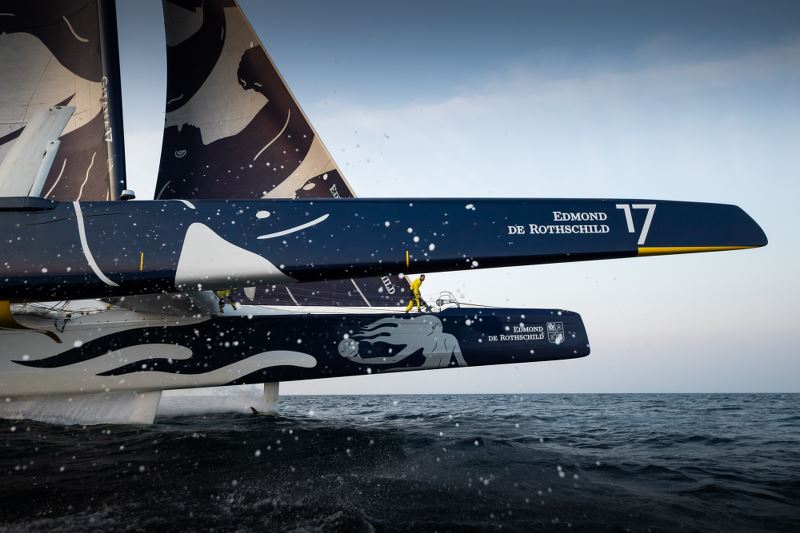
    Exiting the Bay of Biscay with a NE’ly


    Tomorrow morning, if everything goes according to plan, the Gitana Team will switch to code green. From that moment, everything will link together very quickly for the six sailors, who are preparing to secure the outright round the world record under sail, from loading the bags of personal effects to bidding farewell to their families, to the final weather briefing with Marcel van Triest. It will then be time to cast off, bound for Ushant and Le Créac’h lighthouse. As was the case in late November, during their first attempt, the night-time rendez-vous with this point will be their final contact with the French coast as the 32-metre giant turns her bows southwards: “According to our latest forecasts, we’ll likely set sail with a 15-20-knot NE’ly wind in the area in question on very manageable seas. The wind is set to fill out to 25-30 knots as we approach Cape Finisterre and the descent along the length of the Iberian peninsula will be bracing. However, the advantage of a NE’ly breeze is that we’ll have good seas. There’s a low-pressure system at Cape St Vincent which we’ll be hunting down before gybing towards the Azores High. Below the zone of high pressure, we’ll have to put in another gybe before setting a course for the equator,” explained Charles Caudrelier.  

    Though this weather configuration finally seems to be playing out as the crew wants after weeks of waiting, the descent towards the southern hemisphere will be far from restful as the timing is tight: “With this weather window we’re aiming for a sub-5-day time to the equator and a sub-12-day time to Cape Agulhas. If we were solely aiming to break the record to the equator, our departure timing is not the best, but it’s a compromise to ensure we have the best possible window in the Atlantic as a whole. For now, the latter seems quite favourable with a route that isn’t too extreme in the south, but we’ll have to adjust our trajectory again during our descent as that’s still a long way off and there’s time for things to evolve before then”, concluded the co-skipper of the Maxi Edmond de Rothschild.
    Mémo Trophée Jules Verne

    Équipage Maxi Edmond de Rothschild :

    Franck Cammas et Charles Caudrelier, skippers
    David Boileau, régleur N°1
    Erwan Israël, barreur régleur
    Morgan Lagravière, barreur régleur
    Yann Riou, régleur médiaman

    Marcel van Triest, routeur météo
    Yann Eliès, équipier remplaçant 
    Record à battre :
    40 jours, 23 heures et 30 minutes > Record détenu par Francis Joyon et son équipage (Idec Sport) depuis le 26 janvier 2017.