








Heritage

Season 26
Types de médias
  • Photos
  • Vidéos
  • Sons
Années
  • 2026
  • 2024
  • 2023
  • 2022
  • 2021
  • 2020
  • 2019
  • 2018
  • 2017
  • 2016
  • 2015
  • 2014
Afficher les résultats (121)
supprimer tous les filtres
  • News
  • Gallery
  • Gitana 18
  • Team
  • Retractable Y-shaped foils, adjustable in three dimensions

    Inspired by the appendages of the America's Cup foiling monohulls, these Y-shaped foils have a wingspan of over 5 metres. They are designed to generate powerful lift, increase power and offer a wide range of adjustments to optimise flight at every point of sail and in all conditions. Beyond their impressive size, these foils feature many unique innovations.

    Revolutionary U-shaped rudders

    These are probably the most visually striking innovations on the new Maxi Edmond de Rothschild. To fly high above rough seas while maintaining control, the team wanted very long rudders that would remain in contact with the water. The challenge is that longer rudders tend to flex under load, severely affecting steering and the efficiency of their lifting surfaces. A new geometry was needed to give these appendages maximum stiffness, resist cavitation and ultimately improve control of the boat and make better use of its power. The result is a set of U-shaped rudders over 4 metres long, a metre longer than those on Gitana 17. Their shape, reminiscent of a tripod or an inverted π, is only the visible part of what makes them so distinctive.

    A daggerboard optimised to stabilise the boat and limit cavitation

    With its wide span, the daggerboard resembles an aircraft tail assembly, with two adjustable flaps: one on the vertical section and the other on the horizontal section, the distinctive “manta-ray wing”. On Gitana 18, the innovation is to position this wing behind the vertical part of the appendage, rather than directly beneath it, to minimise flow disturbance and cavitation.

    Gitana 18’s daggerboard

    Rig: adjustable spreaders to control mainsail power while sailing

    Gitana 18’s mast is 1.50 metres taller than its predecessor’s. The boom is also shorter, creating a more slender sail plan. The major innovation is a set of spreaders that can be adjusted while sailing to bend the mast fore and aft. Actuated by hydraulic rams, these spreaders can pivot through 35 degrees to adjust the bend in the middle of the mast. This unprecedented system allows the sailor to control mainsail power: adding depth in light winds to take off sooner, or flattening the sail to reduce power at high speed or in strong winds. Adjusting the depth, and therefore the power, of the mainsail can also save a solo sailor time and energy by reducing the need for risky manoeuvres or headsail changes.

    Central hull:
    an integrated, structural coachroof

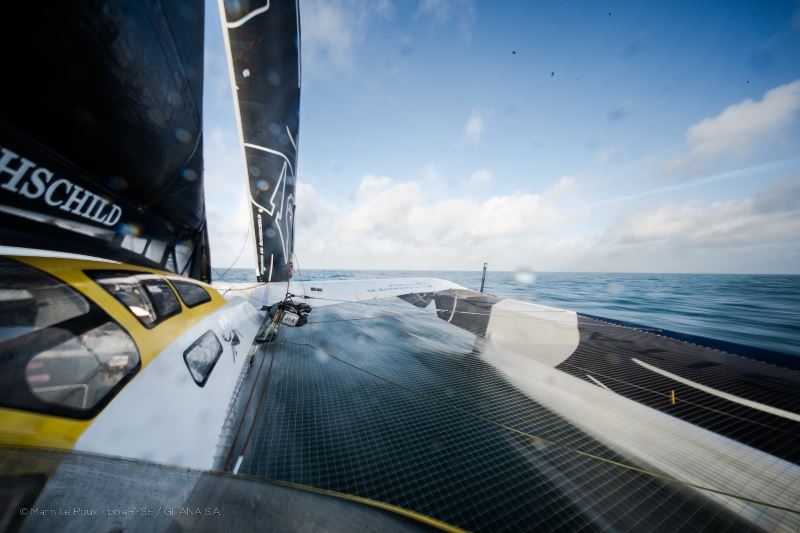
    The naval architects and Gitana design team wanted an exceptionally stiff, structurally robust platform. This applies both to the floats, which must withstand heavy loads from the foils and rudders, and to the central hull, which is subject to torsion. The enclosed coachroof is integrated into the hull and contributes to its structural strength. Inside, the cockpit brings all sail-handling controls together, with ergonomics shaped by many hours of design and development. The coachroof also stands out for the number and size of its windows. This configuration meets the visibility requirements of the Ultim class rules and gives sailors the best possible view to keep a visual watch.

    Gitana 18’s coachroof

    16.01.2024

    Aboard the South Atlantic express train.

    Late yesterday, Charles Caudrelier was passing offshore of the Brazilian coast, abeam of Cabo Frio and the latitude of Rio de Janeiro. This Tuesday, the Maxi Edmond de Rothschild has bent her course right around towards the south-east to begin her passage across the South Atlantic, bound for the first major cape Good Hope of this Arkea Ultim Challe…

    par Gitana

    Late yesterday, Charles Caudrelier was passing offshore of the Brazilian coast, abeam of Cabo Frio and the latitude of Rio de Janeiro. This Tuesday, the Maxi Edmond de Rothschild has bent her course right around towards the south-east to begin her passage across the South Atlantic, bound for the first major cape Good Hope of this Arkea Ultim Challenge. The pace is high and the rhythm being set by the solo sailors is impressing enthusiasts and enlightened observers alike, yet these long downwind tacks are also proving to be a great opportunity to recuperate prior to the tough conditions of the Southern Ocean, as the skipper of Gitana Team admits. At the head of the fleet, the duel between the top two is as intense as ever. At this evening’s ranking, Tom Laperche’s lead had shrunk considerably and Charles Caudrelier had closed to within 10 miles of the young leader.
    A day of transition

    The atmosphere is still tropical aboard the maxi-trimarans in the Arkea Ultim Challenge. Charles Caudrelier’s images from the ocean testify to this, even though the sailor readily admitted that he relished the drop in temperature hinted at over the past few hours. Making headway at 30° South this Tuesday evening, bound for the Cape of Good Hope, he’s well aware that conditions are set to change, most likely from tomorrow. A fleece and foulies will soon replace the shorts and T-shirt for some time to come.

    Neck and neck for some days at the head of the race, Charles Caudrelier and Tom Laperche are stuck together like glue: “Tom is sailing an outstanding race. Congratulations to him! It’s funny because a few years ago we were neighbours in La Trinité-sur-Mer (Brittany) and I remember him training on a foiling Moth. I never thought I’d rediscover him here… We talk to one another a lot and I connect with him. At 26, I didn’t pester guys twice my age, I stuck with the Figaro…” joked Charles Caudrelier.

    Though this top duo is clearly on track to catch a ride on the train of depressions rolling across the south, which will propel them along at high speed ahead of a front bound for their first cape in South Africa, the fate of their pursuers remains uncertain. Very quick throughout the day, Thomas Coville, currently 3rd over 375 miles astern, seems to have his heart set on hooking onto the same wagon.
     

    Sleep and collaboration with the BULTEX teams

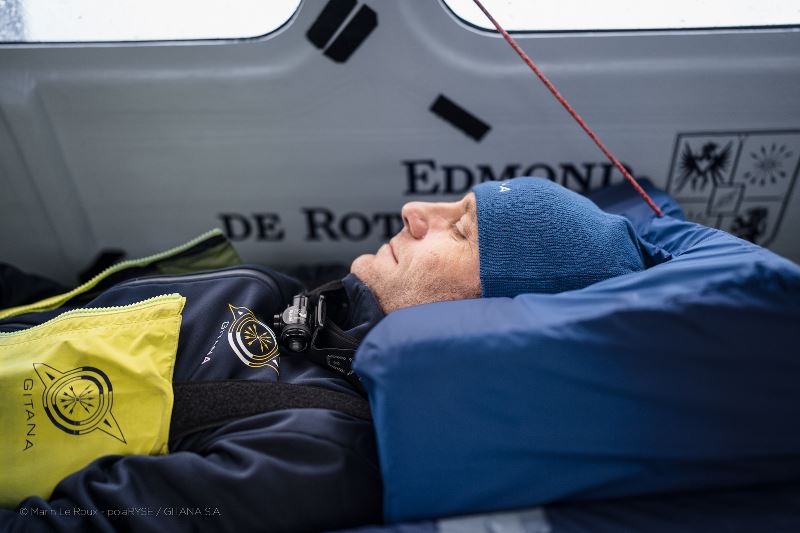
    “Conditions were perfect last night. The boat was making good headway and I got the chance to rack up a lot of sleep and recuperate. It was my longest night since the start, even though I wake up about every hour during my sleep phases to check the trimming is ok. I’m lucky enough to have a made-to-measure BULTEX mattress, especially for this race. It has the right profile, suited to my morphology and the environment in the cockpit of the Maxi Edmond de Rothschild. Last night, I put it outside to benefit from the cooler air and it was perfect. In addition to the mattress, BULTEX has made a cushion moulded to the shape of my head, which makes sure I’m perfectly supported when I sleep.”

    Among the other good news today is the fact that Armel Le Cléac’h is back in action. Forced to make a pit stop in Recife, in northern Brazil, to repair certain elements damaged during the first days at sea (headsail, pulpit, foil hydraulics) the skipper of Banque Populaire XI returned to the racetrack at midday. As a result, the fleet is complete once again at the start of this 10th day of racing.

    Ranking at the 18:00 UTC position report 

    1)     SVR Lazartigue – Tom Laperche     
    2)     Maxi Edmond de Rothschild – Charles Caudrelier – some 9.2 miles behind the leader
    3)     Sodebo Ultim 3 – Thomas Coville – 375.7 miles behind the leader
    4)     Actual Ultim 3 – Anthony Marchand – 1,169.3 miles behind the leader
    5)     Maxi Banque Populaire XI – Armel Le Cleac’h – 1,285.7 miles behind the leader
    6)     Ultim Adagio – Eric Peron – 2,066.3 miles behind the leader