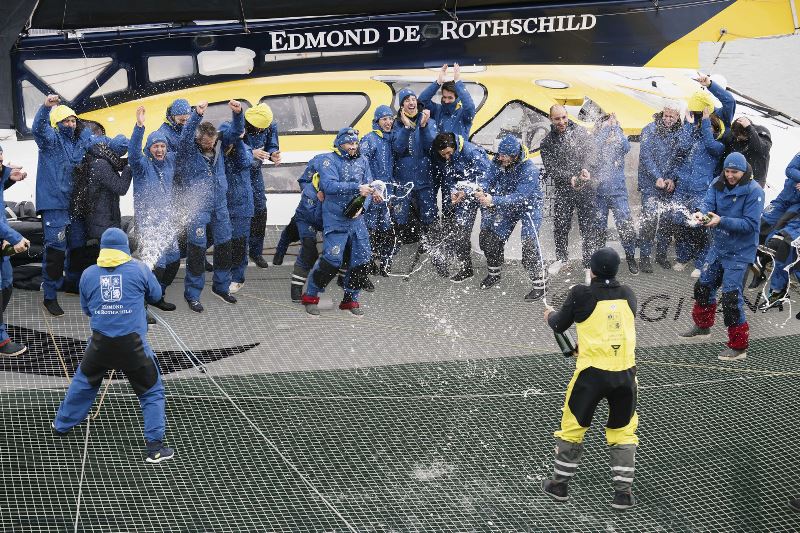
“It is ten times harder than a Vendée Globe”, stated Armel Le Cléac’h on his arrival dockside on Quai Malbert. Having never circumnavigated the globe in IMOCA, Charles Caudrelier cannot share this benchmark, but this comment from his rival, a Vendée Globe champion, does lift the veil on the amount of daily challenges that had to be resolved to race to Brest and back via a circumnavigation of Antarctica.
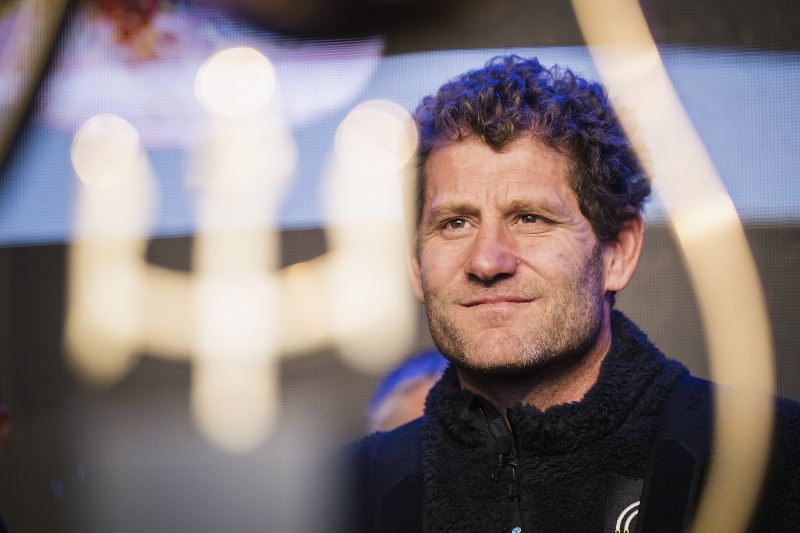
Taking refuge in his modesty, the skipper of the Maxi Edmond de Rothschild remains discreet about the difficulties he encountered during the race. However, his first single-handed circumnavigation of the globe was not a smooth ride. On the contrary, he was able to testify to the veracity of Michel Desjoyeaux’s sentiment that there are daily problems to be resolved whilst navigating one’s way around the planet.
Serious damage to two elements of the boat might well have put paid to his chances of victory and forced him to bring his race to a halt: breaking the fairing on the forward beam and thus exposing it to the elements just four days after the start, then the ripping of the mainsail after rounding Cape Horn, offshore of the Falklands. A third incident – the helming pod ripped out on 5 February -, was a sharp call to order when he inadvertently fell through the hole that had opened up in the cockpit sole, his legs dangling in the void, just centimetres above the water as he rushed across it at 50 km/h.
The full list of technical glitches suffered by the Maxi Edmond de Rothschild goes on and on. “We’ll undergo a four-month refit,”reveals Sébastien Sainson, director of Gitana Team’s design office. Charles Caudrelier resolved practically all the issues aboard, though he lived in constant fear of the various elements breaking again. His strategic 3-day pit stop in the Azores to avoid the impassable weather conditions in the Bay of Biscay due to Storm Louis rolling through, was not a comfortable ‘time-out’ for the skipper. On the contrary, the sailor remained in his sailing gear, connected to his boat, under pressure and keen to get back out on the water and finally get his five-arrow maxi-trimaran to the finish safe and sound.
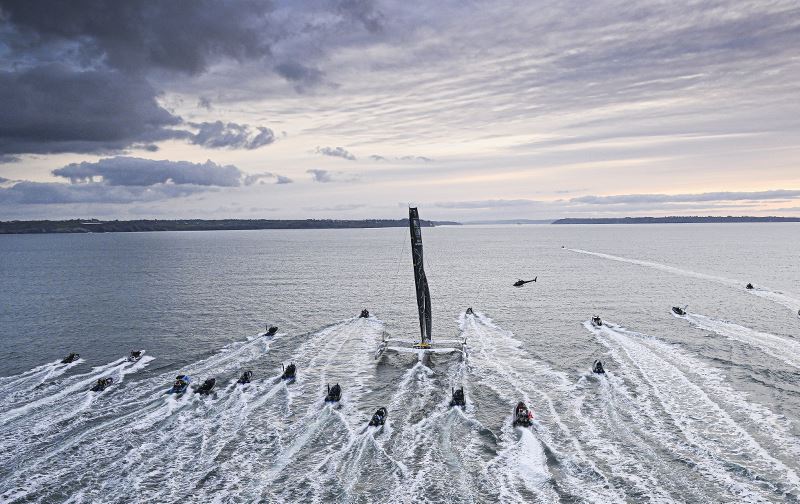
Ultimately, the skipper of Gitana Team was the first to prove that a crazy circuit around the world on a flying boat was possible, provided that one is armed to the hilt technically, physically and mentally, and accompanied every step of the way by a team of men and women focused on the same objective. Behind the collective mechanics, behind a skipper transformed into a winning machine, there is a great deal of human input, willpower, know-how and preparation time.
His victory is the fruit of a lengthy process of creation, work, rolling with the punches and picking oneself up to go again.
The boat’s naval architect Guillaume Verdier, who collaborated with Team New Zealand for the America’s Cup 2013, has helped to bring to life large multihulls capable of flying along at very high speed. For this boat, in collaboration with Gitana Team’s design office and its technical team, he put his experience to work in a bid to pull off the gamble of getting a large trimaran to fly in the open ocean. “From the get-go, the idea was to create a boat that didn’t twist, to place the emphasis on sturdy mechanical systems capable of moving appendages under load and opting for a ray wing (lifting surface on the centreboard), which would give the boat increased stability in flight, despite the drag. We were also the first to come up with T-foil rudders that lift vertically, explains Guillaume Verdier. “It is the ‘MOD 70’ model which made it possible to take the first step in this direction in 2014, he continues. It was a massive step up to a 32-metre multihull. It wasn’t always straightforward, but from the moment the boat got out on the water, it was clear that she was of noble birth and that we had seized the potential.”
With this latest victory, which has to be the finest on her track record, the Maxi Edmond de Rothschild goes down in legend with even more assurance and she still has an illustrious career ahead of her. On the programme is a Jules Verne Trophy for the winter of 2024-2025. Charles Caudrelier will naturally be at the helm, this time with crew.
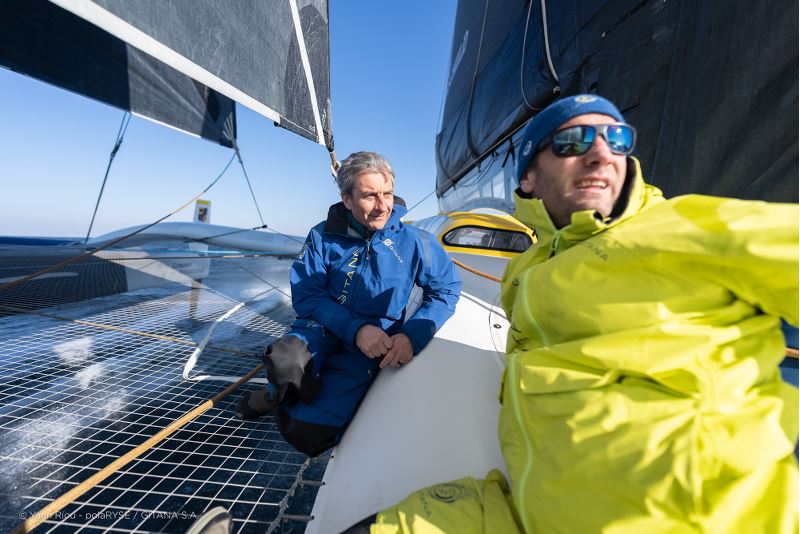
Meantime, he is playing an integral part in the development of the new Maxi Edmond de Rothschild, Gitana 18. Her launch is scheduled for 18 months’ time, in September 2025. This new sailboat is an extension of the epic Gitana saga and represents a whole new challenge for the racing stable founded by Ariane and Benjamin de Rothschild.
“We’re turning the page in what is set to be another leap forward in architecture. We’re taking inspiration from what already exists, whilst working on new areas of innovation. Creating a new boat is not about making a replica of the previous one!” promises Guillaume Verdier.
In the meantime, Charles Caudrelier and his team are easing off the throttle momentarily with a few weeks away from the office. “The dream, now, is to spend every evening at home,” admitted the sailor a few hours after his arrival in Brest. The next stage of his programme is set to be as compelling as it is enthralling.