








Heritage

Season 26
Types de médias
  • Photos
  • Vidéos
  • Sons
Années
  • 2026
  • 2024
  • 2023
  • 2022
  • 2021
  • 2020
  • 2019
  • 2018
  • 2017
  • 2016
  • 2015
  • 2014
Afficher les résultats (121)
supprimer tous les filtres
  • News
  • Gallery
  • Gitana 18
  • Team
  • Retractable Y-shaped foils, adjustable in three dimensions

    Inspired by the appendages of the America's Cup foiling monohulls, these Y-shaped foils have a wingspan of over 5 metres. They are designed to generate powerful lift, increase power and offer a wide range of adjustments to optimise flight at every point of sail and in all conditions. Beyond their impressive size, these foils feature many unique innovations.

    Revolutionary U-shaped rudders

    These are probably the most visually striking innovations on the new Maxi Edmond de Rothschild. To fly high above rough seas while maintaining control, the team wanted very long rudders that would remain in contact with the water. The challenge is that longer rudders tend to flex under load, severely affecting steering and the efficiency of their lifting surfaces. A new geometry was needed to give these appendages maximum stiffness, resist cavitation and ultimately improve control of the boat and make better use of its power. The result is a set of U-shaped rudders over 4 metres long, a metre longer than those on Gitana 17. Their shape, reminiscent of a tripod or an inverted π, is only the visible part of what makes them so distinctive.

    A daggerboard optimised to stabilise the boat and limit cavitation

    With its wide span, the daggerboard resembles an aircraft tail assembly, with two adjustable flaps: one on the vertical section and the other on the horizontal section, the distinctive “manta-ray wing”. On Gitana 18, the innovation is to position this wing behind the vertical part of the appendage, rather than directly beneath it, to minimise flow disturbance and cavitation.

    Gitana 18’s daggerboard

    Rig: adjustable spreaders to control mainsail power while sailing

    Gitana 18’s mast is 1.50 metres taller than its predecessor’s. The boom is also shorter, creating a more slender sail plan. The major innovation is a set of spreaders that can be adjusted while sailing to bend the mast fore and aft. Actuated by hydraulic rams, these spreaders can pivot through 35 degrees to adjust the bend in the middle of the mast. This unprecedented system allows the sailor to control mainsail power: adding depth in light winds to take off sooner, or flattening the sail to reduce power at high speed or in strong winds. Adjusting the depth, and therefore the power, of the mainsail can also save a solo sailor time and energy by reducing the need for risky manoeuvres or headsail changes.

    Central hull:
    an integrated, structural coachroof

    The naval architects and Gitana design team wanted an exceptionally stiff, structurally robust platform. This applies both to the floats, which must withstand heavy loads from the foils and rudders, and to the central hull, which is subject to torsion. The enclosed coachroof is integrated into the hull and contributes to its structural strength. Inside, the cockpit brings all sail-handling controls together, with ergonomics shaped by many hours of design and development. The coachroof also stands out for the number and size of its windows. This configuration meets the visibility requirements of the Ultim class rules and gives sailors the best possible view to keep a visual watch.

    Gitana 18’s coachroof

    03.07.2022

    Close contact sailing on the approach to Madeira.

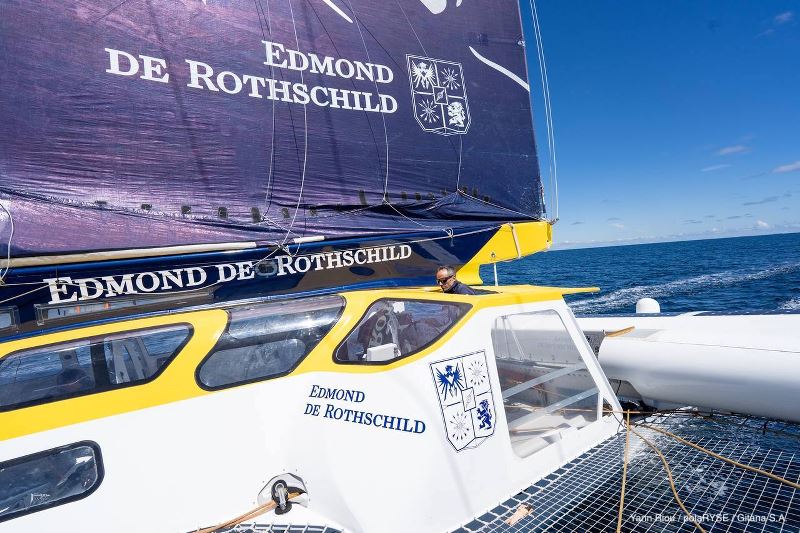
    Aboard the Maxi Edmond de Rothschild, the third day of racing in the Finistère Atlantique did not get off to the best of starts. Whilst Charles Caudrelier and his crew had been leading the way since the race start in Concarneau, by early this afternoon they’d lost the top spot to Armel Le Cléac’h’s men. Indeed, the latter are more at ease and quick…

    par Gitana

    Aboard the Maxi Edmond de Rothschild, the third day of racing in the Finistère Atlantique did not get off to the best of starts. Whilst Charles Caudrelier and his crew had been leading the way since the race start in Concarneau, by early this afternoon they’d lost the top spot to Armel Le Cléac’h’s men. Indeed, the latter are more at ease and quicker in the weather conditions currently being negotiated by the head of the fleet on the approach to Madeira, namely on a downwind point of sail with a dying breeze fluctuating between 11 and 14 knots. As such, after forty-eight hours at sea, it’s game on again for the top two boats, with Sodebo still in contact just thirty or so miles astern of them.
    A change of pace to drop down the Atlantic 

    Yesterday evening, the Ultims set the speedos spinning offshore of the Portuguese coast. In heavier seas punctuated by a 20-25-knot NNE’ly wind, the four crew were really able to show off the extent of the speed potential posted by their 32-metre giants. And it’s within this atmosphere, making an average speed of over 40 knots, that they launched onto an oceanic match race, with each crew having to select the ideal moment to gybe southwards! This Sunday though, conditions have clearly become calmer and the four teams competing in the Finistère Atlantique are now slipping along in a moderate trade wind that’s proving to be a little too tame to enable the Ultims to fly along in a constant and efficient manner…   
    From the hunted to the hunter 

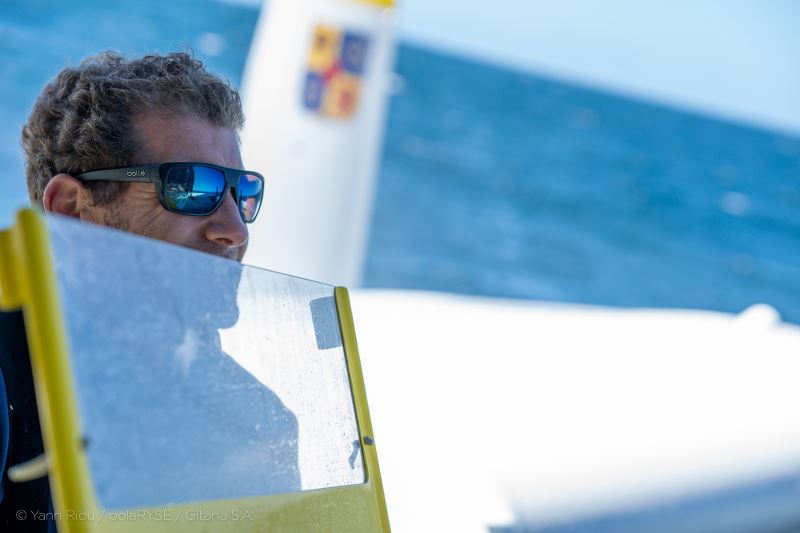
    Since this morning, the various position reports have shown that Banque Populaire has a slight speed advantage. However, it’s only since early this Sunday afternoon that the latter has translated that performance to the scoreboard. Aboard the Maxi Edmond de Rothschild, Charles Caudrelier remained optimistic and even saw the appeal of this unprecedented situation: “Right now, we’re not going as fast as our direct rival, Banque Populaire. It’s not a nice situation, but it is certainly interesting! In phases like these, you learn a great deal, about them, about how much progress they’ve made and the way they trim, and hence about ourselves too. We know that our boat is a little heavier, which is bound to explain this slight speed deficit we’re experiencing. We have light conditions at the moment and our ability to remain airborne is borderline. They must be able to power up on their foils shortly before us, which is enabling them to open up a bit of a lead, so roll on the point on the racetrack where the wind picks back up!” admitted the skipper of Gitana 17, who was very focused on trimming the sails and the appendages during his watch this afternoon.     

    Over the coming hours, the Maxi Edmond de Rothschild and her rivals will have to put in another gybe towards the Canaries and Lanzarote, the next waypoint in the Finistère Atlantique – Challenge Action Enfance. According to the latest routing, the easternmost island of the Spanish archipelago may well be within sight tomorrow, Monday 4 July, either late into the night or in the early hours.     

    The Finistère Atlantique Challenge Action Enfance 

    3,163-mile course across the North Atlantic 
    Concarneau, the Glénan archipelago, Madeira, Lanzarote (Canaries), Santa Maria (Azores), Concarneau (Brittany)     

    Crew on the Maxi Edmond de Rothschild 

    Charles Caudrelier, skipper 
    Franck Cammas, helm, navigator 
    Morgan Lagravière, helm, trimmer 
    David Boileau, trimmer, bowman 
    Erwan Israël, helm, trimmer 
    Yann Riou, media crew, helm