







Heritage

Season 26
Types de médias
  • Photos
  • Vidéos
  • Sons
Années
  • 2026
  • 2024
  • 2023
  • 2022
  • 2021
  • 2020
  • 2019
  • 2018
  • 2017
  • 2016
  • 2015
  • 2014
Afficher les résultats (121)
supprimer tous les filtres
  • News
  • Gallery
  • Gitana 18
  • Team
  • Retractable Y-shaped foils, adjustable in three dimensions

    Inspired by the appendages of the America's Cup foiling monohulls, these Y-shaped foils have a wingspan of over 5 metres. They are designed to generate powerful lift, increase power and offer a wide range of adjustments to optimise flight at every point of sail and in all conditions. Beyond their impressive size, these foils feature many unique innovations.

    Revolutionary U-shaped rudders

    These are probably the most visually striking innovations on the new Maxi Edmond de Rothschild. To fly high above rough seas while maintaining control, the team wanted very long rudders that would remain in contact with the water. The challenge is that longer rudders tend to flex under load, severely affecting steering and the efficiency of their lifting surfaces. A new geometry was needed to give these appendages maximum stiffness, resist cavitation and ultimately improve control of the boat and make better use of its power. The result is a set of U-shaped rudders over 4 metres long, a metre longer than those on Gitana 17. Their shape, reminiscent of a tripod or an inverted π, is only the visible part of what makes them so distinctive.

    A daggerboard optimised to stabilise the boat and limit cavitation

    With its wide span, the daggerboard resembles an aircraft tail assembly, with two adjustable flaps: one on the vertical section and the other on the horizontal section, the distinctive “manta-ray wing”. On Gitana 18, the innovation is to position this wing behind the vertical part of the appendage, rather than directly beneath it, to minimise flow disturbance and cavitation.

    Gitana 18’s daggerboard

    Rig: adjustable spreaders to control mainsail power while sailing

    Gitana 18’s mast is 1.50 metres taller than its predecessor’s. The boom is also shorter, creating a more slender sail plan. The major innovation is a set of spreaders that can be adjusted while sailing to bend the mast fore and aft. Actuated by hydraulic rams, these spreaders can pivot through 35 degrees to adjust the bend in the middle of the mast. This unprecedented system allows the sailor to control mainsail power: adding depth in light winds to take off sooner, or flattening the sail to reduce power at high speed or in strong winds. Adjusting the depth, and therefore the power, of the mainsail can also save a solo sailor time and energy by reducing the need for risky manoeuvres or headsail changes.

    Central hull:
    an integrated, structural coachroof

    The naval architects and Gitana design team wanted an exceptionally stiff, structurally robust platform. This applies both to the floats, which must withstand heavy loads from the foils and rudders, and to the central hull, which is subject to torsion. The enclosed coachroof is integrated into the hull and contributes to its structural strength. Inside, the cockpit brings all sail-handling controls together, with ergonomics shaped by many hours of design and development. The coachroof also stands out for the number and size of its windows. This configuration meets the visibility requirements of the Ultim class rules and gives sailors the best possible view to keep a visual watch.

    Gitana 18’s coachroof

    28.12.2020

    Code yellow despite numerous uncertainties.

    It is common knowledge that the Jules Verne Trophy is primarily a school of patience. Indeed, before any hope of beating the prestigious record held today by Francis Joyon and the men on Idec Sport, it’s vital to find the best possible launchpad from which to set sail on the round the world. And waiting for the right weather window is no easy task,…

    par Gitana

    It is common knowledge that the Jules Verne Trophy is primarily a school of patience. Indeed, before any hope of beating the prestigious record held today by Francis Joyon and the men on Idec Sport, it’s vital to find the best possible launchpad from which to set sail on the round the world. And waiting for the right weather window is no easy task, especially with expectations running so high after two months of standby, heightened by the fact that the elements don’t seem to want to align themselves… However, Franck Cammas, Charles Caudrelier and their four crew have long been familiar with the vagaries of a potential weather window and know how to keep a cool head. Despite a serious deterioration in the weather conditions and extended passage times for both the equator and Cape Agulhas, there is still a slender chance of them setting sail. As long as the window remains ajar, the skippers of the Maxi Edmond de Rothschild are continuing their observations in earnest. The updates on the grib file forecasts from this Monday evening and tomorrow morning will be key in deciding whether or not the team triggers a fresh departure on the theoretical 21,760 nautical miles that make up this big looped circuit around the planet.

    From the get-go, the window currently under study by the Gitana Team’s routing cell has not been a classic one. In fact, Storm Bella, which hit the Breton coast at the end of the weekend has left some scars, starting with some very heavy seas that for now are ruling out any delivery trip to the Jules Verne Trophy start zone, offshore of Ushant. Things are set to calm down over the course of the day tomorrow, which would enable the crew to cross the start line at the end of the day. However, following that, the scenario offered up by the North Atlantic is not favourable for a speed record on the passage down to the southern hemisphere. Indeed, some of the weather models are predicting a low-pressure system forming to the WSW of the Canaries, which could break up the trade wind system and thus force the crew onto a course way out to the east, whilst the doldrums appears to be more cooperative to the west. In short, there is no natural weather sequence, which means that the crew would be obliged to really zigzag their way down to the equator. For all that, there remains a slim chance of some fairly decent courses according to the latest routing. 

    “5% chance already translates as a 5% chance of securing a favourable weather window, so we have to go all out whilst there’s still hope. As things stand today, the window in the North Atlantic certainly isn’t great with a very, very average time to the equator and a difficult course to hold onto and implement along the African coast, which would notably include the negotiation of the Canaries and Cape Verde as they’re close to our planned trajectory. Today though, whilst there is still a possibility, albeit it very slender, of us having a smooth transition in the South Atlantic and hence the potential of a good passage time to Cape Agulhas, we’re keeping our options open right to the wire”, said Franck Cammas as he explained the switch to code yellow.   

    “To set sail, we’d outlined three main criteria. Firstly, manageable conditions to set sail from Ushant and exit the Bay of Biscay, a passage time to the equator of around 4 days 15 hours and a sub-11-day passage to Cape Agulhas. Today, we’re coming up to the second half of our standby period and with time ticking by till the end of our potential waiting period set for mid-February, we’re slightly revising our criteria and our pretensions. A window like the one we’ve pinpointed for the coming days certainly wouldn’t have been considered in early November, but on 28 December it’s worthwhile dwelling on it a little”, explained the co-skipper of the Maxi Edmond de Rothschild. 

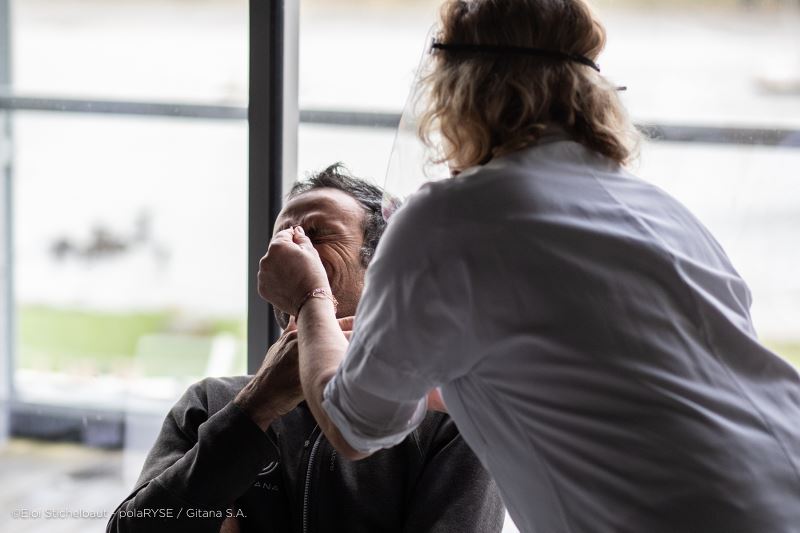
    At the end of a long weather briefing, all the crew gathered together at the five-arrow racing stable’s base in Lorient to undergo another series of PCR tests. Each of them has also finalised their single bag of personal gear before each of them heads home to await the evening’s grib files. 
    Jules Verne Trophy memo:

    Crew of the Maxi Edmond de Rothschild:

    Franck Cammas and Charles Caudrelier, skippers
    David Boileau, trimmer bowman
    Erwan Israël, helm trimmer
    Morgan Lagravière, helm trimmer
    Yann Riou, trimmer media man

    Marcel van Triest, weather router
    Yann Eliès, replacement crew

    Record to beat:

    40 days, 23 hours and 30 minutes > Record held by Francis Joyon and his crew (Idec Sport) since 26 January 2017.