








Heritage

Season 26
Types de médias
  • Photos
  • Vidéos
  • Sons
Années
  • 2026
  • 2024
  • 2023
  • 2022
  • 2021
  • 2020
  • 2019
  • 2018
  • 2017
  • 2016
  • 2015
  • 2014
Afficher les résultats (121)
supprimer tous les filtres
  • News
  • Gallery
  • Gitana 18
  • Team
  • Retractable Y-shaped foils, adjustable in three dimensions

    Inspired by the appendages of the America's Cup foiling monohulls, these Y-shaped foils have a wingspan of over 5 metres. They are designed to generate powerful lift, increase power and offer a wide range of adjustments to optimise flight at every point of sail and in all conditions. Beyond their impressive size, these foils feature many unique innovations.

    Revolutionary U-shaped rudders

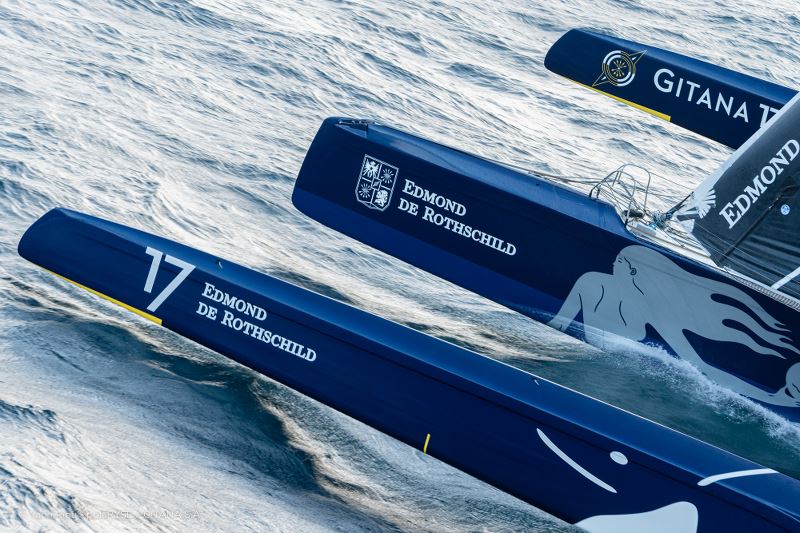
    These are probably the most visually striking innovations on the new Maxi Edmond de Rothschild. To fly high above rough seas while maintaining control, the team wanted very long rudders that would remain in contact with the water. The challenge is that longer rudders tend to flex under load, severely affecting steering and the efficiency of their lifting surfaces. A new geometry was needed to give these appendages maximum stiffness, resist cavitation and ultimately improve control of the boat and make better use of its power. The result is a set of U-shaped rudders over 4 metres long, a metre longer than those on Gitana 17. Their shape, reminiscent of a tripod or an inverted π, is only the visible part of what makes them so distinctive.

    A daggerboard optimised to stabilise the boat and limit cavitation

    With its wide span, the daggerboard resembles an aircraft tail assembly, with two adjustable flaps: one on the vertical section and the other on the horizontal section, the distinctive “manta-ray wing”. On Gitana 18, the innovation is to position this wing behind the vertical part of the appendage, rather than directly beneath it, to minimise flow disturbance and cavitation.

    Gitana 18’s daggerboard

    Rig: adjustable spreaders to control mainsail power while sailing

    Gitana 18’s mast is 1.50 metres taller than its predecessor’s. The boom is also shorter, creating a more slender sail plan. The major innovation is a set of spreaders that can be adjusted while sailing to bend the mast fore and aft. Actuated by hydraulic rams, these spreaders can pivot through 35 degrees to adjust the bend in the middle of the mast. This unprecedented system allows the sailor to control mainsail power: adding depth in light winds to take off sooner, or flattening the sail to reduce power at high speed or in strong winds. Adjusting the depth, and therefore the power, of the mainsail can also save a solo sailor time and energy by reducing the need for risky manoeuvres or headsail changes.

    Central hull:
    an integrated, structural coachroof

    The naval architects and Gitana design team wanted an exceptionally stiff, structurally robust platform. This applies both to the floats, which must withstand heavy loads from the foils and rudders, and to the central hull, which is subject to torsion. The enclosed coachroof is integrated into the hull and contributes to its structural strength. Inside, the cockpit brings all sail-handling controls together, with ergonomics shaped by many hours of design and development. The coachroof also stands out for the number and size of its windows. This configuration meets the visibility requirements of the Ultim class rules and gives sailors the best possible view to keep a visual watch.

    Gitana 18’s coachroof

    31.01.2024

    Direction Point Nemo.

    In the Arkea Ultim Challenge, the men and their magnificent flying machines bear the scars of the past twenty-four days at sea. The speeds at which they have been circumnavigating the globe almost makes you forget the intensity and commitment required in an exercise such as this for the solo sailors competing in this first edition. A solid leader,…

    par Gitana

    In the Arkea Ultim Challenge, the men and their magnificent flying machines bear the scars of the past twenty-four days at sea. The speeds at which they have been circumnavigating the globe almost makes you forget the intensity and commitment required in an exercise such as this for the solo sailors competing in this first edition. A solid leader, Charles Caudrelier is continuing towards Cape Horn at high speed, though the coming days will involve some important choices for the skipper of Gitana Team. The southernmost tip of Latin America is legendary in many ways and the passage around it has to be earned.
    Austral weather

    In this first single-handed round the world race aboard ULTIMs, the Southern Ocean is living up to its reputation. Though Charles Caudrelier has managed to hook onto a sequence of weather systems that all record hunters secretly dream of, enjoying very manageable conditions in the Indian Ocean and in this first section of the Pacific, his pursuers have not been quite so fortunate as they describe what has been a wild Indian over the past few days. However, it is the entry into the Pacific, which appears to be the most problematic today, especially for Armel Le Cléac’h. Indeed, the skipper has had to resolve to taking a much longer route through the Bass Strait, between Australia and Tasmania, far from the direct route, to avoid an extensive low-pressure system set to run rampant to his south over the coming days. The next stage of his trajectory is yet to be shared, but one thing for sure is that the deficit of 3,156 miles Banque Populaire has racked up in relation to the Maxi Edmond de Rothschild will stretch even further.

    Meantime, Thomas Coville announced yesterday that he will be making a pit stop in Hobart, to the south of Tasmania. This island state of Australia lies some 200 km off the south-east coast of the Australian mainland and is known in offshore racing circles through its famous annual race, the Sydney-Hobart. Launched in 1945, it is the equivalent of Europe’s Rolex Fastnet Race in terms of history and prestige. 
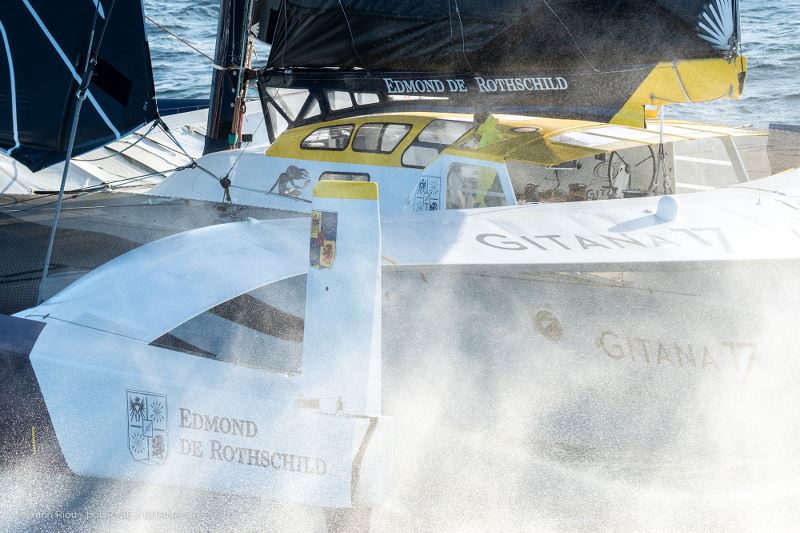

    Charles Caudrelier, 31 January

     “I’ve been sailing a very long way south for a few days, but for now the temperature remains high for this area – between 10 and 14 degrees in the air with 9 degrees in the water. That said, as soon as the wind rotates round to the south that is bound to change and become chillier. I’m preparing for it. I’m trying to sail my own course and take care of the boat, but it’s still a race of course, so every day we’re looking at what’s going on behind, whether that’s Sodebo, which has been forced to stop off in Tasmania, or Banque Populaire which is passing to the north of Tasmania, because the low pressure system to the south is too full-on. The next stage is  not looking quite so clear for us as it was at the start of the Pacific. The weather models (CEP, Arpege and GFS) are really struggling to agree, despite the proximity of the situation in terms of time. The wind strength and wave height vary quite a lot from one to the other too, which doesn’t make the analysis and decision-making any easier for my routing cell (Erwan Israël, Ben Schwartz and Julien Villion, editor’s note). We will find the right trajectory though. Since the start, they’ve been doing an incredible job, which has got me where I am today.”

    Ranking at the 18:00 UTC position report 

    1/ Maxi Edmond de Rothschild – Charles Caudrelier   
    2/ Sodebo Ultim 3 – Thomas Coville – 2,952.8 miles behind the leader (about to make a pit stop in Hobart)   
    3/ Maxi Banque Populaire XI – Armel Le Cleac’h – 3,162 miles behind the leader   
    4/ Actual Ultim 3 – Anthony Marchand – 6,102.3 miles behind the leader   
    5/ Ultim Adagio – Eric Peron – 7,170.4 miles behind the leader   

    Retired
    SVR Lazartigue – Tom Laperche