








Heritage

Season 26
Types de médias
  • Photos
  • Vidéos
  • Sons
Années
  • 2026
  • 2024
  • 2023
  • 2022
  • 2021
  • 2020
  • 2019
  • 2018
  • 2017
  • 2016
  • 2015
  • 2014
Afficher les résultats (121)
supprimer tous les filtres
  • News
  • Gallery
  • Gitana 18
  • Team
  • Retractable Y-shaped foils, adjustable in three dimensions

    Inspired by the appendages of the America's Cup foiling monohulls, these Y-shaped foils have a wingspan of over 5 metres. They are designed to generate powerful lift, increase power and offer a wide range of adjustments to optimise flight at every point of sail and in all conditions. Beyond their impressive size, these foils feature many unique innovations.

    Revolutionary U-shaped rudders

    These are probably the most visually striking innovations on the new Maxi Edmond de Rothschild. To fly high above rough seas while maintaining control, the team wanted very long rudders that would remain in contact with the water. The challenge is that longer rudders tend to flex under load, severely affecting steering and the efficiency of their lifting surfaces. A new geometry was needed to give these appendages maximum stiffness, resist cavitation and ultimately improve control of the boat and make better use of its power. The result is a set of U-shaped rudders over 4 metres long, a metre longer than those on Gitana 17. Their shape, reminiscent of a tripod or an inverted π, is only the visible part of what makes them so distinctive.

    A daggerboard optimised to stabilise the boat and limit cavitation

    With its wide span, the daggerboard resembles an aircraft tail assembly, with two adjustable flaps: one on the vertical section and the other on the horizontal section, the distinctive “manta-ray wing”. On Gitana 18, the innovation is to position this wing behind the vertical part of the appendage, rather than directly beneath it, to minimise flow disturbance and cavitation.

    Gitana 18’s daggerboard

    Rig: adjustable spreaders to control mainsail power while sailing

    Gitana 18’s mast is 1.50 metres taller than its predecessor’s. The boom is also shorter, creating a more slender sail plan. The major innovation is a set of spreaders that can be adjusted while sailing to bend the mast fore and aft. Actuated by hydraulic rams, these spreaders can pivot through 35 degrees to adjust the bend in the middle of the mast. This unprecedented system allows the sailor to control mainsail power: adding depth in light winds to take off sooner, or flattening the sail to reduce power at high speed or in strong winds. Adjusting the depth, and therefore the power, of the mainsail can also save a solo sailor time and energy by reducing the need for risky manoeuvres or headsail changes.

    Central hull:
    an integrated, structural coachroof

    The naval architects and Gitana design team wanted an exceptionally stiff, structurally robust platform. This applies both to the floats, which must withstand heavy loads from the foils and rudders, and to the central hull, which is subject to torsion. The enclosed coachroof is integrated into the hull and contributes to its structural strength. Inside, the cockpit brings all sail-handling controls together, with ergonomics shaped by many hours of design and development. The coachroof also stands out for the number and size of its windows. This configuration meets the visibility requirements of the Ultim class rules and gives sailors the best possible view to keep a visual watch.

    Gitana 18’s coachroof

    18.11.2021

    Drag race to São Pedro.

    There is certainly no dawdling on the way back up towards the equator for the Maxi Edmond de Rothschild. Beam reaching and powered up at an average speed of 32 knots for the past 24 hours, the leaders of the Transat Jacques Vabre are making the most of the optimum conditions currently reigning in the South Atlantic, offshore of Brazil, to show just…

    par Gitana

    There is certainly no dawdling on the way back up towards the equator for the Maxi Edmond de Rothschild. Beam reaching and powered up at an average speed of 32 knots for the past 24 hours, the leaders of the Transat Jacques Vabre are making the most of the optimum conditions currently reigning in the South Atlantic, offshore of Brazil, to show just what their incredible flying machine is capable of. However, Franck Cammas and Charles Caudrelier are keeping a cool head because at such high speeds, they must be permanently concentrated. They also know just how important it is to preserve their steed with 2,500 nautical miles still remaining, especially given the fact that the final sprint is shaping up to be complicated in terms of the weather.

    Making an average speed of more than 32 knots over the past 24 hours and nearly 35 over the last 4 in a wind of between 15 and 18 knots… the point of sail accompanying the head of the Transat Jacques Vabre fleet on their way up to the next course mark suits the pioneer of this generation of flying giants to a T: “We’re absolutely smoking along! Even though the sea is flat, at these speeds we’re bouncing around quite a lot. There isn’t as much breeze as all that, but it is at the perfect angle for making fast headway. We’re beam reaching, heading northwards to São Pedro, the next island we have to round”, explained Franck Cammas.
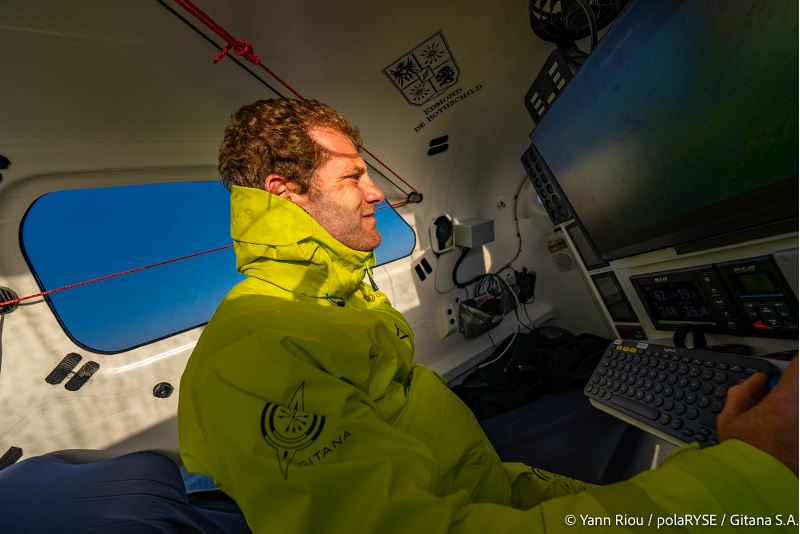
    The speed is exhilarating but the skippers of the Maxi Edmond de Rothschild have not lost sight of the fact that they need to take care of their steed after 11 days at sea: “We’re flat out heading northwards! Things have accelerated nicely, but the name of the game is not to go too fast in fact… We’ve set ourselves a limit of 38 / 39 knots on this tack so as to preserve the boat. All she wants to do is accelerate… As such, we’re braking by easing the sails. It’s only on a multihull that you look to slow things down”, joked Charles Caudrelier, before casting his mind to what’s next on the programme: “despite our sizeable lead, the end of the race is forecast to be complicated. It would seem that there’s no wind in the North Atlantic and our rivals may burst back into contention. We need to stay focused right to the wire!”

    A four-handed transatlantic

    At sea, Franck Cammas and Charles Caudrelier take it in turns night and day, 24/7, in a bid to get the Maxi Edmond de Rothschild firing on all cylinders. Each of them steps up individually as part of a watch rotation, but is able to wake the other for manoeuvres which require all hands on deck, or for making major strategic decisions. On shore, not far from the Gitana Team’s technical base in Lorient, the lives of another duo are following the same rhythm. Though they don’t have to deal with the discomfort of heavy seas or being deprived of a daily shower, Erwan Israël and Stan Honey are enjoying all the other benefits! Thanks to the data at their disposal, they’re constantly on top of what’s happening aboard. Indeed, they have a written messaging system, which is permanently open, enabling highly responsive chats between the weather cell and the boat. 

    Stan is American. As such, all the chats are in English. It’s become standard practice aboard the Maxi Edmond de Rothschild and doesn’t bother our sailors in the slightest as they are all at ease with conversing in the language of Shakespeare since their Volvo Ocean Race experiences. In fact, it’s interesting to note that the round the world with stopovers is a race all four of the men have on their CVs: all of them have won it at least once, with Charles securing two wins! Stan and Franck also share one very fine round the world victory, since in 2010 Stan was the navigator on Groupama during their successful Jules Verne Trophy attempt. 

    The role of the routing cell is clear: offering the best possible route to the skippers of Gitana 17 by deciphering and anticipating the upcoming weather, as well as trying to elude any obstacles looming ahead of the flying maxi-trimaran. A third man, he too an American, completes the device. Indeed, Chris Bedford is a renowned meteorologist and a familiar face in the America’s Cup arena.

    Images from the ocean, day 11 – Double-handed or solo for the Coffee Route?
    Positions on Thursday 18 November at 17:00 UTC
    1. Maxi Edmond de Rothschild (F. Cammas / C. Caudrelier) 2,492.9 miles from the finish
    2. Banque Populaire XI (A. Le Cléac’h / K. Escoffier) + 431.6 miles
    3. SVR – Lazartigue (F. Gabart / T. Laperche) + 554.2 miles
    4. Actual (Y. Le Blevec / A. Marchand) + 888.3 miles
    5. Sodebo (T. Coville / T.Rouxel) +  1,383.5 miles