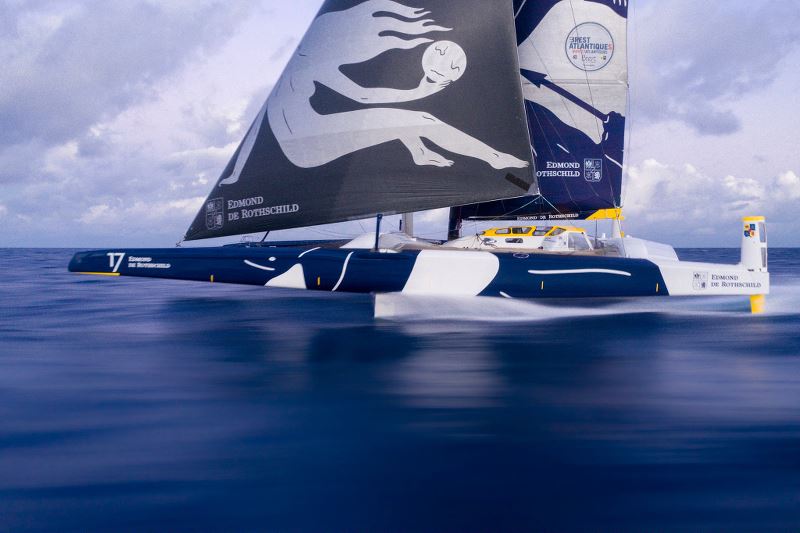
Heritage

Season 26
Types de médias
  • Photos
  • Vidéos
  • Sons
Années
  • 2026
  • 2024
  • 2023
  • 2022
  • 2021
  • 2020
  • 2019
  • 2018
  • 2017
  • 2016
  • 2015
  • 2014
Afficher les résultats (121)
supprimer tous les filtres
  • News
  • Gallery
  • Gitana 18
  • Team
  • Retractable Y-shaped foils, adjustable in three dimensions

    Inspired by the appendages of the America's Cup foiling monohulls, these Y-shaped foils have a wingspan of over 5 metres. They are designed to generate powerful lift, increase power and offer a wide range of adjustments to optimise flight at every point of sail and in all conditions. Beyond their impressive size, these foils feature many unique innovations.

    Revolutionary U-shaped rudders

    These are probably the most visually striking innovations on the new Maxi Edmond de Rothschild. To fly high above rough seas while maintaining control, the team wanted very long rudders that would remain in contact with the water. The challenge is that longer rudders tend to flex under load, severely affecting steering and the efficiency of their lifting surfaces. A new geometry was needed to give these appendages maximum stiffness, resist cavitation and ultimately improve control of the boat and make better use of its power. The result is a set of U-shaped rudders over 4 metres long, a metre longer than those on Gitana 17. Their shape, reminiscent of a tripod or an inverted π, is only the visible part of what makes them so distinctive.

    A daggerboard optimised to stabilise the boat and limit cavitation

    With its wide span, the daggerboard resembles an aircraft tail assembly, with two adjustable flaps: one on the vertical section and the other on the horizontal section, the distinctive “manta-ray wing”. On Gitana 18, the innovation is to position this wing behind the vertical part of the appendage, rather than directly beneath it, to minimise flow disturbance and cavitation.

    Gitana 18’s daggerboard

    Rig: adjustable spreaders to control mainsail power while sailing

    Gitana 18’s mast is 1.50 metres taller than its predecessor’s. The boom is also shorter, creating a more slender sail plan. The major innovation is a set of spreaders that can be adjusted while sailing to bend the mast fore and aft. Actuated by hydraulic rams, these spreaders can pivot through 35 degrees to adjust the bend in the middle of the mast. This unprecedented system allows the sailor to control mainsail power: adding depth in light winds to take off sooner, or flattening the sail to reduce power at high speed or in strong winds. Adjusting the depth, and therefore the power, of the mainsail can also save a solo sailor time and energy by reducing the need for risky manoeuvres or headsail changes.

    Central hull:
    an integrated, structural coachroof

    The naval architects and Gitana design team wanted an exceptionally stiff, structurally robust platform. This applies both to the floats, which must withstand heavy loads from the foils and rudders, and to the central hull, which is subject to torsion. The enclosed coachroof is integrated into the hull and contributes to its structural strength. Inside, the cockpit brings all sail-handling controls together, with ergonomics shaped by many hours of design and development. The coachroof also stands out for the number and size of its windows. This configuration meets the visibility requirements of the Ultim class rules and gives sailors the best possible view to keep a visual watch.

    Gitana 18’s coachroof

    29.11.2019

    East through the Doldrums, bound now for Brest.

    Early on Thursday morning, shortly after 02:00 UTC, the Maxi Edmond de Rothschild was the first boat back into the northern hemisphere after twenty-two days and around fifteen hours at sea. From there Charles Caudrelier and Franck Cammas attacked the much dreaded Doldrums. With their router Marcel van Triest, the duo opted for a relatively eastern…

    par Gitana

    Early on Thursday morning, shortly after 02:00 UTC, the Maxi Edmond de Rothschild was the first boat back into the northern hemisphere after twenty-two days and around fifteen hours at sea. From there Charles Caudrelier and Franck Cammas attacked the much dreaded Doldrums. With their router Marcel van Triest, the duo opted for a relatively eastern passage in terms of longitude between 22 and 23° East – meaning they didn’t have to extend their route. It proved to be a pertinent choice if we are to believe the picture postcard description from Franck at today’s live link-up. In the wake of the latest Gitana, Macif was back up to second place to the detriment of Actual Leader. They are respectively 544 and 619 miles behind the lead boat today.


    A smooth doldrums

    The sailors may have made the passage dozens of times before, but this zone is never one they look forward to as they know just how easy it is to fall into its clutches with no warning. However for some days Marcel van Triest, the weather router for the Maxi Edmond de Rothschild, has been scrutinising the zone and refining the giant’s trajectory so as to come up with the best possible corridor through the weather system for the two sailors. This morning, the duo paid tribute to their analyst’s strategy and Charles Caudrelier even admitted that he hadn’t had such an easy passage in over 14 years!

    “We were in a zone without any convection, there were just some light patches to negotiate, but the wind wasn’t suddenly unstable as it tends to be when there are storms and dark squalls. In this instance, there were virtually no squalls, just a little tiny bit of rain. The wind did drop off a lot at one point, to 6-7 knots, for a few hours, but the boat continued to make headway at over 10 knots. It’s quite simple because the rotation is continuous so there weren’t any significant changes in wind strength. Everything went smoothly compared with our passage through the doldrums on the outward leg, where we had big black squalls and big gusts, which we had to utilise in order to make headway. It did last 200 miles though, so it wasn’t a short passage in terms of distance, but we never came to a standstill”, explained Franck Cammas at the live weekly link-up for the Brest Atlantiques.
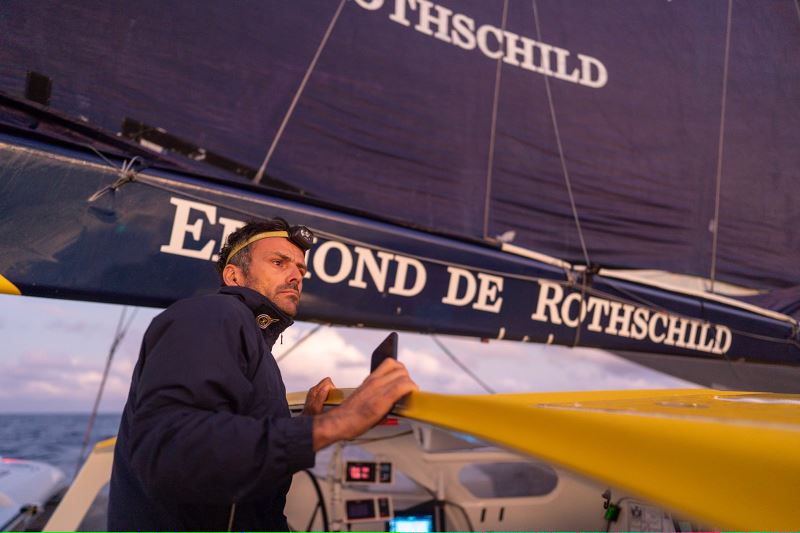
     

    Abeam of Cape Verde

    Since exiting the Inter-tropical Convergence Zone early yesterday evening, the maxi-trimaran fitted out by Ariane and Benjamin de Rothschild has been sailing in the trade winds of the northern hemisphere, bound for Cape Verde, which she is set to leave to starboard tonight. The skipper of Gitana 17 gave us a rather pleasant account of their 25th day of racing: “We’re in a phase of reaching in the trade winds on our climb up towards Cape Verde. We’re punching into a bit of chop which is beginning to subside. It was a bit brutal last night, because we were punching into it at 25 knots. Here, things are gentler but the wind is a little stronger at 18-20 knots. The weather’s good. There are flying fish and a lot of apparent wind so we’re not leaving the cockpit much.” 

    At the 15:00 UTC position report, there were still 2,358 miles to go for the Cammas / Caudrelier duo. Though the climb up the North Atlantic could prove to be quick, it is no less demanding with some tricky passages on the cards where punctuality will be key. At this current pace, we could be in for a finish in Brest midway through next week.

    => TODAY’S VIDEO

    Doldrums ambiance

    In the Atlantic and in sailing, passing from one hemisphere to another involves crossing swords with the famous doldrums. For the second time in less than 19 days, Franck Cammas and Charles Caudrelier have had to negotiate this zone, which is renowned for its instability and very often proves to be a stumbling block. With incessant manœuvres in a fickle breeze and blazing sunshine, the Gitana Team duo spared no effort in their bid to thread their way to the North and the gateway to the trade winds as quickly as possible. Yann Riou takes us for a ride amidst the stress of the Doldrums from inside the cockpit of the Maxi Edmond de Rothschild. 


    Ranking on 29 November 2019 at 15:00 UTC

    1. MAXI EDMOND DE ROTHSCHILD (Franck Cammas / Charles Caudrelier / Yann Riou) – distance to the goal: 2,358.7 miles – average speed over the past 30 mins: 22.7 knots 

    2. MACIF (François Gabart / Gwenolé Gahinet / Jérémie Eloy) – 544.2 miles behind the leader – average speed over the past 30 mins: 20.9 knots

    3.ACTUAL LEADER (Yves Le Blevec / Alex Pella / Ronan Gladu)– 619.7 miles behind the leader – average speed over the past 30 mins: 17.1 knots 

    RETIREMENT – SODEBO ULTIM 3 (Thomas Coville / Jean-Luc Nelias / Martin Keruzoré)