








New York, its skyscrapers, its contagious buzz and its sense of decorum that is as legendary as it is spectacular… there is no doubt that there’s a certain magic here in this city where the superlatives abound. Moored in the very heart of Manhattan, in North Cove Marina, the Transat New York – Vendée fleet waits patiently for the big day of the start on Sunday at 11:00am (New York time), or 15:00 GMT. This afternoon though, the fourteen competitors will leave their pontoon for a few hours of sailing on the Hudson River for the Charity Race devised by OSM (Open Sport Management), organiser of this transatlantic race.
With some two days until this latest race start, Sébastien Josse, skipper of Edmond de Rothschild, shares with us his objectives, sizes up his rivals and gives us an idea of the initial trends in relation to the weather conditions expected in the North Atlantic over the coming days.
Sébastien, following your retirement from The Transat bakerly, were you keen to compete in the New York – Vendée? “The damage suffered in The Transat bakerly and the ensuing retirement came as a real disappointment. The first few hours had gone very smoothly, the boat was quick and I was on my game. We had high hopes for that race. What happened to me is never pleasant, but it’s also the name of the game. Together with the team, we’ve since analysed and above all resolved the problems so we can move on in the right direction. As a result, we’re very lucky to be able to return to the racetrack so quickly, particularly on another transatlantic course. I haven’t lost sight of my objective and that of Gitana Team: we must be ready on 6 November 2016 for the start of the Vendée Globe. There are still five months to go and every bit of time on the water is essential, particularly in race configuration with a line-up like this.”
With some fourteen entries and all the big favourites for the next Vendée Globe, there are sure to be some great battles in this race. “Yes, of course. The line-up is of excellent quality, but that’s fairly logical given that we’re just five months away from the Vendée Globe! Everyone’s here and the standard is going to be very high out on the water. And so much the better, because we’re really here to see how we fair in battle. It’ll be intriguing to get our first idea about the trends and find out how we measure up, but make no mistake, these 3,100 miles remain a dress rehearsal.”
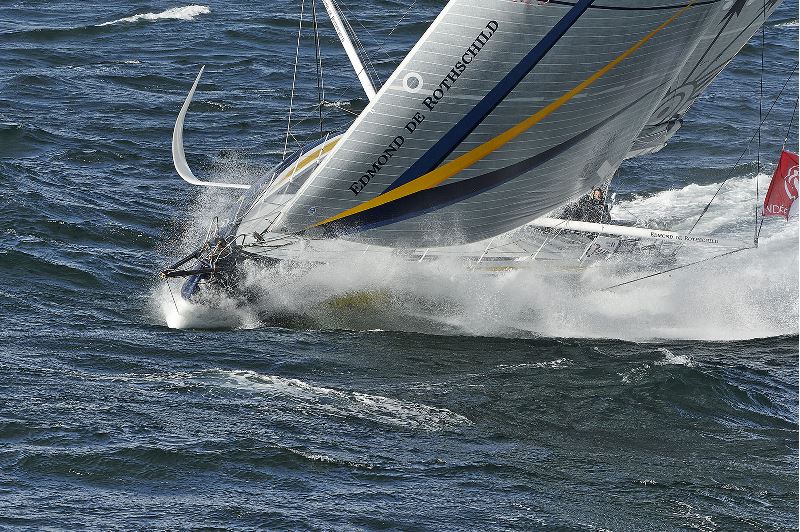
Exactly, so where are you at in terms of your preparation for the Vendée Globe on both a technical and a human level? “Since the launch of the Mono60 Edmond de Rothschild, we’ve known what lies ahead of us. The Imoca60s are complicated, demanding boats within a very accomplished class. The latest generation is no exception to the rule, quite the contrary in fact. The high-tech element and the vast amount of detail aboard these boats call for many long hours of fine-tuning. Up till now we’ve still been in the optimisation phase with a young monohull, lacking quality time on the water. However, setting out on a double-handed delivery trip following our retirement off Spain has enabled us to pass an important milestone. We’re now entering a phase of making the boat more reliable, which is more favourable to performance. That in itself is very satisfying. However, it’s no secret that to make the boat more reliable, we need to work her hard at sea! That’s something Charles (Caudrelier) and I really got our teeth into during the delivery trip here with some boisterous upwind conditions for hundreds of miles. That has enabled us to detect the points of wear and erase them. As such, this transatlantic race is the perfect opportunity to validate all of them and certainly discover new ones… However, once again, that’s the name of the game on the road to the Vendée Globe. The new boats are very high performance, as testified by Armel Le Cléac’h’s victory in The Transat bakerly, and making them reliable will be one of the keys to success! The other part of the work relates to me and my ability to drive this incredible machine at the top level. The automatic reflexes are becoming engrained and any miles racked up on that journey are precious. Everything’s heading in the right direction.”
This Transat New York – Vendée is, with the exception of the end, a route that is very familiar to North Atlantic record hunters. How is the weather shaping up? “The wind is set to be fairly light on Sunday, which may force Race Management to delay the start at the exit from New York harbour, level with Ambrose Light. If that’s how things pan out, it will be a good decision, because with the density of the shipping at the entrance to New York, it would be dangerous to get us to tack in light airs. With regards to the course, for now, the pattern is fairly classic and the routing is giving us a crossing time of 9 to 11 days. Contrary to The Transat bakerly, this eastbound transatlantic race accompanies the weather phenomena and the young lows that develop in the North, which will enable us to sail with relatively eased sheets. As was the case in The Transat, we’ll have an ice gate (exclusion zone to avoid any icebergs) to respect to the south of the Grand Banks of Newfoundland. This zone will signal the first part of the course, at which point the Atlantic playing field will be wide open. The pace will slow up as we approach the finish in Les Sables d’Olonne because at this time of year, the French and Vendée coastline are under the influence of the Azores High, which currently seems to be in its correct position.”