








With its record number of participants – 123 boats all classes combined – the Route du Rhum 2018 is already shaping up to be a red-letter edition. In the star class of Ultimes, this vintage could be a lot bigger and there are even whisperings that it heralds a turning point in offshore racing. In fact, it is the first confrontation on an oceanic playing field for these latest generation maxi-multihulls, racing steeds ultimately designed to speed around the planet in record time. Here, the flying giants are making their grand entrance onto the solo stage, among them the pioneer Maxi Edmond de Rothschild, launched in July 2017.
Flight: how does it work?
When we talk about flight, it’s hard not to get a bit technical! The foil is a submerged appendage, which shares a great many similarities with the wing of a plane. Made of monolithic carbon, this part resembles a massive curved blade, has one profile, one surface, one chord, one leading edge and one trailing edge. “On a foiler, you roughly end up with one wing in the water. And as water is a thousand times denser than air, you don’t need to go very fast to generate strong vertical lift. What happens next also depends on the surface and the form of the foil”, explains Guillaume Verdier, the naval architect responsible for Edmond de Rothschild.
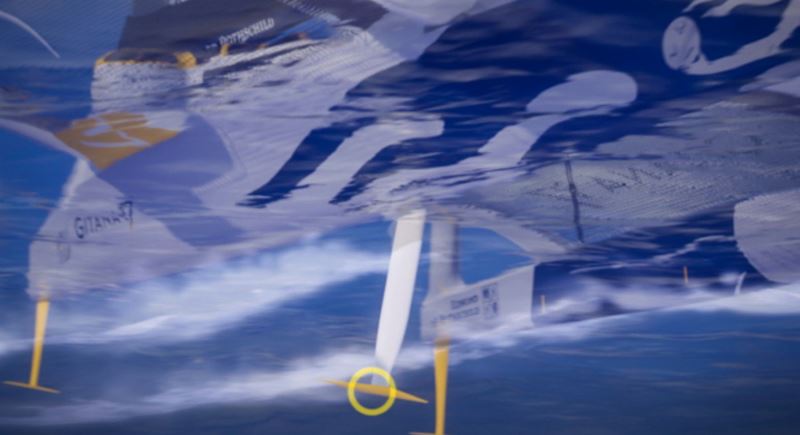
VIDEO 3D – Adjustment of the flaps, the angle of inclination of the foils, the hydraulics circuit… from Archimedean format to flight mode, the Gitana Team offers you the instructions for use by dissecting the major phases of take-off via a 3D animation .
Lower surface of a wing, upper surface and the difference in pressure
In order for the boat to take-off and rise up above the surface of the water, you need to be making a certain speed. The latter, together with the increasing flow of water, will lead to a difference in pressure between the lower surface (the underside of the foil) and the upper surface (top side of the foil). “The flow of water running across the lower surface takes less time to get to the trailing edge than the flow of water running across the upper surface, a phenomenon which creates a difference in pressure”, explains Guillaume Verdier. “All that has been in existence for a very long time, we haven’t invented anything.” The lower surface will end up surrounded by extremely high pressure, whilst the upper surface will be in low pressure. The difference in pressure created in this way will lead to vertical lift, enabling the hulls to be sustained, thus ‘raising’ the boat upwards. This lift pushes the foil upward, which in turn enables the boat to fly. Obviously the form, the surface and the adjustments of the foils have a major influence on how the boat handles and her ability to take-off and then fly in a stable manner.
Logically, the bigger the foil the more significant the lift. However, when you refer to lift, you must also include drag. Indeed, the bigger the foil, the more its progress is slowed in the water. The resulting drag is in fact the resistance created by the water, which conflicts with the movement of the foil. Guillaume Verdier has notably relied on his long collaboration spanning nearly ten years with Team New Zealand, the current America’s Cup holder. Responsible for the foil design, he has gained unrivalled experience in this domain, which has translated across to the design of the giant trimaran. “We could have started out with an Archimedean boat(*) and then tried to sustain it, but we opted for the reverse approach: to make the boat fly and make her as stable and seaworthy as possible,” explains the most popular naval architect of current times.
(*) The theorem of the great Greek scholar Archimedes of Syracuse, born in 287 BC, stipulates that “the upward buoyant force that is exerted on a body immersed in a fluid, whether fully or partially submerged, is equal to the weight of the fluid that the body displaces and acts in the upward direction at the centre of mass of the displaced fluid. This is Archimedes’ principle.”
VIDEO OF THE DAY
Objective: to fly offshore singlehanded
This is the real nub of the issue for an offshore maxi trimaran compared with a catamaran from the America’s Cup or a foiling Moth, which sails on flat water. As soon as there are some waves added to the equation, Edmond de Rothschild must switch back to Archimedes mode as the brutal acceleration, violent deceleration and other impact in the waves at 30 knots could well damage the structure and even injure the skipper. For Guillaume Verdier “it’s all about compromise, because we wanted to limit the drag with a small foil whilst in Archimedean mode, and have a bigger foil to improve the flying capabilities.”
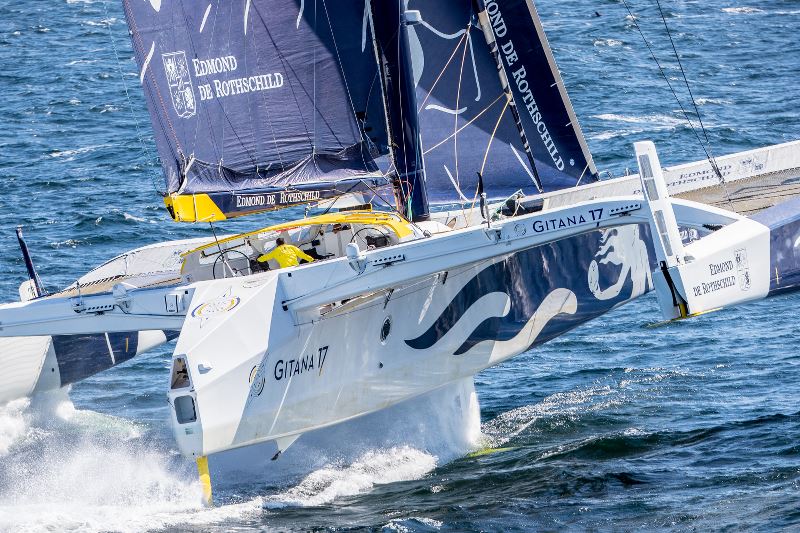
For the skipper, Sébastien Josse, “in upward of 16 knots of breeze (force 4) on a reach (wind on the beam), the boat takes off and then flies. However, it is actually the sea state and the wave height which colour the flight. If there is 30 knots of breeze and flat seas for example, flying isn’t really a problem, and it’s an absolute delight, even if it requires total concentration! However, in heavy seas with waves in excess of 2–2.50 metres, we’ll switch back to Archimedes mode. Flying isn’t as complicated as all that, even sailing singlehanded. You have to increase the angle of inclination on the leeward foil to take off, and that’s something which is easy to do and doesn’t require any additional energy to be expended in relation to hoisting a headsail for example.”
The stability of the boat when flying, doesn’t just come from the shape of the foil, but also the combination of four appendages – the two rudders, the leeward foil and the ‘skate wing’, which was initially designed and validated on the Multi70 Edmond de Rothschild. “We created this stability in flight thanks to these four elements”, explains Guillaume Verdier in more depth. “The trimaran is essentially supported on the foil and the skate wing, which stabilises the boat’s roll, whilst the T-foil rudders stabilise the trim. The idea is also to have robust, reliable foils, which don’t have to be adjusted too much when you’re sailing singlehanded, given how much is required of the sailor already on a machine like this.” Sébastien Josse backs up this statement. “Today, we know how to sail under autopilot on flat seas, but in flight mode in the sea and the waves offshore, as the foils aren’t operated with a servomotor, (it’s currently forbidden by the measurement rule), the pilot doesn’t yet know enough about how to handle this type of situation, and admittedly no Ultime is capable of this feat so far… though the time will come for this. When you’re singlehanded, in a solid breeze with very ordered seas, you fly under autopilot, the boat is on 80–90% of her foil, but ten centimetres above the water. It’s certainly not about gaining in altitude or risking a wipe-out. The foil sustains the hulls and relieves the pressure on the platform. As a result, you fly very low, which doesn’t prevent you from going fast! We call that ‘skimming’. We aren’t allowed to use servo control, so we’re trying to fly like this. When the time comes where we’re able to adjust our four appendages in one second, we’ll be able to fly higher.”