








Heritage

Season 26
Types de médias
  • Photos
  • Vidéos
  • Sons
Années
  • 2026
  • 2024
  • 2023
  • 2022
  • 2021
  • 2020
  • 2019
  • 2018
  • 2017
  • 2016
  • 2015
  • 2014
Afficher les résultats (121)
supprimer tous les filtres
  • News
  • Gallery
  • Gitana 18
  • Team
  • Retractable Y-shaped foils, adjustable in three dimensions

    Inspired by the appendages of the America's Cup foiling monohulls, these Y-shaped foils have a wingspan of over 5 metres. They are designed to generate powerful lift, increase power and offer a wide range of adjustments to optimise flight at every point of sail and in all conditions. Beyond their impressive size, these foils feature many unique innovations.

    Revolutionary U-shaped rudders

    These are probably the most visually striking innovations on the new Maxi Edmond de Rothschild. To fly high above rough seas while maintaining control, the team wanted very long rudders that would remain in contact with the water. The challenge is that longer rudders tend to flex under load, severely affecting steering and the efficiency of their lifting surfaces. A new geometry was needed to give these appendages maximum stiffness, resist cavitation and ultimately improve control of the boat and make better use of its power. The result is a set of U-shaped rudders over 4 metres long, a metre longer than those on Gitana 17. Their shape, reminiscent of a tripod or an inverted π, is only the visible part of what makes them so distinctive.

    A daggerboard optimised to stabilise the boat and limit cavitation

    With its wide span, the daggerboard resembles an aircraft tail assembly, with two adjustable flaps: one on the vertical section and the other on the horizontal section, the distinctive “manta-ray wing”. On Gitana 18, the innovation is to position this wing behind the vertical part of the appendage, rather than directly beneath it, to minimise flow disturbance and cavitation.

    Gitana 18’s daggerboard

    Rig: adjustable spreaders to control mainsail power while sailing

    Gitana 18’s mast is 1.50 metres taller than its predecessor’s. The boom is also shorter, creating a more slender sail plan. The major innovation is a set of spreaders that can be adjusted while sailing to bend the mast fore and aft. Actuated by hydraulic rams, these spreaders can pivot through 35 degrees to adjust the bend in the middle of the mast. This unprecedented system allows the sailor to control mainsail power: adding depth in light winds to take off sooner, or flattening the sail to reduce power at high speed or in strong winds. Adjusting the depth, and therefore the power, of the mainsail can also save a solo sailor time and energy by reducing the need for risky manoeuvres or headsail changes.

    Central hull:
    an integrated, structural coachroof

    The naval architects and Gitana design team wanted an exceptionally stiff, structurally robust platform. This applies both to the floats, which must withstand heavy loads from the foils and rudders, and to the central hull, which is subject to torsion. The enclosed coachroof is integrated into the hull and contributes to its structural strength. Inside, the cockpit brings all sail-handling controls together, with ergonomics shaped by many hours of design and development. The coachroof also stands out for the number and size of its windows. This configuration meets the visibility requirements of the Ultim class rules and gives sailors the best possible view to keep a visual watch.

    Gitana 18’s coachroof

    29.01.2024

    From one ocean to the next.

    Since Sunday 28 January, shortly after midnight UTC, Charles Caudrelier and the Maxi Edmond de Rothschild have been leading the way across the Pacific Ocean in the Arkea Ultim Challenge Brest, the largest liquid expanse on the planet. In this high-speed waltz in the land of shadows, the major challenge is to get to Cape Horn unscathed.

    par Gitana

    Since Sunday 28 January, shortly after midnight UTC, Charles Caudrelier and the Maxi Edmond de Rothschild have been leading the way across the Pacific Ocean in the Arkea Ultim Challenge Brest, the largest liquid expanse on the planet. In this high-speed waltz in the land of shadows, the major challenge is to get to Cape Horn unscathed.
    New reference time

    He romped into the Indian Ocean thanks to a scenario that record hunters usually only dream of, “one you crave for in a Jules Verne Trophy attempt: a depression offshore of Brazil, which will carry you as far as possible with a stable wind and acceptable seas. It was almost idyllic,” says Erwan Israël, one of the three members of the Gitana racing stable’s routing cell.* “Conditions were decent” says Charles Caudrelier, keen to set the record straight just before banging the door shut on this much feared ocean, another reference time to his credit.

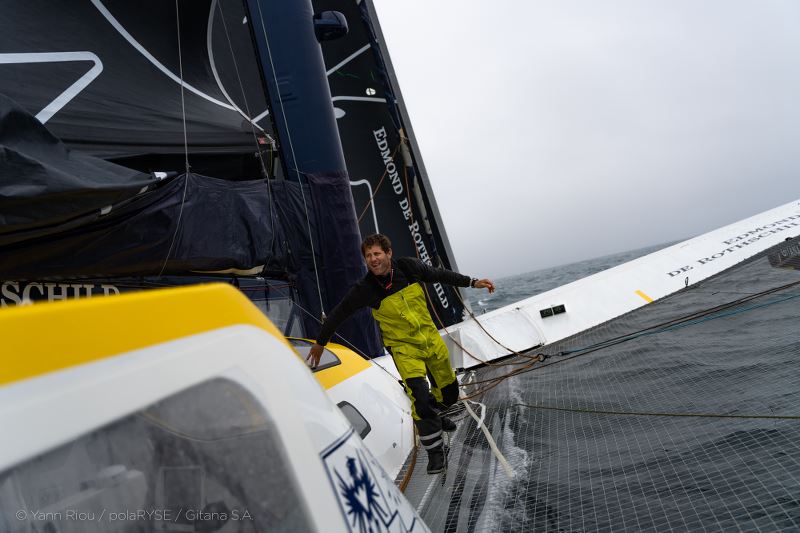
    The five-arrow giant took 8 days, 8 hours, 20 minutes and 36 seconds to get through the Indian, which equates to an average speed of 30.7 knots to cover 6,113 miles** between Cape Agulhas and a longitude of 146° 55′ East, to the south of Tasmania. Impressive figures, which make these sailors the new conquerors of space and time but say precious little about the austerity and difficulty of life aboard large flying multihulls, which today are faster in the open ocean than any other motorised craft. On board, the constant, abrupt motion transforms every action into a daily challenge, every intervention to effect repairs into an exploit. Even the most minor manoeuvre is a trial of strength, not to mention the stress when conditions are bad and the risk of capsize weighs heavily, making sleep impossible at times. Put all that back in its context of virtually total isolation… 

    Suddenly alone

    This is especially true given that at the beginning of the Indian, breakages and pit stops left Charles Caudrelier all alone in the world, way ahead of his rivals. As a result, the race, which he has been leading since 17 January, has adopted a different look: one of compromise. “We put an upper limit on the speed of 30-32 knots when the seas are not too heavy and we opt for tolerant trimming. The aim is to minimise impact so as not to damage the boat, as well as to allow Charles to save some energy and make his life easier,” explains Erwan Israël. The method involves curbing the ardour of the big blue trimaran, and sometimes that of a sailor who is an ultra-perfectionist, unfamiliar with doing anything in half measures. “Sometimes I get annoyed with the weather or with trajectories that are not perfect. It’s quite unusual. I’m managing every aspect of the race and I’m not used to that,” he admits.

    One stress hunts out another

    The high level of tension experienced in the South Atlantic during a speedy mano a mano with Tom Laperche, let other worries invade his mind: escaping the grey tunnel of the Southern Ocean, its austere landscapes and its tempestuous winds unscathed. “These are places where the sailing is gruelling, where you have to be mentally strong (…) As such, I couldn’t care less about breaking a record. My main focus is to get to Cape Horn with a boat in good condition,” admits Charles, in a message sent yesterday, Sunday 28 January. He has yet to smash the largest ocean on the planet.
    Express Pacific

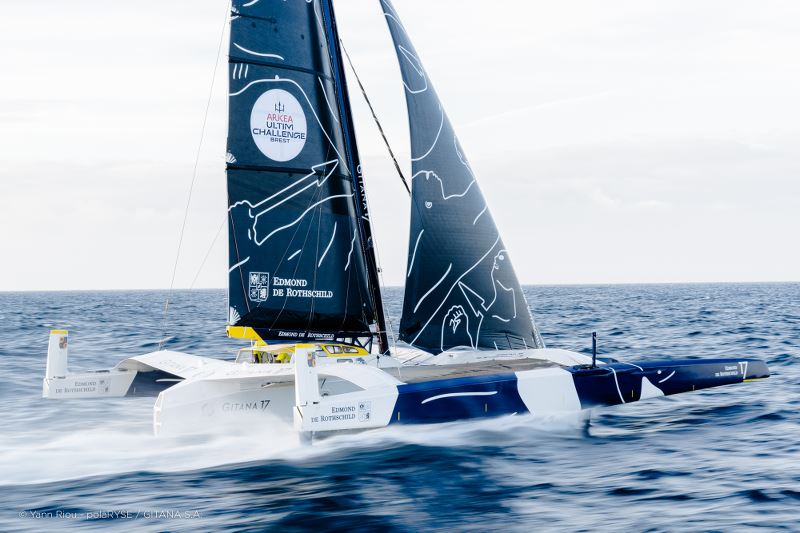
    Upon exiting the strait that bears his name, the Portuguese navigator Magellan ended up in peaceful waters, hence why he christened this newly discovered maritime space the Pacific. The Maxi Edmond de Rothschild burst into this same ocean in the early hours of Sunday 28 January, he too enjoying favourable conditions. In principle, the elements will be in his favour for the 6,000-mile passage towards the tip of South America. “Fairly strong NW’ly winds will push us along in a straight line in the right direction,” predicts the skipper. “It will be the perfect route ahead of a front, virtually as far as the middle of the Pacific, which translates as fast miles in the right direction,” confirms Erwan Israël. From there, the weather situation gets a bit more complicated and the atmosphere will get noticeably chillier around the AEZ, at 58 degrees south. 

    In the meantime, the 49-year-old sailor, who has never spent so much time alone at sea, has taken to it like a duck to water, driving the Maxi Edmond de Rothschild to perfection, despite the doubts and the short bouts of fatigue. “I have the energy from being first, which helps you surpass yourself.”


    * With Benjamin Schwartz and Julien Villion
    **Distance covered over the ground by Maxi Edmond de Rothschild