








Heritage

Season 26
Types de médias
  • Photos
  • Vidéos
  • Sons
Années
  • 2026
  • 2024
  • 2023
  • 2022
  • 2021
  • 2020
  • 2019
  • 2018
  • 2017
  • 2016
  • 2015
  • 2014
Afficher les résultats (121)
supprimer tous les filtres
  • News
  • Gallery
  • Gitana 18
  • Team
  • Retractable Y-shaped foils, adjustable in three dimensions

    Inspired by the appendages of the America's Cup foiling monohulls, these Y-shaped foils have a wingspan of over 5 metres. They are designed to generate powerful lift, increase power and offer a wide range of adjustments to optimise flight at every point of sail and in all conditions. Beyond their impressive size, these foils feature many unique innovations.

    Revolutionary U-shaped rudders

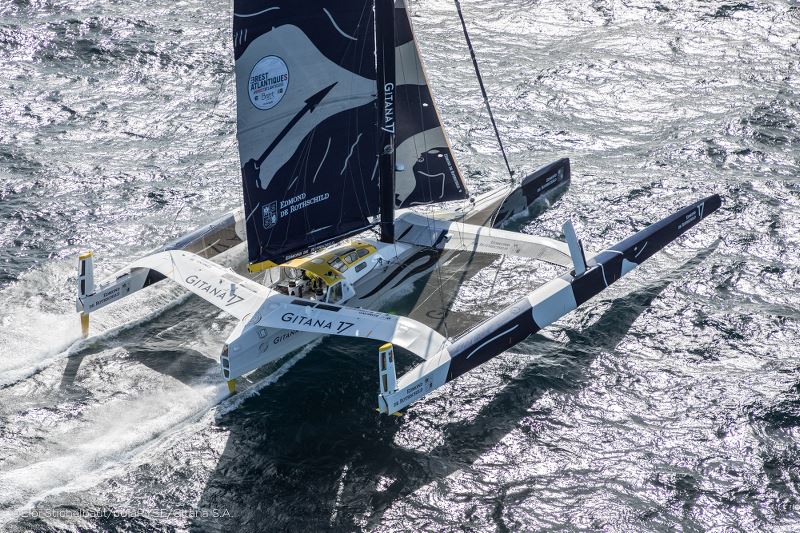
    These are probably the most visually striking innovations on the new Maxi Edmond de Rothschild. To fly high above rough seas while maintaining control, the team wanted very long rudders that would remain in contact with the water. The challenge is that longer rudders tend to flex under load, severely affecting steering and the efficiency of their lifting surfaces. A new geometry was needed to give these appendages maximum stiffness, resist cavitation and ultimately improve control of the boat and make better use of its power. The result is a set of U-shaped rudders over 4 metres long, a metre longer than those on Gitana 17. Their shape, reminiscent of a tripod or an inverted π, is only the visible part of what makes them so distinctive.

    A daggerboard optimised to stabilise the boat and limit cavitation

    With its wide span, the daggerboard resembles an aircraft tail assembly, with two adjustable flaps: one on the vertical section and the other on the horizontal section, the distinctive “manta-ray wing”. On Gitana 18, the innovation is to position this wing behind the vertical part of the appendage, rather than directly beneath it, to minimise flow disturbance and cavitation.

    Gitana 18’s daggerboard

    Rig: adjustable spreaders to control mainsail power while sailing

    Gitana 18’s mast is 1.50 metres taller than its predecessor’s. The boom is also shorter, creating a more slender sail plan. The major innovation is a set of spreaders that can be adjusted while sailing to bend the mast fore and aft. Actuated by hydraulic rams, these spreaders can pivot through 35 degrees to adjust the bend in the middle of the mast. This unprecedented system allows the sailor to control mainsail power: adding depth in light winds to take off sooner, or flattening the sail to reduce power at high speed or in strong winds. Adjusting the depth, and therefore the power, of the mainsail can also save a solo sailor time and energy by reducing the need for risky manoeuvres or headsail changes.

    Central hull:
    an integrated, structural coachroof

    The naval architects and Gitana design team wanted an exceptionally stiff, structurally robust platform. This applies both to the floats, which must withstand heavy loads from the foils and rudders, and to the central hull, which is subject to torsion. The enclosed coachroof is integrated into the hull and contributes to its structural strength. Inside, the cockpit brings all sail-handling controls together, with ergonomics shaped by many hours of design and development. The coachroof also stands out for the number and size of its windows. This configuration meets the visibility requirements of the Ultim class rules and gives sailors the best possible view to keep a visual watch.

    Gitana 18’s coachroof

    01.11.2019

    Gearing up for a confirmed start on Tuesday 5 November?.

    This weekend, the tip of Brittany and more broadly France’s Atlantic seaboard will be swept by the first big autumnal depression with winds bordering on 50 knots and very heavy seas. There is nothing exceptional about these conditions at this time of year, but due to the inherent danger, they’re proving somewhat incompatible with the start of the B…

    par Gitana

    This weekend, the tip of Brittany and more broadly France’s Atlantic seaboard will be swept by the first big autumnal depression with winds bordering on 50 knots and very heavy seas. There is nothing exceptional about these conditions at this time of year, but due to the inherent danger, they’re proving somewhat incompatible with the start of the Brest Atlantiques initially scheduled for Sunday 3 November at 12:02 UTC. In this way, the Maxi Edmond de Rothschild and the other three 32-metre rival giants (Actual Leader, Macif, Sodebo Ultim 3), will have to wait it out for a few days before they can set sail on the 14,000 miles that make up this unique course. A new slot for the start might well present itself on Tuesday 5 November, a scenario that, if confirmed, would suit Franck Cammas and Charles Caudrelier to a T, both of them keen to get their teeth into this race. Watch this space…
    Gale warning, start delayed

    “We’re in a fairly classic weather pattern for the season with what we refer to as a progressive circulation and a train of depressions in the North Atlantic, which are sweeping across Europe with varying degrees of intensity. The one that’s arriving this weekend is very deep, with SW’ly winds clocking round to the WNW of 50 knots and heavy seas with waves 8 to 10 metres high. It’s the first big depression Europe’s been subjected to this autumn and its trajectory has a particular bearing on the Brest Atlantiques”, explains Marcel Van Triest, Gitana Team’s weather specialist, who will also be responsible for ‘routing’ the duo on Edmond de Rothschild once the race is launched.  

    In light of the tempestuous conditions forecast, Jacques Caraës, the Race Director, and the organisers have no other option than to delay the start of the 1st edition of the Brest Atlantiques. This is always a tough decision to make, but it’s also a popular one, welcomed by all the sailors involved:“There was no debate, it would have been impossible to set sail on Sunday in terms of the safety of the men and the machines”, insists Charles Caudrelier: “We often talk about the Southern Ocean as having the most impressive seas, but having circumnavigated the globe several times, the worst conditions I’ve encountered were in the Bay of Biscay. Indeed, more than the wind, it’s the sea state that’s hard to deal with and it may prove dangerous. In the Bay of Biscay, the continental shelf rises very quickly and this can pick up short, cross seas. As such, with the 8 to 10 metre waves announced this weekend, it was deemed unsafe to navigate, even for boats as big as ours that are designed for sailing round the world.”

    Franck Cammas and Charles Caudrelier, as viewed by their media man Yann Riou

    The course for the Brest Atlantiques is unique with its 14,000 nautical miles taking in the North Atlantic and the South Atlantic. The crewed format selected is just as special. Indeed, for the first time in the Ultim category, a media man will accompany the pairs of skippers on Edmond de Rothschild and the decision to go with Yann Riou was quick, simple and natural. The three men know each other very well having sailed together on multiple occasions and during the victorious round the world campaign, the Volvo Ocean Race, in particular, where Yann took up the role of onboard reporter for the first time.
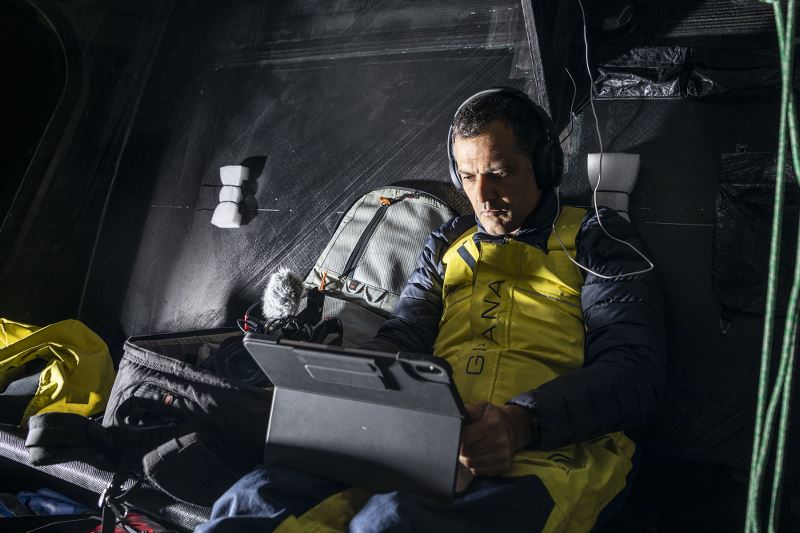


    Just a few days before they set sail on a race that is as thrilling as it is demanding, they share their viewpoints. 

    “Franck is a perfectionist who makes no concessions in his bid to achieve his objectives. I really like sailing with him and I was delighted to see him join the Maxi Edmond de Rothschild project as he has a major impact on performance. On a human level, he’s likeable and we know each other sufficiently well to be able to tell one another things, which is essential in a long race. In the Brest Atlantiques, it’s an impressive line-up and there are some incredible track records! However, I believe that Franck stands out in the sense that he is one of the rare few who has had an influence on his sport and on what offshore racing is today in France. On top of that, on a personal level, the trust he and Stéphane Guilbaud showed in me in the Groupama project and the Volvo Ocean Race 2011-2012 in particular is the reason I do the job I do today!”

    “Above all else, Charles is a friend I get on very well with. From a competitive viewpoint, I believe that his method of preparation is heavily inspired by Franck, whilst adding his own personal touch that includes a great deal of humanity in the way he manages a project. His victory in the last Volvo Ocean Race showed that his determination paid off. At sea, his choices are pertinent and he is driven by the same quest for performance as Franck, whilst remaining human and pleasant to live with.”

    Franck Cammas and Charles Caudrelier, two trajectories and one shared ambition

    For the past six months, the two great sailors have been sharing the helm of the Maxi Edmond de Rothschild. Theirs is a formidable duo, whose complicity dates back a long way before their arrival within Gitana Team. Indeed, their complementary characters were one of the keys to their joint recruitment.

    VIDEO =>