Heritage

Season 26
Types de médias
  • Photos
  • Vidéos
  • Sons
Années
  • 2026
  • 2024
  • 2023
  • 2022
  • 2021
  • 2020
  • 2019
  • 2018
  • 2017
  • 2016
  • 2015
  • 2014
Afficher les résultats (121)
supprimer tous les filtres
  • News
  • Gallery
  • Gitana 18
  • Team
  • Retractable Y-shaped foils, adjustable in three dimensions

    Inspired by the appendages of the America's Cup foiling monohulls, these Y-shaped foils have a wingspan of over 5 metres. They are designed to generate powerful lift, increase power and offer a wide range of adjustments to optimise flight at every point of sail and in all conditions. Beyond their impressive size, these foils feature many unique innovations.

    Revolutionary U-shaped rudders

    These are probably the most visually striking innovations on the new Maxi Edmond de Rothschild. To fly high above rough seas while maintaining control, the team wanted very long rudders that would remain in contact with the water. The challenge is that longer rudders tend to flex under load, severely affecting steering and the efficiency of their lifting surfaces. A new geometry was needed to give these appendages maximum stiffness, resist cavitation and ultimately improve control of the boat and make better use of its power. The result is a set of U-shaped rudders over 4 metres long, a metre longer than those on Gitana 17. Their shape, reminiscent of a tripod or an inverted π, is only the visible part of what makes them so distinctive.

    A daggerboard optimised to stabilise the boat and limit cavitation

    With its wide span, the daggerboard resembles an aircraft tail assembly, with two adjustable flaps: one on the vertical section and the other on the horizontal section, the distinctive “manta-ray wing”. On Gitana 18, the innovation is to position this wing behind the vertical part of the appendage, rather than directly beneath it, to minimise flow disturbance and cavitation.

    Gitana 18’s daggerboard

    Rig: adjustable spreaders to control mainsail power while sailing

    Gitana 18’s mast is 1.50 metres taller than its predecessor’s. The boom is also shorter, creating a more slender sail plan. The major innovation is a set of spreaders that can be adjusted while sailing to bend the mast fore and aft. Actuated by hydraulic rams, these spreaders can pivot through 35 degrees to adjust the bend in the middle of the mast. This unprecedented system allows the sailor to control mainsail power: adding depth in light winds to take off sooner, or flattening the sail to reduce power at high speed or in strong winds. Adjusting the depth, and therefore the power, of the mainsail can also save a solo sailor time and energy by reducing the need for risky manoeuvres or headsail changes.

    Central hull:
    an integrated, structural coachroof

    The naval architects and Gitana design team wanted an exceptionally stiff, structurally robust platform. This applies both to the floats, which must withstand heavy loads from the foils and rudders, and to the central hull, which is subject to torsion. The enclosed coachroof is integrated into the hull and contributes to its structural strength. Inside, the cockpit brings all sail-handling controls together, with ergonomics shaped by many hours of design and development. The coachroof also stands out for the number and size of its windows. This configuration meets the visibility requirements of the Ultim class rules and gives sailors the best possible view to keep a visual watch.

    Gitana 18’s coachroof

    27.11.2020

    Gitana Team’s Maxi-soundbites from the ocean, Season 1 – Episode #1.

    Batten down the hatches, pin back your ears, and above all buckle up before you allow yourself to be carried away by the force of the ocean, the howling wind and the power of the elements aboard the Maxi Edmond de Rothschild. Tuned into the noise, Yann Riou, the on-board media man, aims the mike at the partners joining him in this extreme sailing s…

    par Gitana

    Batten down the hatches, pin back your ears, and above all buckle up before you allow yourself to be carried away by the force of the ocean, the howling wind and the power of the elements aboard the Maxi Edmond de Rothschild. Tuned into the noise, Yann Riou, the on-board media man, aims the mike at the partners joining him in this extreme sailing synonymous with the Jules Verne Trophy. It’s a wonderful invitation to an audio journey sharing the extraordinary daily life of these six crewmen engaged in the quest for the speed record around the seas of the globe.

    Season 1: Descent of the Atlantic 
    Episode 1: Welcome to the on-board discomfort     
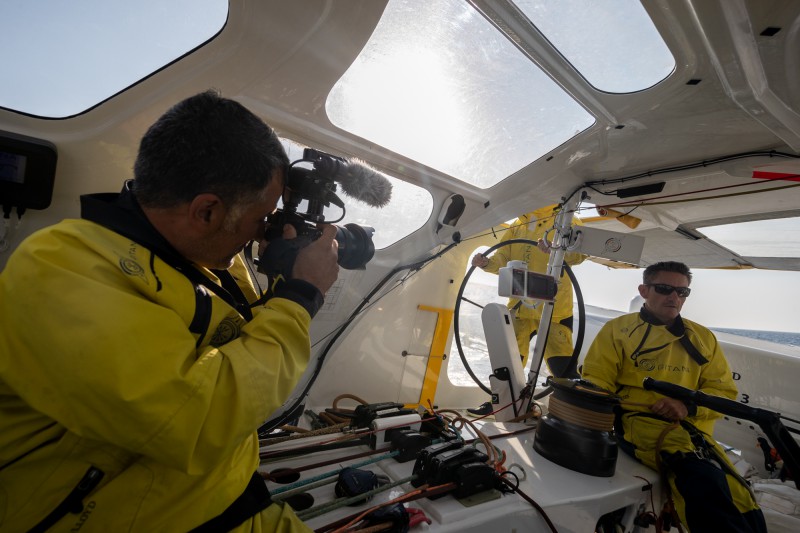
       

    And things get going with a bang, straight into a descent of the Atlantic, which begins with all the sails aloft, snatches of conversation turned inwards at an average of over 30 knots! Behind the numbers, words snapped up inside the cockpit, just like the noises captured up on deck in the heat of the action in this top-flight navigation, show the reality of a race against the clock at a furious pace. In this opening episode, David Boileau and Morgan Lagravière give us an audio account of their first anecdotes relating to the intensity of this competition at the cutting edge of oceanic performance. And it begins briskly offshore of Portugal. We can hear the swell roaring, the waves breaking, the gusts of wind whistling, the boat rushing and accelerating over the crests of the waves, leaving no respite for the men on deck enjoined to hold on tight. Welcome to the on-board discomfort!    

    David Boileau: gliding flight… controlled fortunately   
    “I’d just drained the water from the bilge. I wanted to make sure the galley hatch was closed properly, because the water can come in there and I was laid on top of the galley to close the handles when the boat buried into a wave. I was holding on tightly to these handles but I let everything go and ended up pretty much in the berth compartment. Mid-flight, I fortunately managed to catch hold of the companionway rung (…) I could have hurt myself. However, I had a bit of luck on my side and managed to recover myself as I was flying through the air!”   
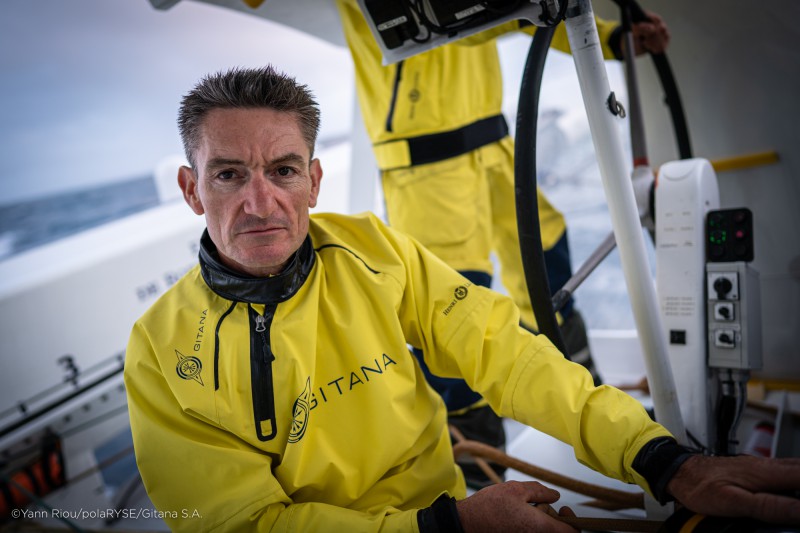
     

    Morgan Lagravière:  watch out for decelerations! 
    “I’m making the most of a wonderful spectacle. I’ve just woken up, the colours are lovely, with white on the surface of the sea. That’s indicative of wind. And looking at the boat’s speedos and anemometers, we’re creaming along! In the bunk, but especially in the outside cockpit, you sometimes find yourself in positions where, despite the fact that you’re holding on, you end up going over the top of the object you were pressed up against. Even during training on this boat, we rarely experienced decelerations like this. You have to be careful. A silly injury can occur just like that and that’s hard to deal with in this environment, you really have to watch out.”