








Heritage

Season 26
Types de médias
  • Photos
  • Vidéos
  • Sons
Années
  • 2026
  • 2024
  • 2023
  • 2022
  • 2021
  • 2020
  • 2019
  • 2018
  • 2017
  • 2016
  • 2015
  • 2014
Afficher les résultats (121)
supprimer tous les filtres
  • News
  • Gallery
  • Gitana 18
  • Team
  • Retractable Y-shaped foils, adjustable in three dimensions

    Inspired by the appendages of the America's Cup foiling monohulls, these Y-shaped foils have a wingspan of over 5 metres. They are designed to generate powerful lift, increase power and offer a wide range of adjustments to optimise flight at every point of sail and in all conditions. Beyond their impressive size, these foils feature many unique innovations.

    Revolutionary U-shaped rudders

    These are probably the most visually striking innovations on the new Maxi Edmond de Rothschild. To fly high above rough seas while maintaining control, the team wanted very long rudders that would remain in contact with the water. The challenge is that longer rudders tend to flex under load, severely affecting steering and the efficiency of their lifting surfaces. A new geometry was needed to give these appendages maximum stiffness, resist cavitation and ultimately improve control of the boat and make better use of its power. The result is a set of U-shaped rudders over 4 metres long, a metre longer than those on Gitana 17. Their shape, reminiscent of a tripod or an inverted π, is only the visible part of what makes them so distinctive.

    A daggerboard optimised to stabilise the boat and limit cavitation

    With its wide span, the daggerboard resembles an aircraft tail assembly, with two adjustable flaps: one on the vertical section and the other on the horizontal section, the distinctive “manta-ray wing”. On Gitana 18, the innovation is to position this wing behind the vertical part of the appendage, rather than directly beneath it, to minimise flow disturbance and cavitation.

    Gitana 18’s daggerboard

    Rig: adjustable spreaders to control mainsail power while sailing

    Gitana 18’s mast is 1.50 metres taller than its predecessor’s. The boom is also shorter, creating a more slender sail plan. The major innovation is a set of spreaders that can be adjusted while sailing to bend the mast fore and aft. Actuated by hydraulic rams, these spreaders can pivot through 35 degrees to adjust the bend in the middle of the mast. This unprecedented system allows the sailor to control mainsail power: adding depth in light winds to take off sooner, or flattening the sail to reduce power at high speed or in strong winds. Adjusting the depth, and therefore the power, of the mainsail can also save a solo sailor time and energy by reducing the need for risky manoeuvres or headsail changes.

    Central hull:
    an integrated, structural coachroof

    The naval architects and Gitana design team wanted an exceptionally stiff, structurally robust platform. This applies both to the floats, which must withstand heavy loads from the foils and rudders, and to the central hull, which is subject to torsion. The enclosed coachroof is integrated into the hull and contributes to its structural strength. Inside, the cockpit brings all sail-handling controls together, with ergonomics shaped by many hours of design and development. The coachroof also stands out for the number and size of its windows. This configuration meets the visibility requirements of the Ultim class rules and gives sailors the best possible view to keep a visual watch.

    Gitana 18’s coachroof

    10.11.2017

    Homing in on the doldrums.

    The duel between the Maxi Edmond de Rothschild and Sodebo Ultim’ is fiercer than ever at the head of the Transat Jacques Vabre race. The two leaders passed the Cape Verde islands over the course of the day and are now preparing to enter the infamous doldrums. Dreaded by sailors due to its random nature, the Inter-Tropical Convergence Zone does appe…

    par Gitana

    The duel between the Maxi Edmond de Rothschild and Sodebo Ultim’ is fiercer than ever at the head of the Transat Jacques Vabre race. The two leaders passed the Cape Verde islands over the course of the day and are now preparing to enter the infamous doldrums. Dreaded by sailors due to its random nature, the Inter-Tropical Convergence Zone does appear to be showing its best side to Sébastien Josse and Thomas Rouxel. In any case, that’s the feeling that emerges from the satellite observations. At the 15:00 UTC ranking, and after a very fine comeback last night, which enabled them to reduce their deficit by half, the men of Gitana Team were positioned 31.8 miles astern of the black and orange trimaran and very slightly to the west of it.

    Tonight, Gitana 17 and her rival will have to negotiate one of the key weather sections of the Route du Café. It is the doldrums of course. Questioned about what lies ahead for them, Thomas Rouxel replied with all the caution demanded by this zone when you’ve had the opportunity to traverse it in the past: “We’ll be tackling the doldrums in a few hours’ time. Of course, we have an idea of where we’d like to cross through it. If we use the basis of the latest forecasts, it looks fairly mild, which means we shouldn’t have to hunt it down too far over to the west. It’s still the doldrums though so you have to watch out! We’re going to try that and then we’ll see how things play out!”

    During the midday audio session, Thomas also took the time to convey how the guys are doing after 5 intense days at sea having covered nearly 3,000 miles. “Yes, it’s hot, but we have a fair bit of cloud cover now so it’s bearable. The fatigue’s setting in a bit and it’s hard to wake up, but things are okay. The Maxi Edmond de Rothschild is a comfortable boat. Sébastien and I are often thinking about Prince de Bretagne; things must be more difficult for them,” admitted the sailor from Brittany.  
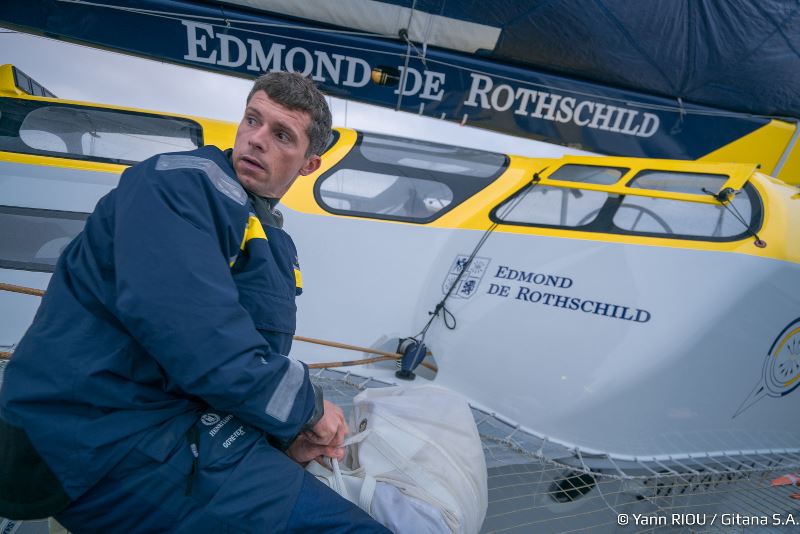
    A highly instructive mano a mano

    The Maxi Edmond de Rothschild is the first boat from the new generation of large oceanic multihulls. Since her launch back in July, all the members of Gitana Team have been working flat out to enable Sébastien Josse and Thomas Rouxel to make the start of the Transat Jacques Vabre. With such a machine, the extent of its technicality and all the detail that the skippers need to be on top of in order to perform well, just being able to set sail from Le Havre was a success in itself.

    To learn more and progress ever faster with understanding and utilising their steed, the Edmond de Rothschild duo were keen to come up against Sodebo Ultim’, one of the references in the category. They’ve got what they came for: “Naturally we’re less familiar with our boat than Thomas and Jean-Luc. As such, with every transition, we take a little more time to find the right trim. In terms of outright speed, yes, the boats are different, so there will be little separating us. However, since this morning, we’ve seen that on the whole Sodebo is a little faster than us. It’s motivating as it enables us to constantly strive to optimise the boat’s performance, which doubtless would have been less evident if we’d had a 200-mile lead. As a result, with a view to developing the boat, the situation is incredibly interesting. In terms of the race, we’d have preferred to have been 200 miles ahead of course. But this is how it is; it’s a great race and frankly we’re having a ball!” concluded the co-skipper of the Maxi Edmond de Rothschild. 


    Ranking at 15:00 UTC, Ultime category – Friday 10 November

    1 – Sodebo Ultim’ – 1,586.8 miles from the finish, 33 knots over 1hr
    2 – Maxi Edmond de Rothschild – 31.8 miles behind the leader, 28.4 knots over 1hr
    3 – Prince de Bretagne – 850 miles, 26.7 knots over 1hr