








Heritage

Season 26
Types de médias
  • Photos
  • Vidéos
  • Sons
Années
  • 2026
  • 2024
  • 2023
  • 2022
  • 2021
  • 2020
  • 2019
  • 2018
  • 2017
  • 2016
  • 2015
  • 2014
Afficher les résultats (121)
supprimer tous les filtres
  • News
  • Gallery
  • Gitana 18
  • Team
  • Retractable Y-shaped foils, adjustable in three dimensions

    Inspired by the appendages of the America's Cup foiling monohulls, these Y-shaped foils have a wingspan of over 5 metres. They are designed to generate powerful lift, increase power and offer a wide range of adjustments to optimise flight at every point of sail and in all conditions. Beyond their impressive size, these foils feature many unique innovations.

    Revolutionary U-shaped rudders

    These are probably the most visually striking innovations on the new Maxi Edmond de Rothschild. To fly high above rough seas while maintaining control, the team wanted very long rudders that would remain in contact with the water. The challenge is that longer rudders tend to flex under load, severely affecting steering and the efficiency of their lifting surfaces. A new geometry was needed to give these appendages maximum stiffness, resist cavitation and ultimately improve control of the boat and make better use of its power. The result is a set of U-shaped rudders over 4 metres long, a metre longer than those on Gitana 17. Their shape, reminiscent of a tripod or an inverted π, is only the visible part of what makes them so distinctive.

    A daggerboard optimised to stabilise the boat and limit cavitation

    With its wide span, the daggerboard resembles an aircraft tail assembly, with two adjustable flaps: one on the vertical section and the other on the horizontal section, the distinctive “manta-ray wing”. On Gitana 18, the innovation is to position this wing behind the vertical part of the appendage, rather than directly beneath it, to minimise flow disturbance and cavitation.

    Gitana 18’s daggerboard

    Rig: adjustable spreaders to control mainsail power while sailing

    Gitana 18’s mast is 1.50 metres taller than its predecessor’s. The boom is also shorter, creating a more slender sail plan. The major innovation is a set of spreaders that can be adjusted while sailing to bend the mast fore and aft. Actuated by hydraulic rams, these spreaders can pivot through 35 degrees to adjust the bend in the middle of the mast. This unprecedented system allows the sailor to control mainsail power: adding depth in light winds to take off sooner, or flattening the sail to reduce power at high speed or in strong winds. Adjusting the depth, and therefore the power, of the mainsail can also save a solo sailor time and energy by reducing the need for risky manoeuvres or headsail changes.

    Central hull:
    an integrated, structural coachroof

    The naval architects and Gitana design team wanted an exceptionally stiff, structurally robust platform. This applies both to the floats, which must withstand heavy loads from the foils and rudders, and to the central hull, which is subject to torsion. The enclosed coachroof is integrated into the hull and contributes to its structural strength. Inside, the cockpit brings all sail-handling controls together, with ergonomics shaped by many hours of design and development. The coachroof also stands out for the number and size of its windows. This configuration meets the visibility requirements of the Ultim class rules and gives sailors the best possible view to keep a visual watch.

    Gitana 18’s coachroof

    30.10.2023

    In the pack bound for Cape Finisterre.

    At 12:05 UTC yesterday, the Maxi Edmond de Rothschild and her adversaries were the first to take the start of the Transat Jacques Vabre Normandie Le Havre. In a SSW’ly wind of around thirty knots and heavy seas, the five duos signed up for the ULTIM class were able to show off the potential of their fantastic giants of the seas, powered up at over…

    par Gitana

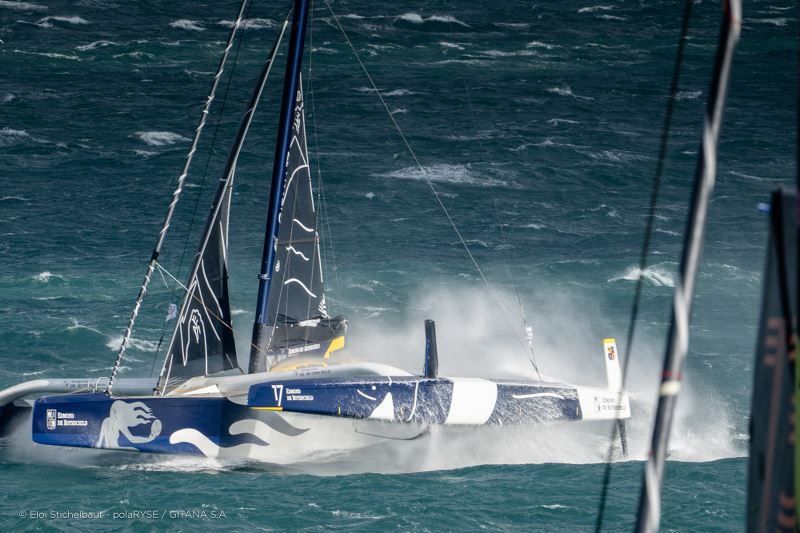
    At 12:05 UTC yesterday, the Maxi Edmond de Rothschild and her adversaries were the first to take the start of the Transat Jacques Vabre Normandie Le Havre. In a SSW’ly wind of around thirty knots and heavy seas, the five duos signed up for the ULTIM class were able to show off the potential of their fantastic giants of the seas, powered up at over 35 knots as they responded to the call of the open ocean… For the reigning champion, this rather full-on start phase was synonymous with stress with two spectacular bear aways, which the photographers and cameramen close to the action are unlikely to forget any time soon. More scared than hurt, once the helm issue was identified and resolved, the five-arrow giant moved back up to the head of the fleet. After 24 hours at sea, punctuated by some relatively boisterous and shifty conditions and a long beat westwards to hunt down a front to the south of Ireland, the ULTIMs are now all barrelling southwards towards Cape Finisterre, which they’re set to reach this evening.
    Helm issue during a lively start

    The last on-the-water clashes during training offshore of Lorient and the recent 24h Ultim race provided a clear indication that the fleet of giants would be competing with daggers drawn this autumn. The first few hours of this race have already confirmed this, as did the images captured yesterday in the Baie de Seine, which will very likely be consigned to the Coffee Route’s history books.


    Early this morning, Erwan Israël shared a quick and concise insight into the state of play with his shore crew, despite being in the midst of manoeuvring in the cockpit of the Maxi Edmond de Rothschild: “The first few hours of racing have been a little complicated aboard Gitana 17. We had a few helm issues during the start phase, which explains two slightly crazy bear aways in the first few miles in the Baie de Seine and our rather mediocre introduction. The problem’s sorted now though and the boat was at ease with the reaching at the start and we got back up into the top trio as we rounded the tip of the Cotentin peninsula. As forecast, conditions were very shifty with some big squalls. In fact, we had up to 50 knots as we passed Cherbourg. We were sailing with 2 reefs in the J3, which was the right sail area for tackling the race start,” explained the co-skipper of Gitana 17. “Further down the racetrack, we played around in the Channel Islands and came off pretty well, which enabled us to snatch back the head of the fleet in the evening, ready to tackle the rounding of the north-west tip of Brittany. Like Banque Populaire and Sodebo, we opted for the inside track at the Ushant TSS  in line with our weather strategy, whilst SVR went around the outside. We tacked this morning onto a long starboard tack southwards to our new course mark level with Madeira.”


    Indeed, whilst the small Brazilian Islands of São Pedro e São Paulo, around 1,000 km to the north-east of Natal in the North Atlantic, were supposed to be the first course mark for the ULTIMs in their descent of the Atlantic, an amendment has since been published by Race Management. The latter indicates a new mark level with the Madeira archipelago and more precisely its northernmost island of Porto Santo, which the 32-metre giants will have to leave to starboard.


    Advantage to the west

    At the 15:00 UTC position report, the duo aboard the Maxi Edmond de Rothschild lamented a 33-mile deficit in relation to the men on SVR-Lazartigue, who are positioned further over to the west and are currently heading the fleet, and around fifteen miles shy of Banque Populaire, which is making headway to the east of her, closer to the great circle route. These deficits are relatively small given the scale of the ULTIMs’ performance capabilities, and also the upcoming weather scenario, with a ridge of high pressure blocking the way forward for the leaders at the latitude of Gibraltar.


    “We were a bit too keen this morning and ideally, we should have waited a few more miles before tacking southwards. We ended up being trapped for a few hours between the old and the new breeze, which took its time latching onto us. The atmosphere as a whole has been very unstable with a number of squalls rolling through. From one cloud to the next, there were very big variations in the intensity of the wind”, admitted the onshore weather cell for the Maxi Edmond de Rothschild, which is made up of Erwan Tabarly and Simon Fisher for this transatlantic race.


    Caught up in this buffer zone posting speeds barely in excess of 10 knots for part of the morning, whilst François Gabart and Tom Laperche were driving along at over 30 knots further out to the west, the sailors of Gitana Team have logically lost some ground: “It’s not very pleasant seeing your competitor making headway 20 knots faster as you await the favourable breeze. However, given the area of light winds sprawled out in front of us from tomorrow… we’re keeping things in perspective! Very soon we’ll all be together,” assured Charles Caudrelier.
     

    Staggered starts for the four classes

    95 duos signed up for the Transat Jacques Vabre – Normandie Le Havre 2023, but the organisers of the 16th edition have had to resort to splitting up the four fleets to adapt to the particularly boisterous weather conditions of this late October. As such, 55 boats from three classes (ULTIM, Class40 and Ocean Fifty) set sail from Le Havre yesterday, whilst the IMOCAs have been forced to remain dockside for now.

    However, thanks to their speed potential and hence their ability to get down to the southern latitudes more swiftly to avoid the worst depressions, the ULTIMs will be able to sail their 7,500-mile course without stopovers. Meantime, the fleet of Ocean Fiftys made landfall in Lorient earlier today and that of the Class40s is expected to enter the port in the coming hours. It is in the Maxi Edmond de Rothschild’s port of registry that the fifty or so boats will sit out the worst of the weather expected to lash France’s Atlantic coast on Wednesday evening, with the situation set to deteriorate again over the weekend.