








A wise decision
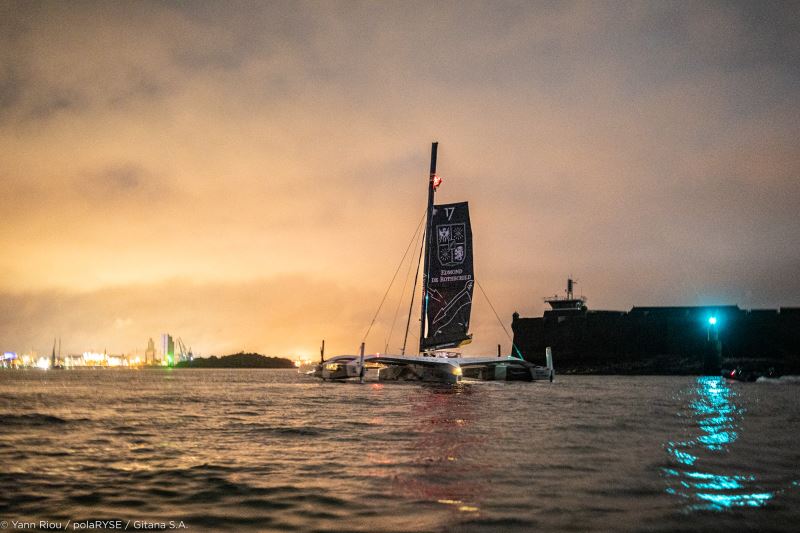
On Tuesday 8 October, shortly before noon local time, Charles Caudrelier contacted his shore team. Having set sail from Antibes 48 hours earlier and set a course for Brittany via Gibraltar, the 35-metre mast snapped above the J3 forestay leaving 11 metres of spar dangling in mid-air. For four hours, the crew rallied together to preserve the platform and make the Maxi secure. Back in Lorient, the team worked hard to locate a port which could accommodate the injured giant whilst part of the shore team hit the road to Andalusia. A few hours later, it was a bruised Gitana 17 which made her entrance into Motril Marina. There was no time to lose. The objective was clear: to enable the Maxi and her crew to head back out to sea as quickly as possible to make for Lorient under jury rig so as not to put the upcoming planetary programme in jeopardy.
Charles Caudrelier reviews the circumstances that led to this damage: “We were very confident in this mast. It’s the boat’s original mast and we had no prior warning of anything untoward. There is nothing in the numbers we have at our disposal today, which allows us to say that we made a big mistake and the cables which support the mast didn’t break. It’s essentially the spar itself which broke. We know that it buckled, doubtless under compression, but so far nothing shocking has come out of the data to explain how that happened. Perhaps it was a previous impact that we didn’t pick up on during our checks, which created a weak spot? The investigations are ongoing…”
During the delivery trip, the shore team in connection with Charles Caudrelier busied themselves with studying all the different avenues open to them. However, not only were the solutions under study for effecting repairs not entirely satisfactory but the timing of the creation of a ‘sleeve’, or something that would require a new spar to be built, would have required a minimum of six months. That simply wasn’t in line with an attempt at the Jules Verne Trophy record, which the team had be targeting, nor the long-term future of the five-arrow team, as the winner of the Arkea Ultim Challenge explained: “When we chose to add the Jules Verne Trophy to our list of goals for the end of 2024, we had the capacity to do so albeit with relatively tight timing for the start and end of standby due to the arrival of the future boat. The team has a new boat to launch in a year’s time and will be especially busy with the end of construction for this fine project. This dismasting has inevitably disrupted this schedule and we have decided to adopt a reasonable approach going forward so as not to confuse our objectives.”
“We’re all extremely disappointed as the Jules Verne is the holy grail we’ve been dreaming of adding to Gitana 17’s list of accolades. She thoroughly deserved it but I think we must cast our minds forward to the future because what awaits us is pretty incredible, and above all we must remember everything that we’ve accomplished with her,” stressed Cyril Dardashti, general manager of the team.

Forever the trailblazer
After 170,000 hours of construction and over 35,000 hours of studies, the Maxi Edmond de Rothschild’s life on the water began on 17 July 2017 with her launch in Vannes in south-west Brittany. This 32-metre long and 23-metre wide maxi-trimaran was a bolt from the blue in offshore racing circles.
The choices made by Gitana Team and Team Verdier with this project were to design and manufacture the first oceanic maxi-trimaran capable of flying in the open ocean. Gitana 17 is a pioneer in a new generation and a new era of offshore racing: that of flying boats. The successes were immediate but from the moment her performance was tweaked, in a way that was totally unlike any mechanical prototype, the Maxi Edmond de Rothschild was able to show the true extent of her massive potential. The latter, together with the multiple talents of the sailors who drive her, who naturally include Charles Caudrelier, result in a fantastic winning formula: Two Rolex Fastnet Races, Brest Atlantiques, Transat Jacques Vabre… With every race, Gitana 17 becomes a legendary reference. The solo victories of Charles Caudrelier in the epic Route du Rhum and more recently in the debut edition of the Arkea Ultim Challenge, the first single-handed round the world race on ULTIMs, definitively catapult the five-arrow giant into a whole new dimension.
“This boat has brought us so much joy! On a personal level, Gitana 17 is the best boat of my life. She’s the one that has made me want to race again and has treated me to the finest solo victories of my career. She is legendary and she’s a long way off being done with podium finishes! She’ll be a formidable competitor and that’s why I hope she’ll remain on the circuit,”admits Charles Caudrelier.
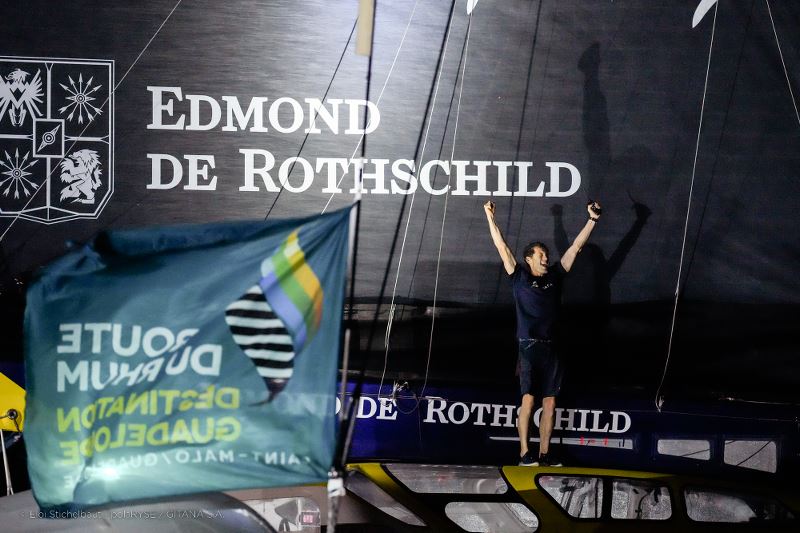
“Victory in the Arkea Ultim Challenge was a crowning success for our owner, Ariane de Rothschild, and for all our team. Securing first place around the world was the perfect way to round off a dream we envisaged ten years ago at the very beginning of the Gitana 17 programme. I’m incredibly proud for all the team about the ground we’ve covered and I’m also extremely confident about the road that lies ahead of us. These past few years with Gitana 17 have been incredibly rich both technically and in human terms, and it is this same richness which forms the foundation stone for the Gitana 18 project: how lucky we are!” concludes Cyril Dardashti.
Last December, Ariane de Rothschild announced the construction of a brand-new Maxi Edmond de Rothschild: Gitana 18. As such, with the announced sale of Gitana 17 to leave the way clear for the future giant, which is currently in build at CDK in Lorient, this Thursday 17 October 2024 marks the end of another chapter in Gitana Team’s journey.
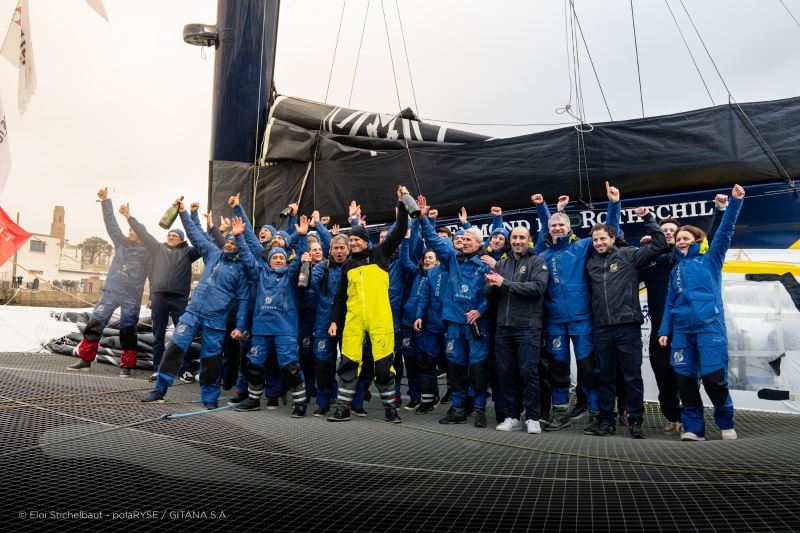
After seven and a half years of good and loyal service, with close to 200,000 miles navigated on all the seas of the globe, Gitana 17 will be hauled out in a few days’ time to prepare for her new life, which the whole team hopes will be just as wonderful.
The key numbers and dates for the Maxi Edmond de Rothschild
– 170,000 hours of construction including 35,000 hours of studies
– 190,000 nautical miles covered since her launch
– 51.7 knots, peak speed reached
– 10 victories, 15 podiums out of 16 races contested
Verdier design created in collaboration with the Gitana Team
Track record:
2017
– 17 July: launch in Vannes
– 17 August: 1st flights offshore of Lorient
– November: participation in her 1st race, the Transat Jacques Vabre, where she finishes 2nd
2018
– November: participation in the Route du Rhum – Destination Guadeloupe, port float damage with a broken 8-metre section forward of the beam on the first night.
>> New skippers: Charles Caudrelier and Franck Cammas
2019
– June: 2nd in the ArMen Race Uship, crewed
– August: winner of the Rolex Fastnet Race, crewed
– December: winner of the Brest Atlantiques, double-handed
2020
– July: winner of the Drheam Cup, crewed
– November: 1st Jules Verne Trophy record attempt, crewed – curtailed due to damage
2021
– January: 2nd Jules Verne Trophy record attempt, crewed – curtailed due to damage (rudder on starboard float). New reference time between Ushant and the Cape of Good Hope: 11 days 14 hours and 3 minutes.
– August: winner of the Rolex Fastnet Race for the 2nd consecutive time, crewed
– November: winner of the Transat Jacques Vabre, double-handed
>> Skipper: Charles Caudrelier
2022
– July: winner of the Finistère Atlantique – Challenge – Action Enfance 2022, crewed
– September: winner of the 24h Ultim, Charles Caudrelier single-handed
– November: winner of the Route du Rhum – Destination Guadeloupe in 6 days 19 hours 47 minutes and 25 seconds (new event record), Charles Caudrelier single-handed
2023
– February: 3rd Jules Verne Trophy record attempt, crewed – curtailed due to damage
– October: 2nd 24h Ultim, double-handed, Charles Caudrelier and Erwan Israël
– November: 3rd in the Transat Jacques Vabre, double-handed, Charles Caudrelier and Erwan Israël
2024
– February: winner of the Arkéa Ultim Challenge in 50 days 19 hours 7 minutes, 42 seconds, 1st round the world race for ULTIM, Charles Caudrelier single-handed
– September: winner of the 24h Ultim, crewed
– October: 2nd Finistère Atlantique, crewed
Livery:
> An original work designed especially for this project by the artist Cleon Peterson.
> Commission: Hugo Vitrani, curator Palais de Tokyo.
> Creation: Jean-Baptiste Epron
> The Maxi Edmond de Rothschild is the 1st floating ‘against the wall’ work for the Palais de Tokyo