








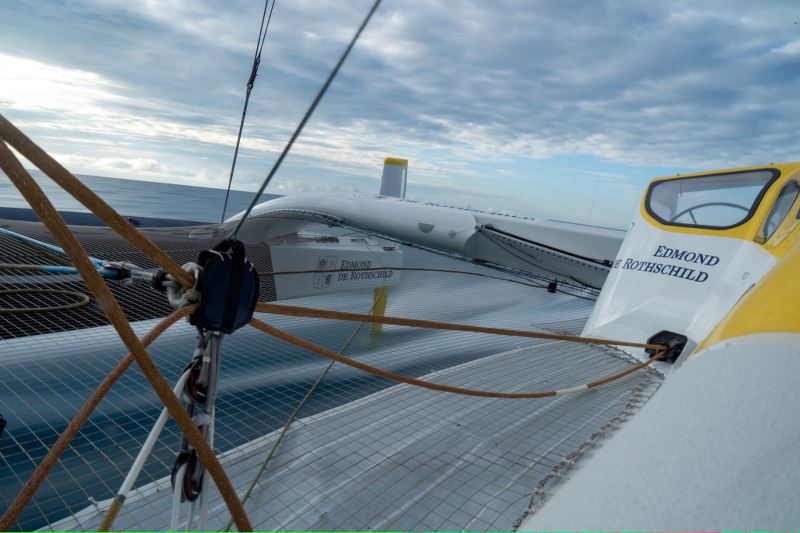
From light airs to high speed, without any transition
Yesterday, making her way along the Brazilian coast, the latest addition to the Gitana fleet broke the records for slowness… Posting an average speed of 2.6 knots over four hours, Charles Caudrelier and Franck Cammas had no other option than to just grin and bear it, whilst they traversed a windless zone left over by an ‘old’ front that was fading away. However, the rewards finally came at the end of the day with the return of a steadier breeze that became more established the further South the Maxi Edmond de Rothschild got.
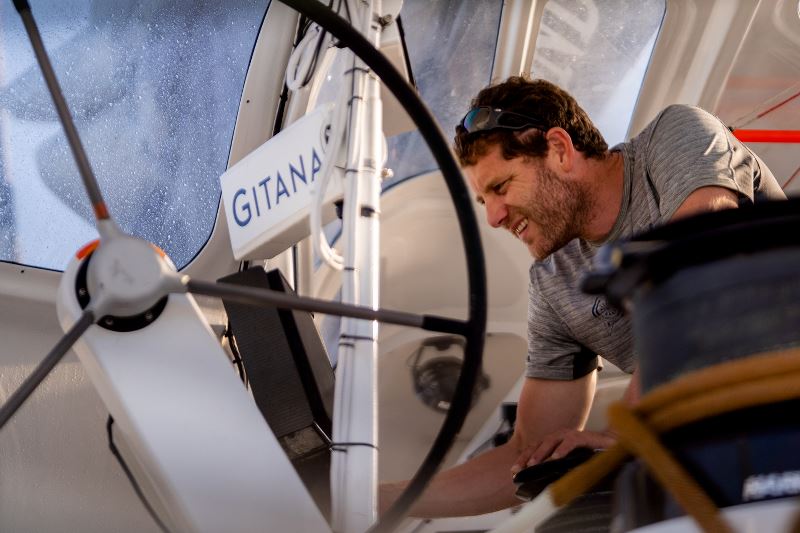
«There we go! What joy…», gushed Charles Caudrelier with the arrival of the first gust, before reiterating his gratitude to the shore crew for all their work: «The stopover in Salvador cost us very dearly, as we’ve had a lot of light airs, but the boat is going extremely quickly once again, an average of 3 to 4 knots quicker than when the daggerboard was damaged. The team did a fantastic job.” This sense of satisfaction was widely shared by Franck Cammas: “We’ve rediscovered the sensations we felt prior to our breakage. Making a pit stop really was the right decision, even though it wasn’t an easy one to make. We lost a lot of miles but I’m hopeful we’ll quickly make them up.»
One day later and a few miles further South, the wishes of the skipper of Edmond de Rothschild appear to have been fulfilled.
Bottleneck at the foot of the Corcovado
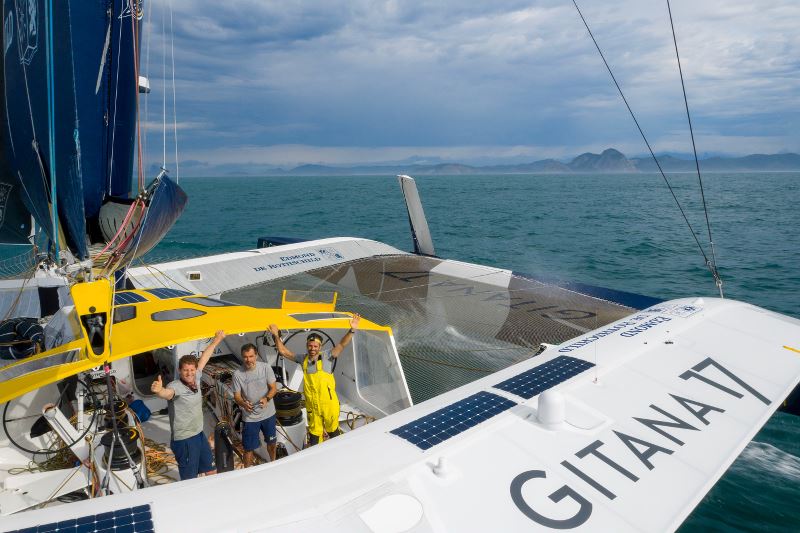
As planned, Macif made a pit stop in the Marina Gloria in Rio de Janeiro to replace the rudder on her central hull, which broke after colliding with a UFO. It proved to be a long operation since they made the dock yesterday at 19:00 UTC and François Gabart and Gwénolé Gahinet then headed back out to sea today shortly before 15:00 UTC. At the front of the fleet, Sodebo Ultim made the most of this pit stop to snatch the lead and rounded the Cagarras Islands yesterday at 22:23 UTC. However, since then there’s been a dramatic turn of events since at midday, Thomas Coville announced that he was putting the race to one side temporarily for meteorological reasons and was retracing his steps towards Rio at the 15:00 UTC ranking. All this activity worked in the favour of the latest addition to the Gitana fleet, enabling our two skippers to get right back into the match once the Cagarras Islands were in the wake of their 32-metre giant. In fact, this official passage mark was immortalised in magnificent fashion by Yann Riou, the media man on the Maxi Edmond de Rothschild, thanks to his talents as a drone pilot extraordinaire.
=> Video of the day :
A demanding South Atlantic
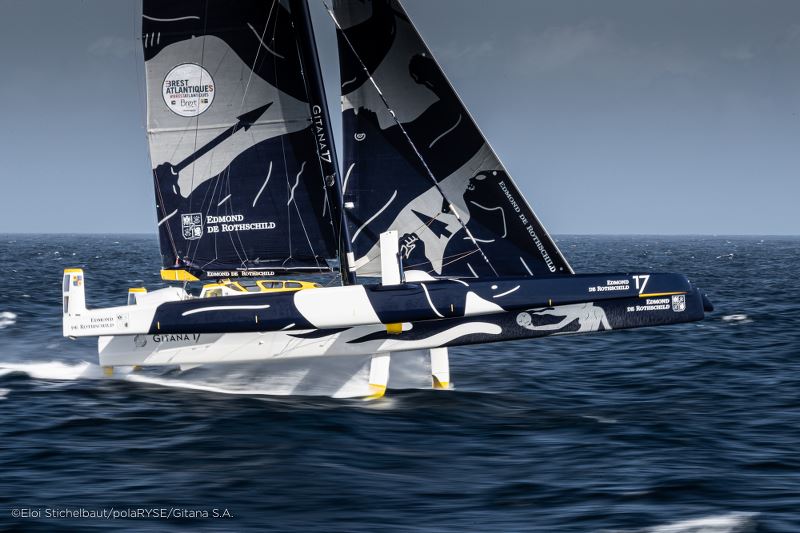
For several days, Marcel van Triest, like his fellow Maxi router ‘colleagues’, has been observing the classic pattern synonymous with the South Atlantic, namely a Saint Helena High positioned over the island that is its namesake and a downwind route to her South to make Cape Town, that didn’t look like a feasible option. Indeed, the high pressure is further South than usual and following the detection of ice by the CLS*, Race Management for the Brest Atlantiques has positioned an ice gate fairly far North, with its highest point at 38° South. This meteorological element combined with the safety element, and hence necessary, bars the way forward on the S’ly course, thus forcing the competitors to adopt a N’ly course, sailing fairly close to the wind, in order to reach the next course mark of Robben Island in South Africa. “We’re going to set off from Rio on a reach / upwind with the sheets eased a little, which is not a comfortable point of sail for either the sailors or the boat, as it puts a fair amount of pressure on the platform. At this time, the forecasts along the course we’re planning to take are announcing 3-metre waves and around thirty knots or so of breeze, which remains practicable. We’re remaining vigilant, primarily through Franck and Charles on-board, and of course through their router Marcel Van Triest, who’s scrutinising the situation with the utmost care”, admitted Cyril Dardashti, director of the five-arrow stable.
* CLS means Satellite-based location and data collection system. CLS is a subsidiary of the CNES (National Centre for Space Studies), ARDIAN and IFREMER, which is an international company that has been a pioneer in the provision of monitoring and surveillance solutions for the Earth since 1986.
Ranking on Thursday 14 November 15:00 UTC
1. SODEBO ULTIM 3 (Thomas Coville / Jean-Luc Nelias / Martin Keruzoré) – 8,837.3 – average speed over the past 30 mins: 25.1 knots
2. MAXI EDMOND DE ROTHSCHILD (Franck Cammas / Charles Caudrelier / Yann Riou) – 135.2 miles behind the leader – average speed over the past 30 mins: 19.7 knots
3. MACIF (François Gabart / Gwenolé Gahinet / Jérémie Eloi) – 137.8 miles behind the leader – average speed over the past 30 mins: technical pit stop in Rio de Janiero
4. ACTUAL LEADER (Yves Le Blevec / Alex Pella / Ronan Gladu) – 165.7 miles behind the leader – average speed over the past 30 mins: 12.8 knots