








Heritage

Season 26
Types de médias
  • Photos
  • Vidéos
  • Sons
Années
  • 2026
  • 2024
  • 2023
  • 2022
  • 2021
  • 2020
  • 2019
  • 2018
  • 2017
  • 2016
  • 2015
  • 2014
Afficher les résultats (121)
supprimer tous les filtres
  • News
  • Gallery
  • Gitana 18
  • Team
  • Retractable Y-shaped foils, adjustable in three dimensions

    Inspired by the appendages of the America's Cup foiling monohulls, these Y-shaped foils have a wingspan of over 5 metres. They are designed to generate powerful lift, increase power and offer a wide range of adjustments to optimise flight at every point of sail and in all conditions. Beyond their impressive size, these foils feature many unique innovations.

    Revolutionary U-shaped rudders

    These are probably the most visually striking innovations on the new Maxi Edmond de Rothschild. To fly high above rough seas while maintaining control, the team wanted very long rudders that would remain in contact with the water. The challenge is that longer rudders tend to flex under load, severely affecting steering and the efficiency of their lifting surfaces. A new geometry was needed to give these appendages maximum stiffness, resist cavitation and ultimately improve control of the boat and make better use of its power. The result is a set of U-shaped rudders over 4 metres long, a metre longer than those on Gitana 17. Their shape, reminiscent of a tripod or an inverted π, is only the visible part of what makes them so distinctive.

    A daggerboard optimised to stabilise the boat and limit cavitation

    With its wide span, the daggerboard resembles an aircraft tail assembly, with two adjustable flaps: one on the vertical section and the other on the horizontal section, the distinctive “manta-ray wing”. On Gitana 18, the innovation is to position this wing behind the vertical part of the appendage, rather than directly beneath it, to minimise flow disturbance and cavitation.

    Gitana 18’s daggerboard

    Rig: adjustable spreaders to control mainsail power while sailing

    Gitana 18’s mast is 1.50 metres taller than its predecessor’s. The boom is also shorter, creating a more slender sail plan. The major innovation is a set of spreaders that can be adjusted while sailing to bend the mast fore and aft. Actuated by hydraulic rams, these spreaders can pivot through 35 degrees to adjust the bend in the middle of the mast. This unprecedented system allows the sailor to control mainsail power: adding depth in light winds to take off sooner, or flattening the sail to reduce power at high speed or in strong winds. Adjusting the depth, and therefore the power, of the mainsail can also save a solo sailor time and energy by reducing the need for risky manoeuvres or headsail changes.

    Central hull:
    an integrated, structural coachroof

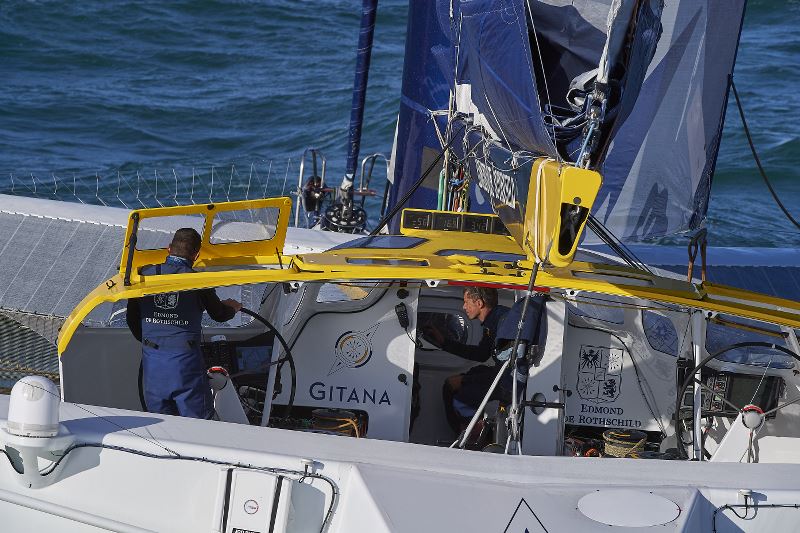
    The naval architects and Gitana design team wanted an exceptionally stiff, structurally robust platform. This applies both to the floats, which must withstand heavy loads from the foils and rudders, and to the central hull, which is subject to torsion. The enclosed coachroof is integrated into the hull and contributes to its structural strength. Inside, the cockpit brings all sail-handling controls together, with ergonomics shaped by many hours of design and development. The coachroof also stands out for the number and size of its windows. This configuration meets the visibility requirements of the Ultim class rules and gives sailors the best possible view to keep a visual watch.

    Gitana 18’s coachroof

    06.11.2017

    On the front line.

    After leaving Le Havre yesterday at 12:35 UTC, this lunchtime the Transat Jacques Vabre fleet is being led down the Atlantic by the Josse - Rouxel duo aboard the Maxi Edmond de Rothschild. Setting sail with a degree of caution from the foot of the Cap de la Hève, the sailors that make up Gitana Team wasted no time in powering up and showing just wh…

    par Gitana

    After leaving Le Havre yesterday at 12:35 UTC, this lunchtime the Transat Jacques Vabre fleet is being led down the Atlantic by the Josse – Rouxel duo aboard the Maxi Edmond de Rothschild. Setting sail with a degree of caution from the foot of the Cap de la Hève, the sailors that make up Gitana Team wasted no time in powering up and showing just what this latest addition to the Gitana fleet is made of. After an express exit from the English Channel, which they dealt with in just 9hrs at an average speed of 28 knots, Sébastien and Thomas are currently heading westwards where they’re due to hit a cold front, which they’ll have to negotiate at the end of today with strong wind and very rough seas on the programme. At the 11:00 UTC ranking, Gitana 17 was nearly 10 miles ahead of her closest rival, Sodebo Ultim.

    A lively start and first night

    Yesterday, offshore of Le Havre, only the most courageous witnessed the start of the 13th Transat Jacques Vabre out on the water, but they were rewarded by the most stunning spectacle. The sea, which was particularly rough and short, coupled with the tail end of a low, presented them with some fabulous images and contrasts of the fleet of 37 competing boats. True to their original mindset, Sébastien Josse and Thomas Rouxel set sail somewhat cautiously to the south of the start line, holding fire on their fantastic machine throughout the 12-mile course, which took the sailors towards the France 3 mark at Etretat. However, the minute this mark was behind them and they were finally clear of the coast, the Maxi Edmond de Rothschild and her crew could really get their teeth into the race.

    “It was a fairly sporty introduction! Last night the wind was very shifty. We had a little too much sail aloft and the boat was barrelling along at 40 knots at times. We had heavier seas than forecast and we were punching into 3 to 3.5-metre waves in places. It wasn’t very easy to manage such conditions and we had to make sure we were on our game and very focused. However, Thomas and I managed to get into a rhythm, each of us eating our superb meals cooked up by the chef Julien Gatillon* and each taking turns to get a bit of sleep. It was very pleasant to benefit from clear skies with a virtually full moon, especially given our AIS issues, which have plagued us since the start,” stated Sébastien Josse.

    Indeed, yesterday, Cyril Dardashti – Gitana’s team manager – alerted Race Director Sylvie Viant to the fact that the Maxi Edmond de Rothschild was experiencing difficulties with her AIS (Automatic Identification System). This system of automated message exchanges between vessels via VHF radio, which provides data about the identity, status, position and course of vessels in a particular navigation zone, was not replying. This is a significant handicap in sectors like the English Channel, which are renowned for their intense shipping. Fortunately, the two sailors were able to count on the support of the local coastguard service, particularly as they crossed the shipping lane off Ushant, which is one of the most heavily frequented maritime passages in the world.

    Despite all this, those boats heading the Transat Jacques Vabre race, with Gitana 17 leading the way, managed to cover the 255 nautical miles between the start and the island of Ushant in just 9 hours, which equates to an average speed of 28.3 knots; figures which testify to the swiftness of the start of this transatlantic race. Indeed, the Maxi Edmond de Rothschild was polled on several occasions making 39 knots and the duo negotiated the Channel Islands at over 35 knots, despite punching into a tide running at nearly 5 knots.
     

    Video – Taking-off for the Atlantic, relive the final moments ashore for the Edmond de Rothschild duo and Gitana Team

    Bound for the front!

    Since late last week, the various weather models have been on the same page and so the resulting scenario was pretty clear. As such, before casting off the Edmond de Rothschild had a perfect handle on how the initial days of the race would play out. Having crossed the ridge of high pressure on their arrival in the Bay of Biscay, which explains the relatively low speeds posted by the Ultime trio this morning, Sébastien and Thomas are currently making for their first cold front. Leading the hunt westwards, our two sailors are currently on port tack beating into around twenty knots of breeze. This SW’ly breeze is set to build steadily to reach an average of 30-35 knots as the front rolls through, which is estimated to be around 20:00 UTC this Monday evening. According to the latest observations made by the onshore routers – Jean-Yves Bernot and Antoine Koch – the phenomenon is very active. Heavy rain and gusts bordering on 40-45 knots are on the cards. The seas will be heavy with a swell of at least 5 metres expected.

    In other words, the atmosphere is set to get increasingly lively throughout the day aboard the Maxi Edmond de Rothschild with this first key passage of the Transat. 
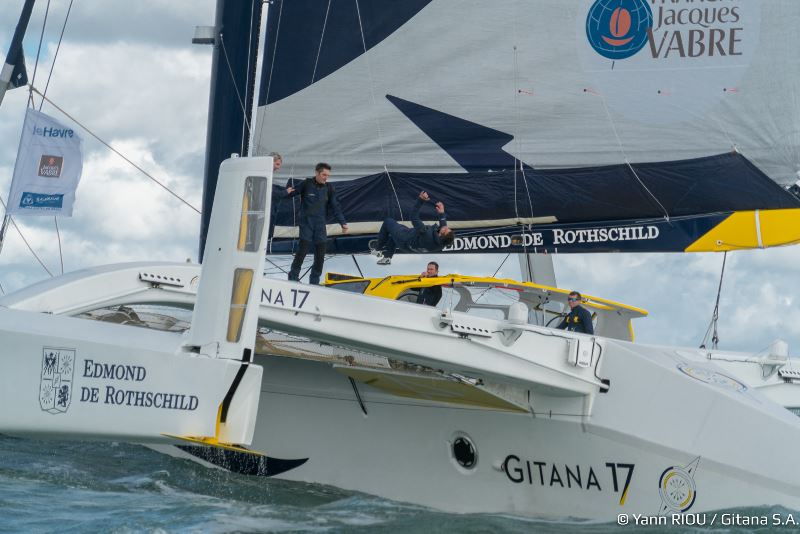
    Video – “First times” series, #4 First race start. Our mediaman Yann Riou threw himself into the water to give you the best possible images of the Maxi Edmond de Rothschild setting sail.

    Extracts from the radio session – Sébastien Josse on Monday 6 November at 04:00 UTC

    “The race got off to a good start! We tried to be sparing with the boat as the seas were breaking hard with the current in the English Channel. We can see that the boat has real potential and we have a lot on our plate right now. It’s noticeable that there’s little between us as Thomas isn’t very far behind. We don’t have a lead of 100 miles so these are very much race conditions.”