








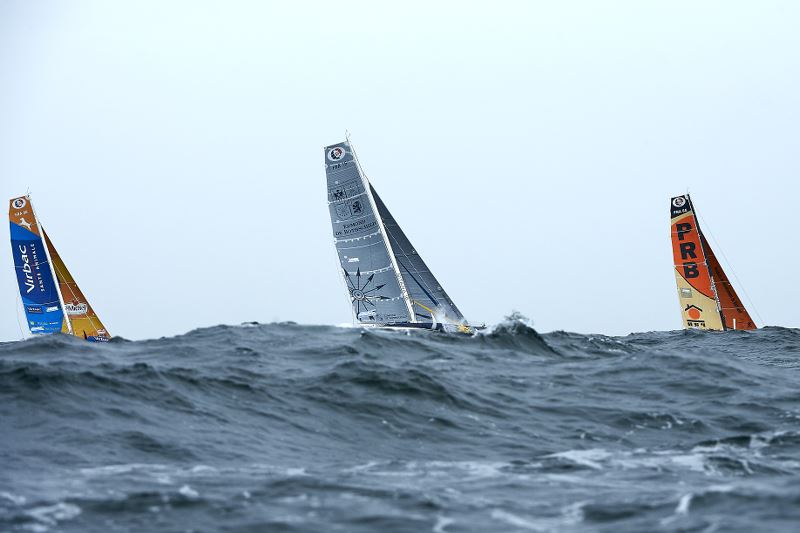
Devised by Titouan Lamazou and created by the sailor Philippe Jeantot, the Vendée Globe draws its inspiration from the British Golden Globe Challenge in 1968. The first singlehanded yacht race without stopovers, it was an incredible epic that Sir Robin Knox-Johnston was the only sailor to complete in Falmouth a er 313 days at sea!
Twenty years later, the French inaugurated the Globe Challenge, which was subsequently rechristened the Vendée Globe. e rst edition of this new round the world race via the three capes gathered together some thirteen skippers for the kick-off on 26 November 1989. With a slim amount of weather information and virtually no means of communication, it is the total unknown and an adventure throughout. Aboard Écureuil d’Aquitaine II, Lamazou, the ‘hazelnut nibbler’ took the head of the eet three days out. He held onto that lead right the way to the finish to secure the crown after some 109 days of racing, ahead of Loïck Peyron and Jean-Luc Van den Heede. e media infatuation for o shore racing went o the scale.
On the back of the success of this major rst, a second edition in 1992 attracted new favourites, including Alain Gautier and Philippe Poupon, as well as youngsters Yves Parlier and Bertrand de Broc. e latter caused a stir when he had to sew his tongue back up, alone in the Roaring Forties. Above all, it was a year marked by the rst dramas, with the disappearance of Mike Plant and Nigel Burgess. Half of the competitors completed the course and the crown went to Alain Gautier, who took the win on his brand new Finot-Conq design, Bagages Superior.
Four years later, the third Vendée Globe upset the public. At the start were two women, Isabelle Autissier and Catherine Chabaud, as well as Parlier with his revolutionary Aquitaine Innovations equipped with a rotating wing mast. Norman, Christophe Auguin, had already won the Boc Challenge twice (round the world with stopovers) and sets off strongly, quickly taking control of the 1996-1997 edition. Isabelle Autisser diverts due to rudder damage and Parlier has stay issues. Having set sail as a ‘pirate’ after his late entry was turned down, Raphaël Dinelli capsizes and is picked up by British sailor Pete Goss, whilst ierry Dubois and Tony Bullimore’s boats also ip over. More drama ensues: Groupe LG’s Argos beacon stops emitting in the Paci c and Canadian skipper Gerry Roufs is unresponsive… Six months later, the wreckage of his boat is found o shore of Chile’s coastline. His friend, Christophe Auguin, profoundly a ected by this tragedy, ends up winning the event and Catherine Chabaud becomes the rst woman to complete the solo round the world without stopovers.
e naval architects and racers draw many lessons from it. e number of canting keels is eshed out and from then on the boats have to meet stricter safety criteria and be able to right themselves following a capsize. In 2000-2001, the Vendée Globe enters a whole new era: that of a close-contact planetary race. In this way, an incredible duel plays out between the leader, a certain Michel Desjoyeaux from the sailing Mecca of the Vallée des Fous in Port-la- Forêt, Brittany, and a little slip of a woman, the young British sailor Ellen MacArthur who, despite being only 24, nishes second in the Vendée Globe, behind the man who goes by the nickname of ‘le professeur’.
In 2004-2005, the sailors from north-west France take control. Vincent Riou, whose battle with Jean Le Cam is the driving force until the last few miles, earns PRB a second victory, having already excelled four years earlier in the hands of Desjoyeaux. Vincent’s preparation buddy at that time, Sébastien Josse, is starting o on his rst round the world but hits a chunk of iceberg with his bowsprit in the Paci c, which will put him at a disadvantage all the way to the nish where he ranks fifth.
The sixth opus of the Vendée Globe in 2008-2009 sees the records tumble with 30 skippers signed up, 13 from overseas, 2 women and 2 former winners. Lamenting dismastings and damage before even exiting the Bay of Biscay, the tone is set. Several competitors, including Michel Desjoyeaux, return to Les Sables d’Olonne to e ect repairs. e skipper sets sail again with a 41-hour deficit but manages to catch up the entire eet thanks to a hellish pace. In the Indian Ocean, Yann Eliès breaks his femur. Supported by Marc Guillemot, who waits with him until the Australian rescue services get on zone, the Breton sailor makes it back to land, but is unable to salvage his boat. A er a very solid start to the race, Sébastien Josse is leading at Saint Helena, but there is little to separate the other boats. e native of Nice battles hard as far as the South of New Zealand where his boat is caught by a breaker. The machine can no longer continue. Bitterly disappointed, the sailor is forced to give up. On the approach to Cape Horn, it’s Jean Le Cam’s turn for some drama when he becomes imprisoned in his boat, which has f lipped over following the loss of his keel. He’s rescued by Vincent Riou, who unfortunately damages his boat in the process. The monohull dismasts the next night and the two men divert to Patagonia. Michel Desjoyeaux triumphs in Les Sables d’Olonne to become the first sailor in history to pull off the double.
The seventh and last edition heralds the advent of a match- racing set-up. The 2012-2013 race is punctuated from beginning to end by the breathtaking duel between Armel Le Cléac’h – second four years earlier – and François Gabart, the highly successful rising star of ocean racing. The two solo sailors remain together, powering along at a very fast speed. Barely 80 minutes separate them at Cape Horn. Slight damage to the gennaker in the last week causes Armel to drop off the pace and he is no longer in a position to catch his rival who, just days before his 30th birthday, becomes the youngest winner of the event. For the first time, Phileas Fogg’s wager is beaten with a time of 78 days and 2 hours.
THREE GOLDEN RULES
The Vendée Globe is a race that is…
SINGLEHANDED
On pain of disquali- fication, it is categorically forbidden for the skipper to have anyone aboard, except in the case of absolute neces- sity, such as the rescue of a fellow competitor for example, which is what happened in the 3rd and 6th edition.
NON-STOP
It is forbidden to set foot on land beyond the foreshore, which means the upper limit of the highest tide. In 2000, Yves Parlier repaired his mast in this way in a creek on Stewart Island in New Zealand. He went ashore but never crossed the said limit. The competitors also have 10 days after the race start to return to effect repairs in Les Sables d’Olonne, where they can be assisted by other people.
AND UNASSISTED
Outside the start port, the sailors cannot receive any material or technical assistance. At sea, they are permitted to consult the naval architect and their shore crew but must effect repairs on their own. A sailor can also receive medical advice but cannot be treated directly by a third party. Finally, weather routing is forbidden. Every skipper receives the same information from Race Management as their competitors and makes their strategic choices in all good conscience.
Track record
2012 – 2013 – François Gabart – Macif – 78d 2h 16mn 40s (record)
2008 – 2009 – Michel Desjoyeaux – Foncia – 84d 3h 9mn 8s
2004 – 2005 – Vincent Riou – PRB – 87d 10h 47mn 55s
2000 – 2001 – Michel Desjoyeaux – PRB – 93d 3h 57mn 32s
1996 – 1997 – Christophe Auguin – Geodis – 105d 20h 31mn
1992 – 1993 – Alain Gautier – Bagages Superior – 110d 17h 20mn 8s
1989 – 1990 – Titouan Lamazou – Ecureuil d’Aquitaine II – 109d 8h 47mn 55s