








Heritage

Season 26
Types de médias
  • Photos
  • Vidéos
  • Sons
Années
  • 2026
  • 2024
  • 2023
  • 2022
  • 2021
  • 2020
  • 2019
  • 2018
  • 2017
  • 2016
  • 2015
  • 2014
Afficher les résultats (121)
supprimer tous les filtres
  • News
  • Gallery
  • Gitana 18
  • Team
  • Retractable Y-shaped foils, adjustable in three dimensions

    Inspired by the appendages of the America's Cup foiling monohulls, these Y-shaped foils have a wingspan of over 5 metres. They are designed to generate powerful lift, increase power and offer a wide range of adjustments to optimise flight at every point of sail and in all conditions. Beyond their impressive size, these foils feature many unique innovations.

    Revolutionary U-shaped rudders

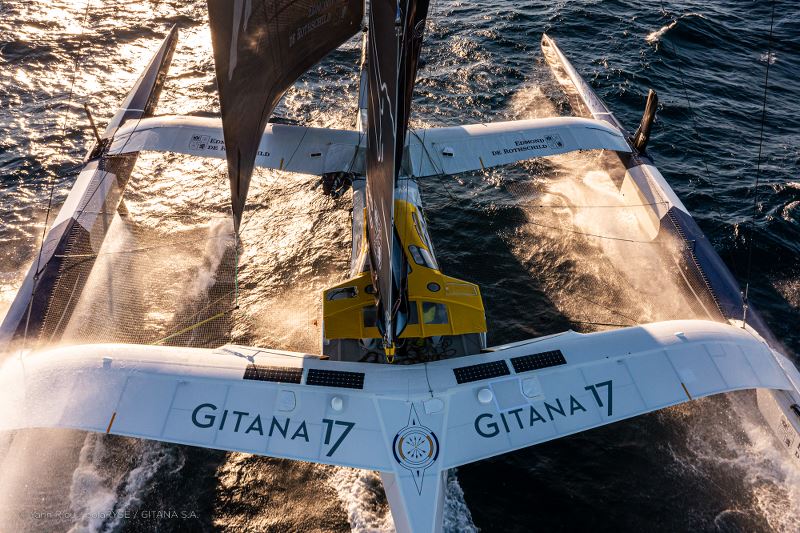
    These are probably the most visually striking innovations on the new Maxi Edmond de Rothschild. To fly high above rough seas while maintaining control, the team wanted very long rudders that would remain in contact with the water. The challenge is that longer rudders tend to flex under load, severely affecting steering and the efficiency of their lifting surfaces. A new geometry was needed to give these appendages maximum stiffness, resist cavitation and ultimately improve control of the boat and make better use of its power. The result is a set of U-shaped rudders over 4 metres long, a metre longer than those on Gitana 17. Their shape, reminiscent of a tripod or an inverted π, is only the visible part of what makes them so distinctive.

    A daggerboard optimised to stabilise the boat and limit cavitation

    With its wide span, the daggerboard resembles an aircraft tail assembly, with two adjustable flaps: one on the vertical section and the other on the horizontal section, the distinctive “manta-ray wing”. On Gitana 18, the innovation is to position this wing behind the vertical part of the appendage, rather than directly beneath it, to minimise flow disturbance and cavitation.

    Gitana 18’s daggerboard

    Rig: adjustable spreaders to control mainsail power while sailing

    Gitana 18’s mast is 1.50 metres taller than its predecessor’s. The boom is also shorter, creating a more slender sail plan. The major innovation is a set of spreaders that can be adjusted while sailing to bend the mast fore and aft. Actuated by hydraulic rams, these spreaders can pivot through 35 degrees to adjust the bend in the middle of the mast. This unprecedented system allows the sailor to control mainsail power: adding depth in light winds to take off sooner, or flattening the sail to reduce power at high speed or in strong winds. Adjusting the depth, and therefore the power, of the mainsail can also save a solo sailor time and energy by reducing the need for risky manoeuvres or headsail changes.

    Central hull:
    an integrated, structural coachroof

    The naval architects and Gitana design team wanted an exceptionally stiff, structurally robust platform. This applies both to the floats, which must withstand heavy loads from the foils and rudders, and to the central hull, which is subject to torsion. The enclosed coachroof is integrated into the hull and contributes to its structural strength. Inside, the cockpit brings all sail-handling controls together, with ergonomics shaped by many hours of design and development. The coachroof also stands out for the number and size of its windows. This configuration meets the visibility requirements of the Ultim class rules and gives sailors the best possible view to keep a visual watch.

    Gitana 18’s coachroof

    10.01.2024

    Premier passage de front.

    Time goes by and every day is different in the Arkea Ultim Challenge Brest fleet. Released from the clutches of the high pressure, which blocked progress yesterday offshore of the Portuguese archipelago of Madeira, the skipper of the Maxi Edmond de Rothschild and his travelling companions are preparing to tackle some boisterous conditions over the…

    par Gitana

    Time goes by and every day is different in the Arkea Ultim Challenge Brest fleet. Released from the clutches of the high pressure, which blocked progress yesterday offshore of the Portuguese archipelago of Madeira, the skipper of the Maxi Edmond de Rothschild and his travelling companions are preparing to tackle some boisterous conditions over the coming hours. Indeed, tonight they will have to negotiate the first storm of their round the world. On the menu, a front is set to roll through and they have to position a gybe just right in an average of 30 knots of breeze, with seas possibly reaching 4-5 metres. Though this latest weather phenomenon is due to be short-lived, it will be no less intense for Charles Caudrelier and his fellow ULTIM solo sailors, especially as the seas will remain heavy for some time.

    Change of atmosphere between Madeira and the Canaries

    Yesterday, the Portuguese archipelago of Madeira, and above all the rounding of a high-pressure zone, shook up the established hierarchy within the Arkea Ultim Challenge – Brest fleet and the head of the race in particular. Positioned at the centre of play, event youngster Tom Laperche benefited from more favourable conditions to snatch control of the fleet, whilst further north, Charles Caudrelier and Thomas Coville had to just grin and bear it until they were able to extract themselves from a windless zone…

    This morning, flying along at over 30 knots on a long reach (beam wind), bound for a meaty depression, the skipper of the Maxi Edmond de Rothschild had already left this episode behind him and was fully focused on the main event of the evening. Indeed, the solo sailors in this ULTIM round the world will have to contend with their first storm and the associated front rolling through. Not only is this vast Atlantic depression the first major obstacle of the course, but it will also influence play as they drop down towards the equator, since its unusual S’ly position will hav
    e considerable consequences on the establishment of the NE’ly trade wind.

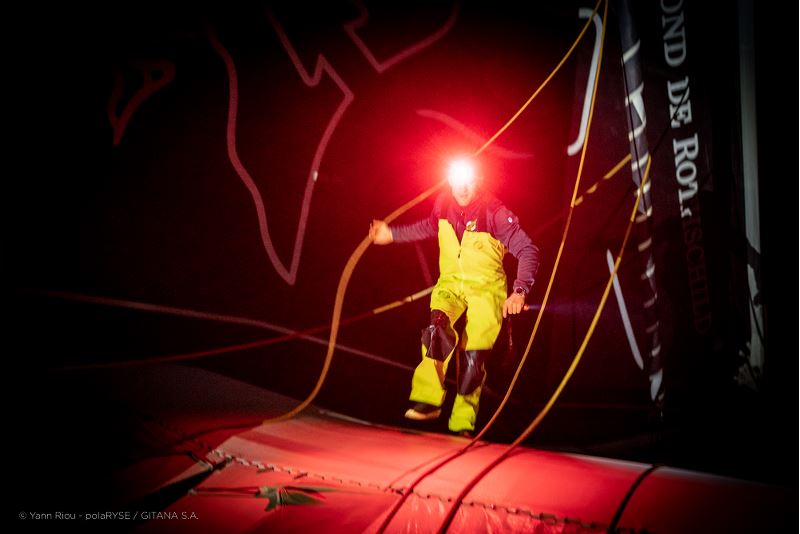
    To prepare for it as best he can, Charles Caudrelier has racked up a lot of sleep over the past few hours in a bid to ensure he has enough energy for the various manoeuvres that await him in the pitch black.

    >> Images from aboard 
    Charles Caudrelier, Wednesday 10 January 

    “End of day three at sea. We passed Madeira last night and right now we’re on a gentle reach hunting down a big front with a bit of breeze and heavy seas! Everyone is trying to position themselves to the south a little to avoid the strongest breeze. The results of the first three days are pretty good. The boat’s in good shape, as am I. I was a bit disappointed about last night. We were nicely positioned but we had a terrible wind hole for several hours. I don’t know where it came from! We thought we’d be the first to escape the high pressure but we remained trapped inside… It rolled under us and over the top of us. Sodebo, which was a long way behind, caught us up again with the breeze close to the centre, and conditions were favourable below us too. There wasn’t a lot we could do! The damage has been mixed as SVR slipped through but Banque Populaire, which took the outside track, ended up trapped by the exclusion zone for cetaceans off Madeira.

    I’m in good shape. I got a decent amount of sleep last night, the boat’s quick and we’re heading into rough weather, which is something she really likes. We’re in the thick of the action and we’re tightly bunched in any case. We’ll have a debrief tomorrow as it’s going to be a lively night with the first front passing through!”

    Position ranking at 17:00 UTC: 
    1) SVR Lazartigue – Tom Laperche
    2) Maxi Edmond de Rothschild – Charles Caudrelier – 12.2 miles behind the current leader
    3) Sodebo Ultim 3 – Thomas Coville  – 15.4 miles behind the current leader
    4) Maxi Banque Populaire XI – Armel Le Cléac’h – 45.3 milles behind the current leader
    5) Actual Ultim 3 – Anthony Marchand – 104.5 milles behind the current leader
    6) Ultim Adagio – Eric Peron – 406.6  behind the current leader