








Heritage

Season 26
Types de médias
  • Photos
  • Vidéos
  • Sons
Années
  • 2026
  • 2024
  • 2023
  • 2022
  • 2021
  • 2020
  • 2019
  • 2018
  • 2017
  • 2016
  • 2015
  • 2014
Afficher les résultats (121)
supprimer tous les filtres
  • News
  • Gallery
  • Gitana 18
  • Team
  • Retractable Y-shaped foils, adjustable in three dimensions

    Inspired by the appendages of the America's Cup foiling monohulls, these Y-shaped foils have a wingspan of over 5 metres. They are designed to generate powerful lift, increase power and offer a wide range of adjustments to optimise flight at every point of sail and in all conditions. Beyond their impressive size, these foils feature many unique innovations.

    Revolutionary U-shaped rudders

    These are probably the most visually striking innovations on the new Maxi Edmond de Rothschild. To fly high above rough seas while maintaining control, the team wanted very long rudders that would remain in contact with the water. The challenge is that longer rudders tend to flex under load, severely affecting steering and the efficiency of their lifting surfaces. A new geometry was needed to give these appendages maximum stiffness, resist cavitation and ultimately improve control of the boat and make better use of its power. The result is a set of U-shaped rudders over 4 metres long, a metre longer than those on Gitana 17. Their shape, reminiscent of a tripod or an inverted π, is only the visible part of what makes them so distinctive.

    A daggerboard optimised to stabilise the boat and limit cavitation

    With its wide span, the daggerboard resembles an aircraft tail assembly, with two adjustable flaps: one on the vertical section and the other on the horizontal section, the distinctive “manta-ray wing”. On Gitana 18, the innovation is to position this wing behind the vertical part of the appendage, rather than directly beneath it, to minimise flow disturbance and cavitation.

    Gitana 18’s daggerboard

    Rig: adjustable spreaders to control mainsail power while sailing

    Gitana 18’s mast is 1.50 metres taller than its predecessor’s. The boom is also shorter, creating a more slender sail plan. The major innovation is a set of spreaders that can be adjusted while sailing to bend the mast fore and aft. Actuated by hydraulic rams, these spreaders can pivot through 35 degrees to adjust the bend in the middle of the mast. This unprecedented system allows the sailor to control mainsail power: adding depth in light winds to take off sooner, or flattening the sail to reduce power at high speed or in strong winds. Adjusting the depth, and therefore the power, of the mainsail can also save a solo sailor time and energy by reducing the need for risky manoeuvres or headsail changes.

    Central hull:
    an integrated, structural coachroof

    The naval architects and Gitana design team wanted an exceptionally stiff, structurally robust platform. This applies both to the floats, which must withstand heavy loads from the foils and rudders, and to the central hull, which is subject to torsion. The enclosed coachroof is integrated into the hull and contributes to its structural strength. Inside, the cockpit brings all sail-handling controls together, with ergonomics shaped by many hours of design and development. The coachroof also stands out for the number and size of its windows. This configuration meets the visibility requirements of the Ultim class rules and gives sailors the best possible view to keep a visual watch.

    Gitana 18’s coachroof

    03.10.2016

    SERIES “AWAKENING THE SENSES.

    About to be isolated as he circumnavigates the world in the Vendée Globe, Sébastien Josse knows himself to be robust. However, the skipper of the Mono60 Edmond de Rothschild is well aware that these latest generation monohulls are breaking new ground and offer no comfort and even a great deal of hostility. In order to get a better grasp of what the…

    par Gitana

    About to be isolated as he circumnavigates the world in the Vendée Globe, Sébastien Josse knows himself to be robust. However, the skipper of the Mono60 Edmond de Rothschild is well aware that these latest generation monohulls are breaking new ground and offer no comfort and even a great deal of hostility. In order to get a better grasp of what these words actually mean, we’ve asked the sailor to describe to us the way in which his five senses behave inthis most extreme reality. Through until the start of the race on 6 November, discover a new sense each week and immerse yourself a little deeper in the world that awaits Sébastien, alone, on this unique course.


    #1 SIGHT

    SEEING, BUT HOW?

    At first sight, seeing is essential. Only, with this flat, high volume hull up forward, a real benefit in terms of speed, hundreds of litres of sea water sweep across the deck of Gitana 16, making the sailor’s protection essential. As such, Sébastien spends most of his time taking shelter under the cuddy, which covers the watch and manoeuvring station, whilst his eyes struggle to vary the viewpoints.

    “As soon as you’re sailing 20 miles offshore, the boat is under water and you can no longer see in front of you,” he explains. “Even if you poke your head out, you can’t see anything. Leaving the cockpit means you expose yourself massively, battling against the elements and inviting a great deal of inflow. That’s the name of the game but you only go up top when strictly necessarily, otherwise you live down below or under the cuddy. At the start, for measurement and weight reasons, that section was very opaque, but we’ve added some Plexiglas openings. In this way, I can see the sails, sky, clouds, sunsets, squalls, birds, horizon and other boats, etc. I can anticipate better and I can make the most of my surroundings.”

    SEEING IN THE DARK
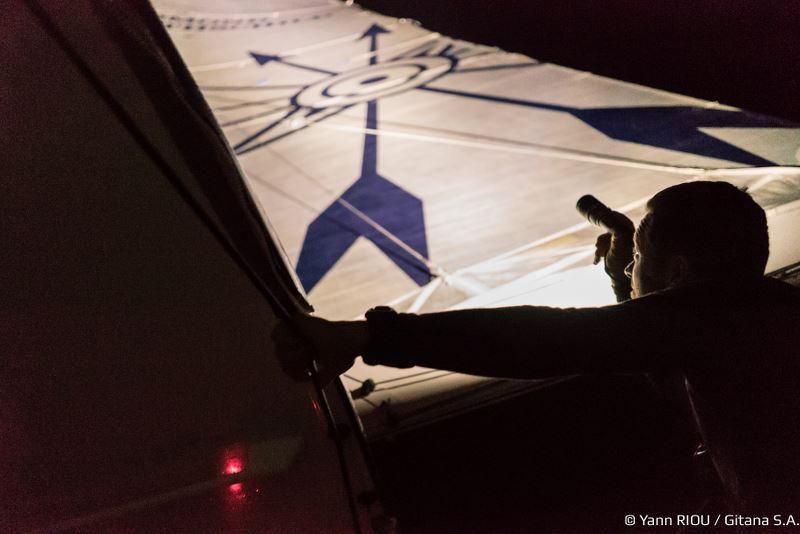
    Life at sea involves routine and the all too important rituals. “At night, you lose your sight and therefore a big reference,” he continues. “Before the sun sets, I go over that day’s trimming so that helps me through until the next day. We really like to have our way lit by the moon but if it’s pitch black, you light up your sails, you seek out fresh references and you refer back even more to the numbers on the screens. You also remain more on the alert, like a cat, ready for anything. As such, it’s not necessarily the kind of night that you’re going to get any sleep… you relax more once day breaks.”

                                 “It’s down to me to adapt and the not the reverse,” 
                                                  assures Sébastien Josse.

    SEEING LAND

    To circumnavigate the globe under sail, you need to traverse all the longitudes of the earth and the route encompasses the Deep South around Antarctica. In reality, the sailors go round the capes of Good Hope and Leeuwin several hundred miles to the South of Africa and Australia. As such, seeing land is very rare in the Vendée Globe, which isn’t a bad thing Sébastien admits. “The coasts are often a source of concern, due to the maritime shipping, the swell and the wind ruffled by the landscape or the risks of collision with blocks of wood, containers or cetaceans. Ultimately, Cape Horn is the only one you’re happy to see and with it comes a very special emotion!”


    SEEING A FELLOW COMPETITOR?

    With the boats’ performances being increasingly similar and trajectories that are a little ‘forced’ due to the exclusion zones, the solo sailors can end up within sight of each other, side by side, even after several weeks at sea. “It’s good to have a fellow competitor on the radar but I don’t necessarily like to see them with the naked eye, otherwise you can’t take your eyes off them. You enter into a game of close-contact racing and start sprinting whilst you’re midway through a full Iron Man,” admits the skipper of Gitana Team

    AND SEEING YOURSELF?

    In response to the question, do you carry a mirror on a round the world? “Yes, but only to shave,” is Sébastien’s first response. “Once a week, I allow myself to take a bit of care over my person. I have a sea water shower, I remove the salt from my body and put on a clean shirt and a bit of music and that bucks me up!” Otherwise you never look at yourself? “Yes, when you hit yourself, to see if you’re injured… and also when you get to the point where you’re really suffering from fatigue. When you no longer really know where you are, looking at your face, its shadows, its sunken features, seeing yourself helps to gain self-awareness.”


    Next week, discover #2 TOUCH