








Recruited back in 2011, Sébastien Josse got the chance to cut his teeth in the multihull world, benefiting from most high-performance platforms of the day. Considered to be one of France’s top monohull specialists, with several circumnavigations of the globe to his credit spanning both the Vendée Globe and the Volvo Ocean Race circuits, the sailor made no secret of how amazingly lucky he was to get the opportunity to express himself on another craft. Working alongside the members of Gitana Team for eight years, the sailor racked up a number of seasons and competitions in crewed, double-handed and singlehanded configuration, fleshing out Gitana’s incredible and unique track record: Multi70 victory in the Tour de l’Europe and the Transat Jacques Vabre 2013, a very striking 3rd place in the Route du Rhum 2014, the Vendée Globe adventure and the first foray on the giant Gitana 17… Ariane de Rothschild thanks Sébastien Josse for the eight years spent working together.

The five-arrow team is keen to embark on a new, ambitious campaign geared around offshore optimisation with the aim of setting sail on a singlehanded round the world race aboard these giants (the new date for this event will be announced in the coming weeks).
The optimisation of a giant
Launched in July 2017 after a build period lasting over a year and a half and requiring 170,000 man-hours, the Maxi Edmond de Rothschild is the first large offshore multihull devised and designed to fly on the open sea. The pioneer of a new generation, this 32-metre Verdier design is leading the way forward. After a promising 2nd place in the Transat Jacques Vabre 2017, just months after exiting the yard, Gitana 17 was forced to retire from the last Route du Rhum, a victim of bow damage to her starboard float whilst ranking as one of the firm favourites in this anniversary edition. Since that time, the Maxi has been in refit at the team’s base in Lorient, south-west Brittany. Alongside the project’s naval architects and engineers, the members of Gitana Team have carried out a number of investigations to gain a better understanding of the causes behind the breakage and find a solution for them. In this way, repairs to the damaged float are underway, as is the optimisation work previously scheduled for the winter refit, and the latest addition to the Gitana fleet is due to be relaunched in early May.
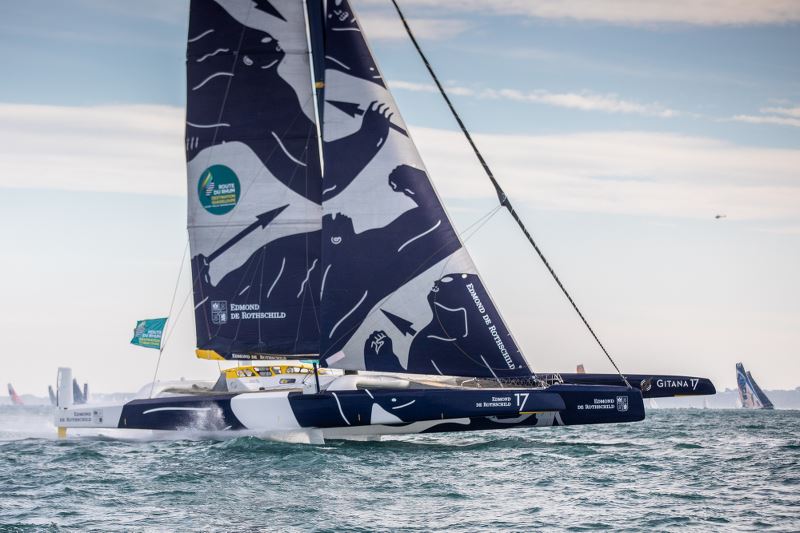
“The Ultimes are extraordinary machines, which are driving us all to push the envelope, whether it be on a competitive or technical level. The advances made with this new generation of multihulls are a reflection of this… To be a pioneer is about preparing the way forward and this journey inevitably involves a number of unknown elements, which we must accept in order to make progress. Success is a gradual process. To support us in this major technological challenge, I believe we’ve surrounded ourselves with the best people and, crucially, we’ve made sure that they are extremely motivated to work towards the common goal of developing a revolutionary boat. Together with the boat’s owners, we’re convinced we’re on the right track, and we’re where we wanted to be in any case, but these things take time. Every time the Maxi gets out on the water is a step in the right direction. Since her launch, we’ve taken some giant leaps forward and there’s still a huge amount to learn” explains Cyril Dardashti, director of the racing stable.
Gitana joins the collective
Since the genesis of the Maxi Edmond de Rothschild project, innovation has been uppermost in all the technical and architectural choices. Thanks to the unfailing support and the willingness of Ariane and Benjamin de Rothschild and the teams they manage within their Group to undertake this journey, the members of Gitana have been able to dare to imagine and build a remarkable multihull, which contrasts sharply with its predecessors and is opening up a whole new era. Today, the lessons learned by the five-arrow team since the Maxi’s launch deserve to be shared to help the whole industry make progress. Indeed, in light of recent events within the Class 32/23, and despite the still notable differences in opinion regarding the technical elements (servo-control in particular), it seems important henceforth for Gitana and Edmond de Rothschild to join the four other founder owners, Sodebo, Macif, Actual and Banque Populaire, in any key decisions in the future.
