








A new Maxi Edmond de Rothschild on the horizon
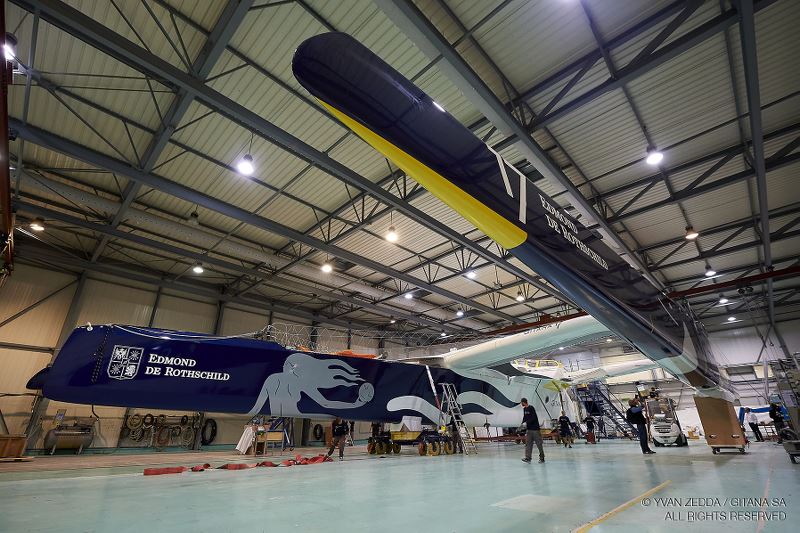
Boasting a maritime history spanning 150 years, the Gitanas are undoubtedly of their time. It is a lineage that is not about to end with the official announcement – this Thursday – of the start of construction of a brand-new Maxi Edmond de Rothschild.
Though Gitana 17 raised the bar nearly seven years ago with the advent of offshore flight, her successor, a 32-metre long and 23-metre wide ULTIM, will likely have a great deal in her favour. Designed to adhere to the Class’s architectural framework (dimensions and key rules), this new craft will however retain a certain freedom in terms of targeted developments, as was the case with Gitana 17, especially with regards to areas relating to servo control. Indeed, to go back to the formula of her main naval architect, this Maxi will once again be a 2-in1 craft: Archimedean and airborne, for single-handed and crewed sailing, for races and records. Extremely versatile, she will be the fruit of a top-flight design team combining the skills of Guillaume Verdier and his team, notably joined in this project by Benjamin Muyl, and the Gitana design office, headed by Sébastien Sainson, which will play a key role in the design.
Though Gitana 18 may well resemble her predecessor at first glance, in reality the two giants will be very different despite a similar platform geometry. In the broad outlines of the specifications for this new five-arrow craft, the emphasis is on two key elements: improvement of the ‘motor’, namely the sails and everything above deck, and the limitation of drag. In terms of aerodynamics, considerable effort will go into the platform, as this Maxi will be the first craft to be built around a new visibility rule, as well as the rig. In terms of hydrodynamics, all the appendages (foils, rudders, ray wing daggerboard) will be revised with the focus on getting airborne sooner and they will not only benefit from state-of-the-art technology, but also and above all the expertise gained from the data collected on Gitana 17. Finally, the new Maxi Edmond de Rothschild is designed with the emphasis on having a boat that is even more geared around long-haul sea passages and major challenges with a view to enhancing performance at high speed in heavy seas.
The ‘Gitana 18’ project will also be a major departure from the team’s norm, since the new giant will be built at CDK Technologies. In fact, the five-arrow stable has chosen to entrust their steed to Stéphane Digard and his teams at CDK Group. Their latest creations, both in ULTIM and in other classes, the reliability of their approach, the manufacturing process and the quality of their infrastructure with its cutting edge industrial tooling, meet all their expectations and prompted the final choice. On top of that, the yard is close by, which is a real benefit in terms of project management as well as Gitana’s approach towards reducing their carbon footprint. The build monitoring will be piloted by Pierre Tissier, the racing stable’s technical director.
The first carbon laminates for this new giant will be laid up over the coming weeks, with the launch scheduled for September 2025.
One month away from the epic planetary challenge
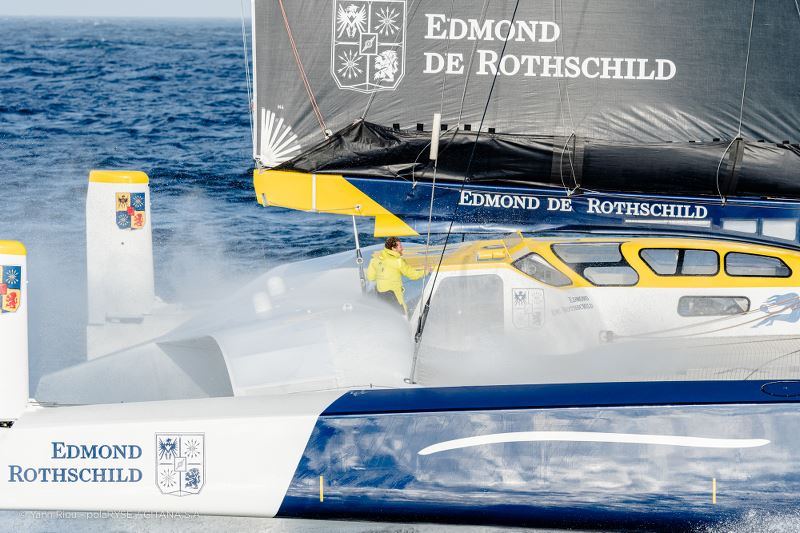
On 7 January 2024, the fleet competing in the first single-handed race around the world for the ULTIM category, the Arkea Ultim Challenge – Brest, will set sail. For the six pioneers and their teams, the end of 2023 promises to be busy. Right now, it’s another technical race against the clock for the teams to test, check and prepare the 32-metre giants after a full-on Transat Jacques Vabre.
In late December, 29th to be precise, the Maxi Edmond de Rothschild and her rivals will have to be dockside on Quai Malbert in Brest. The locals know how to celebrate, so after ten days of festivities, Charles Caudrelier and his five fellow adventurers will finally cast off on the 22,000-mile circuit (around 40,000 km) that make up this incredible planetary challenge. With the Atlantic and its many pitfalls, the big three legendary capes to be left to port, the trials of the Southern Ocean and the magic of single-handed sailing, which is inextricably linked to setting new targets, the race has all the necessary ingredients to make this major first a memorable experience.
Thirty years ago, in 1993, Bruno Peyron headed a 5-person crew who managed to sail around the globe in 79 days and a few hours. Alone on their XXL craft – 32 metres long by 23 metres wide – the solo sailors in the Arkea Ultim Challenge are targeting 45 to 50 days to complete this circumnavigation. Such is the magnitude of the challenge that awaits them!
Today, one woman, Ellen MacArthur, and three men – Thomas Coville, Francis Joyon and François Gabart – have pulled off the feat of circumnavigating the globe single-handed on large multihulls during various record attempts. Joining this hallowed circle is the primary goal of the skipper of the Maxi Edmond de Rothschild for the coming weeks. In a month’s time, he’ll be among the skippers taking on that challenge, racing aboard flying maxi-trimarans.
Verbatim
Ariane de Rothschild
“Throughout history, we’ve seen how Gitana has always been and will always be a laboratory for technologies – which define tomorrow’s norms in Sailing. With the current Maxi Edmond de Rothschild, Gitana 17, which I’ve been personally involved in, we’ve dared to do the unthinkable: transposing the concept of flying boats from the America’s Cup to offshore racing. It was a bold gamble. A genuine revolution in the sailing world. Such a project required a great deal of effort and perseverance. When you prepare the way forward, you take some knocks in the process. However, we’ve never let our convictions slide. This boat has paved the way forward for a new era, a new generation of maxi-trimarans, and we are particularly proud of that. However, I remain convinced that there’s still a lot to do. My husband, Benjamin, said in 2017 that we’re only on letter A of a new offshore racing alphabet with flight. Today, I’m happy to confirm that we’ve made the decision to set to work on a new boat, a new Maxi Edmond de Rothschild.”
Cyril Dardashti, Managing Director of GITANA
“7 has always been a lucky number for us! It’s a wonderful day which, following a great deal of work, has prompted new projects for the team that I’m honoured to manage. Six years on from the launch of the Maxi Edmond de Rothschild and armed with the lessons learned from seven very rich seasons and a track record that has lived up to our expectations for this boat, we are thrilled to formalise the construction of a new Maxi Edmond de Rothschild. It is in the DNA of Gitana and more widely Ariane de Rothschild’s family, to innovate. We’ve looked very closely at what is going on in the other classes, but today we are keen to continue our efforts and the technological breakthroughs achieved with Gitana 17. We believe that we are still in the early days of offshore flight, even though the experience gained since 2017 has been vast. There is still a lot to do and to discover and after a few months of studies, we’re utterly convinced that very significant gains are possible. The timing is tight, as our aims include defending our title in the next Route du Rhum and once again the project is very ambitious, but that’s the way we like it. Naturally, we’re fortunate to be able to do this on a daily basis thanks to the trust, support and innovative spirit of the owner, Ariane de Rothschild, her daughters and Groupe Edmond de Rothschild. Building and developing the Maxi Edmond de Rothschild was an incredible gift in itself, but having the opportunity to repeat this adventure to such a high standard and such a high level of technical skill is exceptional.”
Charles Caudrelier, skipper of the Maxi Edmond de Rothschild
“Since I joined the Team as skipper in 2019, time has just flown by. We’re enormously lucky to be able to take on a sequence of projects and races in this way. As I’ve said before, this boat has relaunched my career and my desire to sail offshore. After my Volvo Ocean Races, which were tough both personally and professionally, I had a sense of weariness. However, sailing on the Maxi Edmond de Rothschild the first few times reshuffled the cards. This boat is fabulous! Winning the Route du Rhum was a dream. It became a reality last year and this victory will always have a special place in my heart, just like my victory in the Solitaire du Figaro. The Round the World, the Arkea Ultim Challenge, which awaits me in exactly a month’s time, is something else again. It’s the Ultim challenge. As someone who so wanted to do the Vendée Globe… I’m just a few days away from my first single-handed race around the world at the helm of one of the most iconic boats. It’s a huge responsibility but also an honour.
The announcement of construction of a new Maxi is inevitably big and wonderful news. With the Verdier architectural team and our in-house design office, studies began some months ago. Experimenting with new options on land and continuing to develop the extraordinary platform that is Gitana 17 has been massively rewarding. I value it and I’m very grateful for the place I have within the team.”
Guillaume Verdier, naval architect of Gitana 17 and the future Maxi Edmond de Rothschild
“In the project to design the first Maxi Edmond de Rothschild I loved the challenge, the blank page, as well as the collective approach we used to design the boat, especially the teamwork with my associates – Véronique Soulé, Romaric Neyhousser, Hervé Penfornis, Loic Goepfert and Romain Garo among others – as well as the trusting relationship we had with the Gitana Team during the fine-tuning. Not everything worked out of the box, which is kind of par for the course when you’re really breaking new ground, but together we found solutions for getting the results we’ve had. It was important to be bold and Ariane (de Rothschild, editor’s note) and Gitana were bold!
Today, we’re keen to continue with the story. With this new boat, we’re all keen to take the next step and there is a lot of material and a lot of different routes. We’re perhaps a third of the way there and counting with regards to our understanding of offshore flight. In the new project, studies have shown that there’s potential. There will be some small steps forward and some major technological breakthroughs. Weighing all that up will create this new Maxi. We’re working on a boat, which will have the same assets in terms of performance, whilst addressing the weaknesses we’ve identified. One of the main criteria too in our approach is durability, seeking out as many innovative solutions as possible to minimise the impact and the deterioration of the various elements. We’ve also put more thought into the sailor’s integration in the platform as the stresses on these boats are in no way on a human scale and it is also our responsibility to make it accessible to the sailor. I’m always interested in encounters and hunting out and discovering things along the way, which we didn’t necessarily expect. Today, with the Gitana design team, we form a unique team, which is also bound to be one of the keys to success.”
Stephane Digard, Deputy General Manager of CDK Group
“We’re fortunate in that we are able to work with the best teams in the ULTIM class, who we have supported in their constant quest for performance by equipping ourselves with what are unique tools and know-how in the industry, particularly in terms of our mastery of the manufacturing of large autoclaved composite parts. We have relished monitoring the performance of Gitana Team, which has boasted one of the finest track records of this class since its creation. The fact that a team such as this has trusted us to build its future Maxi Edmond de Rothschild is a fantastic reward for all of CDK Group’s associates. This stellar team and this ambitious project will enable us to raise our game even more in the quest for excellence.”
The key stages in the construction of the new Maxi Edmond de Rothschild
Start of studies > November 2022
Tooling > from December 2023 to May 2024
Manufacture of the beams > from January 2024 to January 2025
Manufacture of the central hull > from April to November 2024
Manufacture of the floats > May 2024 to March 2025
Assembly of the platform > from November 2024 to July 2025
Fit-out > from May to August 2025
Launch scheduled > September 2025